
Buyer-first forex comparison · reviewed July 25, 2026
Funded Trading Plus vs FundedNext Buyer’s Scorecard
Start with the same account size and evaluation structure. Compare the complete cost to an eligible payout, how losses are calculated, the rules that continue after passing, platform and country fit, and the evidence behind each firm—not the branded plan name.
| Decision point | Funded Trading Plus | FundedNext |
|---|---|---|
| Matched product | $100K 2-Step Classic | $100K Stellar 2-Step |
| Current price | $384.30 with WC30 / $549 list | $549 |
| Profit target | 7% then 7% | 8% then 5% |
| Daily / maximum loss | 4% balance-based daily / 8% static max | 5% daily / 10% starting-balance floor |
| Consistency / symbol risk | 35% evaluation, 50% funded, plus 3% symbol-loss rule | No standard evaluation consistency rule; prohibited-strategy and risk reviews still apply |
| Minimum days / time | Unlimited period; consistency can extend either phase | 5 days per phase; unlimited period |
| Funded payout | 80% standard; first request after 10 days; 1% account-size minimum | 80%, up to 90%; payout cycle and minimum depend on method/account |
Advanced checks before paying
- Convert the loss limits into your normal per-trade risk and losing-streak budget.
- Include resets, rebills, activation, data, platform and withdrawal costs in the attempt price.
- Check consistency, qualifying days, buffers, payout caps, account lifecycle and scaling rules after passing.
- Verify the contracting entity, country eligibility, recent complaint themes, support answer for your strategy, and a small first payout before scaling.
Prices and rules are tied to the named products and were reviewed against linked official pages on July 25, 2026. Promotions and terms can change.
Last verified: June 6, 2026. Rule, payout, platform, country, and checkout terms can change without a third-party article updating at the same time.
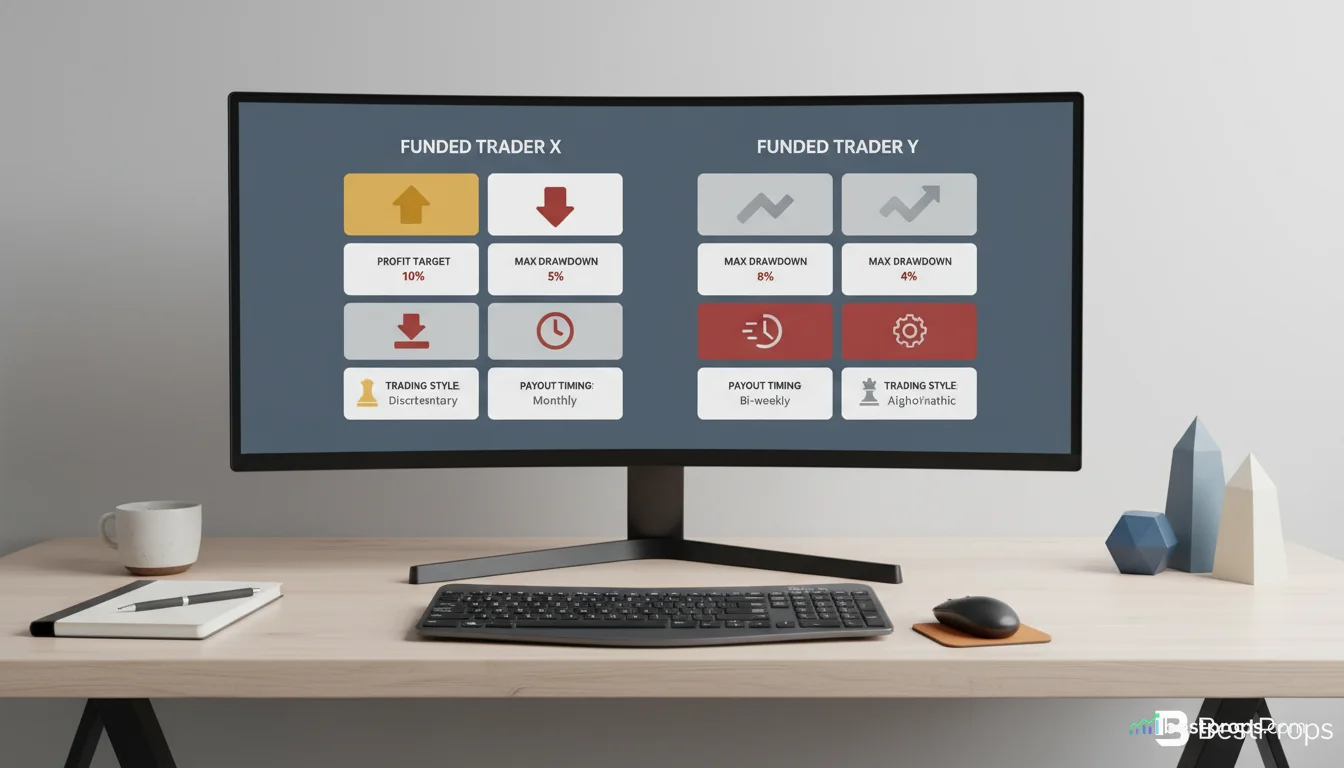
If you are searching for Funded Trading Plus vs FundedNext, you probably do not need another generic prop firm list. You need to know which rule set fits the way you actually trade. The answer depends less on brand popularity and more on drawdown style, payout timing, consistency checks, platform rules, and whether you prefer a faster evaluation path or a more conventional two-step account.
This comparison uses official help-center and firm pages where possible. Competitor comparison pages and review sites are useful for search intent, but they are not reliable enough for rules, payout eligibility, pricing, or denial-risk details. Treat this as a decision guide, then verify the current checkout and account contract before paying either firm.
Funded Trading Plus vs FundedNext quick verdict
Choose Funded Trading Plus if you want a firm whose official materials clearly separate 1-step, 2-step, instant, and legacy-style program details, and if you are comfortable reading the rule page for the exact program you plan to buy. The official FT+ 1-Step Express page reviewed on June 6, 2026 says the challenge requires a 10% simulated profit target while staying inside 6% relative maximum drawdown and 4% daily drawdown limits. The official FT+ 2-Step Classic page points to 7% profit targets on both phases, 8% static maximum drawdown, and a 4% daily drawdown limit.
Choose FundedNext if your priority is a large, heavily searched brand with Stellar account models, clear published rule pages, and a payout process that is documented in detail. The official FundedNext Stellar 1-Step CFD help page reviewed on June 6, 2026 lists a 3% daily loss limit, 6% maximum loss limit, and 2 separate trading days. Its Stellar 2-Step help page lists a 5% daily loss limit, 10% maximum loss limit, and 5 minimum trading days in each phase.
Neither is the best choice for every trader. A scalper, news trader, swing trader, algorithmic trader, and low-frequency discretionary trader can all read the same comparison and reach different conclusions.
Funded Trading Plus vs FundedNext comparison table
| Category | Funded Trading Plus | FundedNext |
|---|---|---|
| Core model to compare first | 1-Step Express or 2-Step Classic | Stellar 1-Step or Stellar 2-Step |
| 1-step rule snapshot | 10% target, 6% relative maximum drawdown, 4% daily drawdown on the FT+ 1-Step Express page | 3% daily loss, 6% maximum loss, and 2 minimum trading days on the Stellar 1-Step CFD help page |
| 2-step rule snapshot | 7% target on both phases, 8% static maximum drawdown, 4% daily drawdown on the 2-Step Classic page | 5% daily loss, 10% maximum loss, and 5 minimum trading days on the Stellar 2-Step help page |
| Payout or reward share | FT+ lists an 80% standard payout split for 1-Step Express and 2-Step Classic documentation | FundedNext lists 80% initial Reward Share for Evaluation, Stellar Lite, Stellar 1-Step, and Stellar 2-Step accounts, with 90% possible through Scale-Up |
| Timing to watch | FT+ 1-Step Express says withdrawal requests can begin from day 1 when in profit, with later requests every 7 days. FT+ 2-Step Classic says first request can be 10 calendar days after account creation if criteria are met | FundedNext withdrawal help says eligible requests are made from the dashboard and payouts are processed within 24 hours after submission, while account-specific trading cycles still matter |
| Main rule-risk area | Consistency limits, drawdown type, symbol loss limits on some programs, and 30-day activity requirements | Model-specific loss limits, copy-trading restrictions, IP or VPN/VPS expectations, EA or indicator restrictions, and prohibited strategy rules |
| Platforms and US notes | FT+ says it currently offers MT5 and Match Trader, and MT5 is not available in the US (checked October 4, 2026) | FundedNext says US CFD clients use Match-Trader, while futures clients can use NinjaTrader, Tradovate, and TradingView |
| Markets and leverage notes | FT+ publishes forex, metals, indices, energy, and crypto leverage tables by program | FundedNext publishes platform and challenge terms by account model, so check the exact CFD or futures program page |
| Best fit | Traders who want to choose among distinct FT+ program types and are comfortable checking program-specific rules | Traders who want a known Stellar model and are comfortable following account-model specific operating rules |
Pricing and fee note
This page does not reproduce current fees, discounts, coupon codes, or account-size prices. Prop firm pricing changes too often for a static comparison to be the source of truth. Use this page to choose which rule set to investigate, then verify the live checkout price, platform, account size, add-ons, refund terms, and country availability on each official site before buying.
Funded Trading Plus rules to check first
Funded Trading Plus describes itself as offering 100% simulated trading accounts with potential real USD withdrawals on FT+ Trader simulated live accounts, subject to contract terms, risk policies, and account rules, on its official What is Funded Trading Plus page. That matters because the firm is not presenting these as live brokerage accounts.
For the 1-Step Express program, the official FT+ help page says traders must hit a 10% simulated profit target while staying inside drawdown allowances. It also states a 6% relative maximum drawdown, 4% daily drawdown, overnight and weekend holding, no stop-loss requirement, and no time limit apart from activity rules. The same page says the upgraded simulated live account lets traders request a withdrawal when in profit, with a $50 minimum withdrawal, a day-1 first request, later requests every 7 days, and an 80% standard payout split.
For the 2-Step Classic program, FT+ says the program uses static drawdown, not relative trailing drawdown. Its official page lists 7% profit targets on both phases, 8% static maximum drawdown, and a 4% daily drawdown limit. It also lists a 35% consistency rule in both challenge phases and a 50% consistency rule on the FT+ Trader simulated live account.
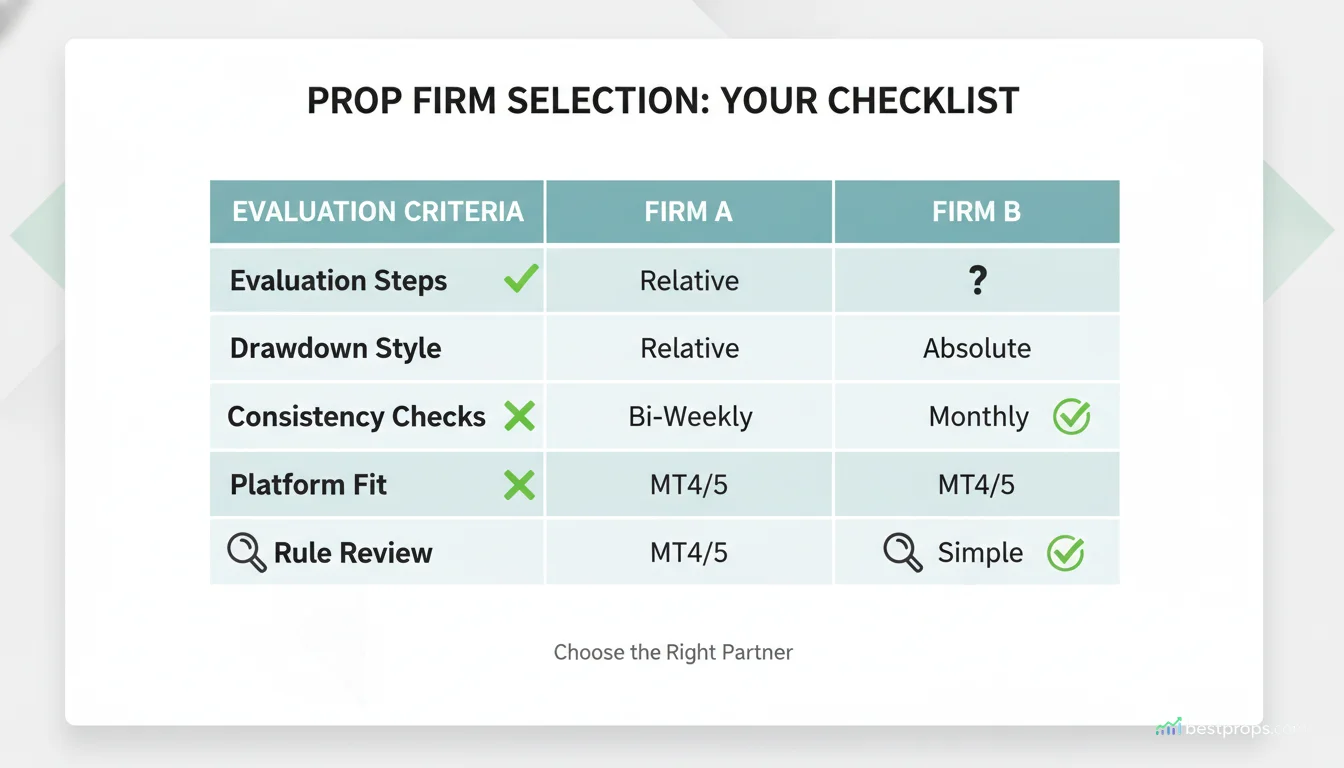
The consistency rule is especially important. The official FT+ Consistency Rule page says no single trading day’s net profit can exceed 35% of total net profit in a 2-Step Classic challenge step, and no single day can exceed 50% of total net profit in the funded-stage payout evaluation period. That can matter more than headline drawdown if your strategy often depends on one large winner.
FundedNext rules to check first
FundedNext’s current help material separates Stellar 1-Step, Stellar 2-Step, Stellar Lite, CFD, and other account variations. You should read the exact page for the model and region shown at checkout.
For Stellar 1-Step CFD, FundedNext’s official help page lists a 3% daily loss limit and a 6% maximum loss limit. It also says traders must trade on at least 2 different days, with at least 1 trade each day. The same page flags copy-trading restrictions, IP consistency, VPN/VPS usage guidance, EA and indicator limits, and prohibited strategies.
For Stellar 2-Step, FundedNext’s help material says traders must maintain a 5% daily loss limit and a 10% maximum loss limit. It also says traders must place trades on at least 5 separate trading days with at least 1 trade per day in each phase. A related FundedNext help page says Phase 1 requires 8% growth and Phase 2 requires 5% growth when the rules and minimum trading days are satisfied.
FundedNext’s official Reward Share page says Evaluation, Stellar Lite, Stellar 1-Step, and Stellar 2-Step accounts start at 80% Reward Share and can increase to 90% with Scale-Up. It also notes that some older or reset timing conditions can affect the structure, including a January 12, 2026 cutoff for some Challenge Accounts. That is the kind of detail you should check before relying on a review page.
Platforms, markets, and leverage
Platform fit can decide the comparison before payout split does. The official FT+ platform page says Funded Trading Plus currently offers MT5 and Match Trader, while also noting that MT5 is not available in the US (checked October 4, 2026). The FT+ available markets page lists forex majors and minors, exotics, spot metals, commodities, indices, and cryptos. The FT+ leverage page says 2-Step Classic can go up to 1:50 on forex, while 1-Step Express and Instant go up to 1:30 on forex, with lower published leverage for metals, indices, energy, and crypto.
FundedNext’s platform help page says the firm offers MT4, MT5, Match-Trader, cTrader, and TradingView for analysis, with execution handled on trading platforms rather than TradingView at the time reviewed. For US-based CFD traders, FundedNext says Match-Trader is the available platform. Its US client guide also says US-based traders cannot use cTrader for new purchases after March 31, 2026 and cannot switch away from Match-Trader on those accounts.
Payout timing and withdrawal fit
Payout timing is one of the biggest practical differences between firms, but it is also one of the easiest areas to misunderstand.
FT+ 1-Step Express documentation says the simulated live account allows a withdrawal request as soon as the account is in profit, subject to the $50 minimum and other review criteria, with later requests every 7 days. FT+ 2-Step Classic documentation says the first withdrawal request can be made 10 calendar days after account creation, if the account has met the 50% consistency rule, has not been hard breached, and the minimum withdrawal threshold is met.
FundedNext’s official withdrawal help page says traders request payouts from the dashboard after fulfilling trading-cycle and profitability criteria. It lists USDT, USDC, Confirmo, and RiseWorks as available methods and says payouts are processed within 24 hours after submission, with gateway charges paid by the trader. That 24-hour processing line is useful, but do not confuse it with automatic eligibility. The trading-cycle rules for your specific model still decide when you can request.
Trading style fit by trader type
If you trade with fewer, larger wins, read the FT+ consistency pages carefully. A strategy can hit the profit target and still fail a consistency requirement if too much of the profit comes from one day. FundedNext also has operational restrictions, so large-win traders should check news, IP, copy-trading, and restricted-strategy language before assuming the account is flexible.
If you want a one-step path, compare FT+ 1-Step Express against FundedNext Stellar 1-Step. FT+ uses a 10% target with 6% relative maximum drawdown and 4% daily drawdown on the official page reviewed here. FundedNext Stellar 1-Step uses lower published loss limits, with 3% daily and 6% maximum loss, plus 2 trading days. The better fit depends on whether you prefer the target-and-drawdown pairing at FT+ or FundedNext’s model-specific operating rules.
If you want a two-step path, compare FT+ 2-Step Classic against FundedNext Stellar 2-Step. FT+ publishes 7% targets on both phases with 8% static maximum drawdown and 4% daily drawdown. FundedNext publishes 8% Phase 1 growth and 5% Phase 2 growth in its help material, with 5% daily loss and 10% maximum loss on Stellar 2-Step. The main decision is whether a static FT+ drawdown structure and consistency rule feel better than FundedNext’s Stellar 2-Step rule set.
If you hold overnight or over weekends, do not assume all programs work the same way. FT+ 1-Step Express and 2-Step Classic pages reviewed here say holding overnight and over weekend is allowed. FundedNext traders should review the exact model, instrument, news, and prohibited-strategy policies before holding through events.
If you use EAs, indicators, copy trading, or VPS setups, read FundedNext especially closely. The Stellar 1-Step CFD help page reviewed here says automated or algorithmic trading is not allowed on Match-Trader accounts and restricts third-party indicators. The Stellar 2-Step help snippets indicate EA and indicator treatment can vary by model or region. That is a publish-time verification item for any trader relying on automation.
Common mistakes when comparing these firms
The first mistake is comparing a single FT+ program against the whole FundedNext brand. Each firm has multiple models, and rule details can change by account type.
The second mistake is ranking by payout split alone. An 80% or 90% share is only useful if you can reach payout eligibility without violating drawdown, consistency, news, copy-trading, or platform rules.
The third mistake is trusting a third-party comparison table for pricing. Fees and discounts change often. Use comparison tables to build your shortlist, then verify current checkout pricing directly with each firm.
The fourth mistake is ignoring account terminology. Both firms use simulated trading language, review processes, and rule-based payout eligibility. Read the contract and terms, not just the sales page.
Reputation and user review context
Trustpilot and Reddit can help you spot common concerns to investigate, but they should not be treated as primary sources for rules, payouts, or denial reasons. Page-1 search results for this keyword include Trustpilot and third-party comparison sites, which confirms that readers care about reputation. For the final buying decision, use those pages to build questions, then verify the answer against official rules, current support responses, and your own risk tolerance.
US client availability
For Funded Trading Plus, the official prohibited countries page reviewed on June 6, 2026 does not list the United States among prohibited countries, but its platform page says MT5 and cTrader are not available in the US. That means a US trader should verify available platforms during checkout rather than assuming all FT+ platforms apply.
For FundedNext, the official US client answer says the firm accepts US traders for CFDs and futures challenges. Its USA client guide adds that US CFD clients use Match-Trader, with futures platform choices handled separately. This is a current-source answer, not a guarantee that future availability will stay the same.
Funded Trading Plus vs FundedNext decision checklist
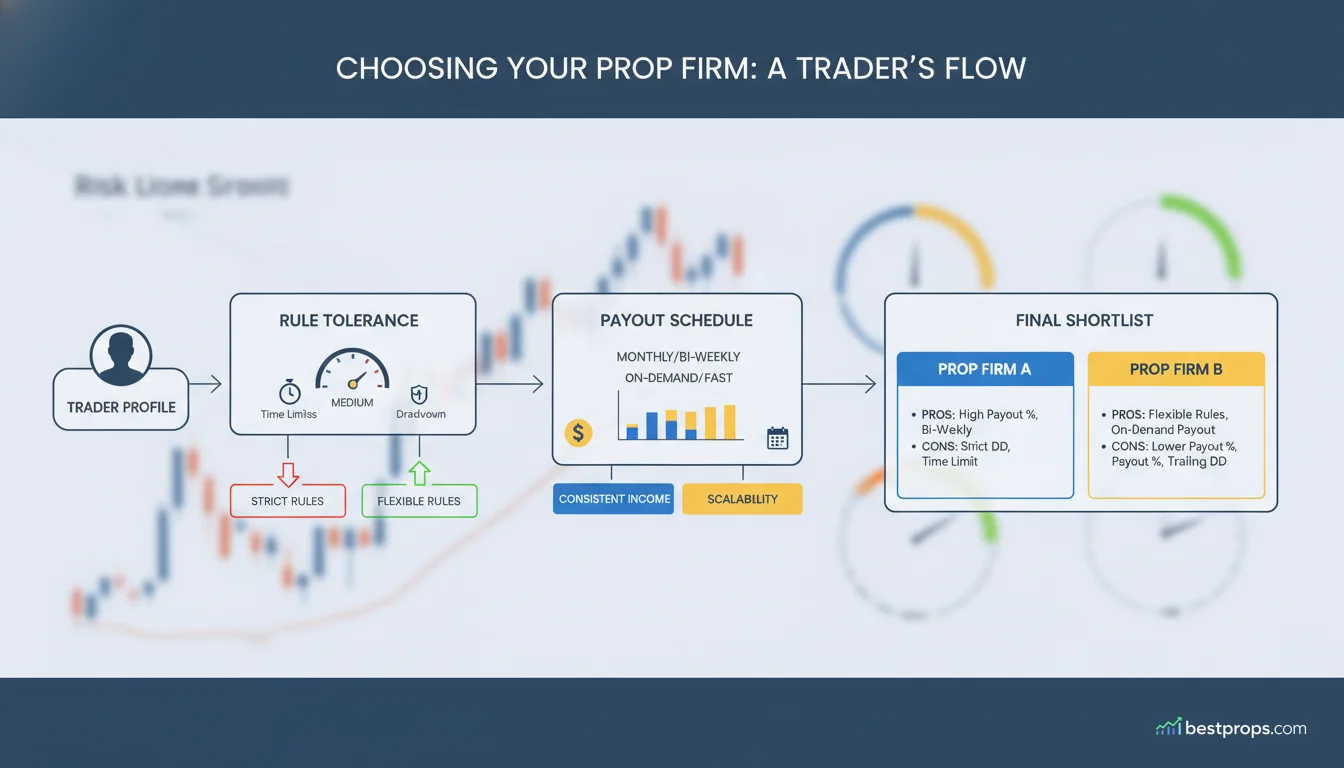
- Pick the exact program first, not just the firm name.
- Verify current checkout pricing before buying.
- Compare daily loss, maximum loss, and drawdown type.
- Check whether profit targets are realistic for your strategy.
- Read payout eligibility rules, not just payout split.
- Check consistency rules and single-day profit limits.
- Review news, weekend holding, EA, indicator, copy-trading, and IP rules.
- Confirm available withdrawal methods for your country.
- Save the official rule page version you relied on before starting.
Page-one comparison check · US desktop results reviewed August 6, 2026
What to verify before choosing Funded Trading Plus or FundedNext
Decision summary: The headline account size and profit split do not identify the better fit on their own. Compare the complete cost, loss calculation, first-payout path, platform route, and restrictions for two specific programs before paying.
| Decision point | How to compare it |
|---|---|
| Payment, refund, and tax details | Check accepted payment methods, refund eligibility, taxes, currency conversion, chargeback restrictions, and whether a promotion changes any refund term. |
| Support and dispute path | Save the applicable rule version and confirm the support, appeal, and dispute route before buying, especially when your strategy needs written clarification. |
Promotions and program rules can change independently. Use this page to narrow the choice, then confirm every decision-critical term in each firm’s current official program document, checkout, and trader agreement. Screenshots or saved copies help if a rule changes after purchase.
FAQ
Is Funded Trading Plus good
It can be a reasonable firm to research if you like its published rule style, simulated-account framing, platform choices, and payout structure. Do not judge it by brand claims alone. Check the exact program rules, platform availability, consistency requirements, and checkout terms before buying.
Is Funded Trading Plus better than FundedNext
Not universally. Funded Trading Plus may fit traders who prefer its documented 1-Step Express or 2-Step Classic structures, while FundedNext may fit traders who prefer Stellar models and a larger brand footprint. The better choice depends on your strategy and rule tolerance.
Which firm has faster payouts
The answer depends on the account model. FT+ 1-Step Express documentation says withdrawal requests can begin from day 1 when in profit, subject to criteria. FundedNext’s withdrawal help says payouts are processed within 24 hours after a valid request, but eligibility depends on the trading cycle and account rules.
Does Funded Trading Plus pay out
FT+ official help pages describe withdrawal requests and standard payout splits for specific simulated live account programs. That supports the idea that payouts are part of the program design, but it does not guarantee any individual payout. Eligibility depends on KYC, contract completion, account status, consistency, drawdown, minimum withdrawal, and risk review terms.
Which firm has easier drawdown rules
Easy depends on how you trade. FT+ 2-Step Classic uses static drawdown, which some traders prefer because the threshold does not trail with gains. FT+ 1-Step Express uses relative maximum drawdown. FundedNext Stellar 1-Step and 2-Step publish fixed daily and maximum loss percentages that traders need to keep in view.
Does FundedNext offer higher reward share than Funded Trading Plus
FundedNext says current Evaluation, Stellar Lite, Stellar 1-Step, and Stellar 2-Step accounts start at 80% Reward Share and can increase to 90% with Scale-Up. FT+ pages reviewed here list an 80% standard payout split for 1-Step Express and 2-Step Classic. Add-ons, timing cutoffs, and program changes can affect the comparison.
Do these firms allow weekend holding
FT+ 1-Step Express and 2-Step Classic documentation reviewed here says overnight and weekend holding is allowed. For FundedNext, check the exact current model page and terms before holding through weekends or news events.
Should US traders choose Funded Trading Plus or FundedNext
US traders should start by verifying availability and checkout terms directly with each firm. FT+ does not list the United States on its prohibited-country page reviewed here, but it does limit MT5 and cTrader availability in the US. FundedNext says US traders can join CFDs and futures challenges, with Match-Trader for US CFD accounts.
Which is the best funded trader program
There is no universal best funded trader program. A good shortlist should match your strategy to daily loss rules, maximum loss rules, drawdown mechanics, platform access, trading hours, payout eligibility, and country availability. If your strategy conflicts with the rules, a bigger brand or higher advertised payout split will not fix the fit problem.
What should I verify before buying either challenge
Verify current price, account size, platform, country availability, drawdown rules, payout eligibility, payout methods, consistency rules, prohibited strategies, news policy, and refund terms directly on the official pages and checkout flow.
Conclusion
Funded Trading Plus vs FundedNext is not a simple winner-takes-all comparison. Funded Trading Plus looks more attractive if its 1-Step Express or 2-Step Classic structure matches your drawdown and consistency preferences. FundedNext looks more attractive if you want Stellar account models, clear current help pages, and a payout process documented around dashboard requests and 24-hour processing after eligibility.
The practical next step is to choose one exact program from each firm, open the official rule pages side by side, and compare the rules against your last 20 to 50 trades. If your normal strategy would violate consistency, daily loss, news, copy-trading, or automation rules, the better-known firm is still the wrong fit.
This article is educational and is not financial, legal, tax, or trading advice. Prop firm rules, fees, payout terms, and account availability can change. Always verify the latest official terms before purchasing or trading a challenge.
Research and disclosure
How this comparison was reviewed
- Basis
- Document-based comparison of official product pages, trading objectives, and help-center material cited in this page.
- Scope
- Funded Trading Plus and FundedNext programs and the exact account comparisons stated on this page. Other firms and changing checkout promotions are outside this comparison.
- Limitations
- BestProps did not purchase an account or perform first-hand trading, support, identity-check, or payout testing for this comparison. Recheck current terms before purchase.
- Commercial