
Key takeaways
MyFundedFutures Builder Default 50K is our best overall Bulenox Qualification alternative for a looser funded best-day rule and fewer request days: $3,350 profit supports $1,000 trader cash at an 80% split, versus Qualification’s $3,600, 40% cap and ten ordinary days.
Read the full summary
MyFundedFutures Builder Default 50K is our best overall Bulenox Qualification alternative for a looser funded best-day rule and fewer request days: $3,350 profit supports $1,000 trader cash at an 80% split, versus Qualification’s $3,600, 40% cap and ten ordinary days. FundedNext Futures Flex 50K needs $2,105.28 and has no funded best-day cap, but requires five $200 qualifying days. Seven outside firms demonstrate at least one improvement. First compare Bulenox’s own Momentum Option 2 at $143 and Fast Track Option 2 at $488. Momentum’s exact cash threshold remains unknown; Fast Track’s first 20% cap still implies five positive days. All cost-per-loss-room figures are marked † because full required charges or later-stage allowances are not completely established.
The useful switching question is not which brand has the biggest advertised account. It is which exact futures plan removes the restriction that is stopping your next withdrawal. A $50,000 simulation with a $2,000 loss allowance is not $50,000 of spendable capital. Likewise, a low payout minimum does not establish how much profit you must earn before $1,000 can leave the account.
Our primary comparison is Bulenox Qualification 50K Option 2 followed by its Master stage. Momentum and Fast Track have different terms, so an improvement over Qualification is not automatically an improvement over every Bulenox product. Rules and exact product prices were checked October 8–9, 2026. Review-profile dates are shown separately. We examined public offerings and official rules, not completed purchases, trading execution or actual payout receipt.
Bulenox alternatives compared by the restriction they remove

| Firm and product | Need score | Profit for $1k | Best-day cap | Payout days | Cost per $1k | Main trade-off |
|---|---|---|---|---|---|---|
| Bulenox Qualification 50K Option 2 | Baseline | $3,600 | 40% each request | 10 ordinary trading days | $161.50† | $2,600 retained reserve; weekly processing |
| MyFundedFutures Builder Default 50K | 2.5 / 4 | $3,350 | 50% each cycle | 2 trading days + 48 hours | $76.50† | 80% split; one Builder funded account |
| FundedNext Futures Flex 50K | 2.5 / 4 | $2,105.28 | None funded | 5 days at $200+ | $89.33† | Only 50% of profit withdrawable |
| BluSky Launch 50K Volumetrica | 2 / 4 | $4,112 cumulative | None sim; 34% Buffer | 3 Buffer days, then new sim profit | $79.00† | $3,000 Buffer cannot be withdrawn |
| Top One Futures Elite Daily V2 50K Black Arrow | 2 / 4 | Impossible in first cycle | None funded | Daily request; no funded day count | $109.00† | $1,000 gross cap pays only $900 |
| DayTraders.com 50K EOD Rithmic monthly | 1.5 / 4 | $3,000 | 30% each cycle | 8 days at $200+ | $55.00† | 30% cap is tighter than Qualification |
| Phidias Fundamental 50K monthly Rithmic | 1 / 4 | $2,600 | 30% each request | 10 days at $150+ | $125.20† | Mandatory $149 activation; live allowance unknown |
| Purdia EOD Evaluation 50K | 1 / 4 | Cannot calculate | None in Temp SFA | 10 days, including 5 at $200+ | $162.63† | Original SFA cannot pay; Temp floor unknown |
† Cost per $1k means known regular list entry plus published activation, divided by the smallest quantified overall loss allowance and multiplied by $1,000. It is a fee-only or known-stage lower bound, not a verified all-in bill. It is unrelated to the $1,000 cash target. Required platform/data charges, receiving fees and incomplete later-stage loss information can make the true comparison worse. No firm receives a cheapness point on an advantage those unknowns could reverse.
The need score runs from zero to four. It adds improvements in first-cash profit, funded best-day concentration, request-day requirements and demonstrated cost. A full improvement earns one point, a conditional improvement half a point, and an unresolved condition earns no demonstrated credit. An unknown is not printed as a proven failure. Scores are not safety ratings or a forecast of trader success. Firms are ordered by score first and unrounded list-cost metric second. That is why DayTraders.com does not lead simply because its displayed cost is lowest.
- Looser concentration plus fewer ordinary days
MyFundedFutures Builder Default 50K offers 50% funded consistency and a two-trading-day requirement with a separate 48-hour lock. Its 80% split and one-account limit matter.
- Lowest demonstrated first-cash profit among the ranked continuing 50K plans
FundedNext Futures Flex 50K removes funded best-day consistency. Five $200 benchmark days and a 50% profit-withdrawal cap still apply.
- No funded best-day cap, but not less total profit
BluSky Launch 50K removes the cap after Buffer. Count the $3,000 nonwithdrawable Buffer before comparing its new-sim cash requirement.
- Stay with Bulenox if the internal change solves the problem
Momentum has a lower entry metric and five qualifying days. Fast Track skips evaluation, but its first 20% cap is stricter than Qualification’s 40%.
| Firm and product | List + activation | Smallest loss room | Floor by stage | First cash cap | Platform | Live move |
|---|---|---|---|---|---|---|
| Bulenox Qualification 50K Option 2 | $175 once + $148 | $2,000 initial live | EOD / EOD / EOD | $1,500 first-three cash cap | Rithmic / NinjaTrader | Discretionary; refusal closes Master |
| MyFundedFutures Builder Default 50K | $153 once + $0 | $2,000 all stages | EOD / EOD / EOD | $1,600 trader cash | Choose exact platform | Mandatory after payout five |
| FundedNext Futures Flex 50K | $133.99 once + $0 | $1,500 eval and sim | EOD / EOD / trailing | $1,425 trader cash | Tradovate / NinjaTrader | Review at 15 rewards |
| BluSky Launch 50K Volumetrica | $59 monthly + $99 | $2,000 eval, Buffer, live | EOD / static / not published | $2,250 trader cash | Volumetrica price used | All sim disabled on invitation |
| Top One Futures Elite Daily V2 50K Black Arrow | $218 monthly* + $0 | $2,000 all stages | EOD / EOD / EOD | $900 trader cash | Black Arrow | Review after five Daily payouts |
| DayTraders.com 50K EOD Rithmic monthly | $105 monthly + $5 | $2,000 eval and sim | EOD / EOD / not published | $2,000 trader cash | Rithmic; Onyx / Quantower | Other active accounts close |
| Phidias Fundamental 50K monthly Rithmic | $164 monthly + $149 | $2,500 known eval and CASH | EOD / EOD / not published | $1,600 trader cash | Rithmic route | One live; capped credits |
| Purdia EOD Evaluation 50K | $179 monthly + $130 | $1,900 initial live* | EOD / EOD then static / static | Not published | Tradovate / NinjaTrader | Rule-triggered onboarding |
In the floor column, the order is evaluation, simulated funded and live. EOD means the threshold moves at the end of the trading day; it does not promise that an open trade can fall through that threshold without failure. Cash caps apply after the published split and before unknown receiving charges. Qualification’s displayed first-three cap assumes the first-$10,000 100% split still applies to that profile. Top One’s monthly billing has conflicting homepage wording, explained below. Purdia’s $1,900 allowance assumes untouched target profit at initial live transfer; its temporary-stage floor is not quantified.
These comparisons keep price, loss room, payout, platform and variant together. A cheaper Rithmic route cannot supply the price for a differently configured Black Arrow account, and an instant-funded price cannot be paired with an evaluation’s looser consistency rule.
Bulenox Qualification payout rules that an alternative must beat
First watch-out is the live move. Bulenox can review Master accounts after three payouts, rather than guaranteeing indefinite simulated trading. Its current transition clause says that refusing closes the affected Master account with no additional Reward from it. Eligible accounts can transition separately, but accumulated simulated profit does not transfer as trading capital. That is a decision for the trader, not the reason to exclude Bulenox or any other firm here. Read Bulenox’s Master terms and Qualification terms, checked October 8, 2026.
The Qualification route is an evaluation followed by Master, not instant funding. The 50K Option 2 entry is $175 with $148 activation. Its evaluation target is $3,000. No Qualification evaluation minimum-day condition was established in the current terms; that says nothing about Master withdrawals. Qualification starts with two mini contracts and scales toward the four-mini or 40-micro Option 2 limit. The evaluation and Master overall loss allowance is $2,500, while the initial live transition allowance is $2,000. Our conservative metric is therefore ($175 + $148) / $2,000 × $1,000 = $161.50†, not a denominator of $50,000, the daily pause or the payout reserve.
Current official cancellation/access text describes one-time Qualification entry with automatic 30-day access expiry and no renewal. Do not budget it as an automatically renewing monthly subscription. The published $78 Qualification reset does not extend the original access window. Buying another access period, failing, resetting and paying an activation charge are separate events. An older explanation that calls all Bulenox plans monthly is not evidence for this purchase. Check Bulenox’s current pricing and the linked current help terms before paying.
Master’s first withdrawal requires ten individual trading days, a request of at least $1,000, the Safety Threshold Reserve and a best day no greater than 40% of cycle Total P&L. The 50K reserve is $2,600 above starting balance and must remain after the request. Its own minimum first-cash equation is $50,000 + $2,600 + $1,000 = $53,600. At the published first-$10,000 100% trader split, a $1,000 gross request leaves $52,600 and sends $1,000 before bank, intermediary or PayPal charges. After that profile-level $10,000, the trader split becomes 90%. Bulenox says it charges no transfer fee, but receiving charges can still reduce cash.
Assuming the Option 2 floor has locked at $50,100, the post-request loss room is $52,600 minus $50,100 = $2,500. That is different from the $2,600 retained profit, different from the $2,500 original simulated allowance, and different from the $2,000 initial live allowance used in the entry-cost comparison. A prior floor path or a loss while a request is pending changes the amount actually available. No withdrawal example authorizes trading below the enforced threshold.
Qualification permits at most $1,500 on each of the first three 50K payouts; the maximum cap is removed after the third. The reserve, minimum request, ten days and 40% rule continue. The first-cycle concentration denominator includes the reserve. At $3,600 total profit, a best day of $1,440 meets 40%. A $2,000 best day instead needs $5,000 total profit. It does not become eligible merely because the minimum balance has been reached. A consistency miss delays the request rather than automatically closing the account.
There is a small timing ambiguity in the consistency explanation: it discusses resets after an approved payout and also a new calculation following a withdrawal request. The day-count terms are more explicit: the next ten-day period begins after the previous payout has been completed. Do not count the waiting period as ten new eligible days. Requests must arrive by Friday at 11:59 PM CT for Wednesday processing. Request submission, review, Wednesday processing and receipt through the bank are four different events.
Bulenox’s connection terms document Rithmic and NinjaTrader setup. One Rithmic user ID can cover up to five Master/Fast Track/Momentum accounts. That account allowance is not, by itself, explicit permission to copy trades. The optional third-party Rithmic API/software connection charge is $100 monthly, and professional data is quoted at $116 monthly; nonprofessional exchange data is included in the stated terms. Native Mac NinjaTrader suitability and the exact live-platform assignment are not established here. No browser entitlement is inferred from a software name.
Bulenox asks for identification and its Withdrawal Information Form before the first Master payout, with handwritten W-9 or W-8BEN paperwork according to tax status and matching beneficiary details. These are the firm’s documentation requirements, not personal tax advice. Its Trustpilot profile showed 4.7/5 from 1,812 reviews on October 8, 2026. We did not establish a balanced current review-theme sample, so the score cannot supply a support or payout guarantee. No genuinely current official product-rules video was verified for this comparison.
Bulenox Momentum and Fast Track may solve the problem internally
| Bulenox 50K Option 2 | List + activation | Profit for $1k | Best-day cap | Payout days | Cost per $1k |
|---|---|---|---|---|---|
| Qualification to Master | $175 once + $148 | $3,600 | 40% each request | 10 ordinary days | $161.50† |
| Momentum | $143 once + $0 | Cannot calculate | 35% each cycle | 5 days at $150+ | $71.50† |
| Fast Track | $488 once + $0 | $3,000 | 20%, then 25%, then 30% | 5 positive days implied first | $244.00† |
Momentum 50K Option 2 is the first internal price comparison. It has $143 one-time entry, no activation fee, $3,000 evaluation target, one evaluation day and 30-day access. Its evaluation and sim allowance is $2,250, with $2,000 initial live room under the applicable transition table. That produces $71.50† per $1,000 of the smallest stated loss room. Option 2’s $1,200 daily loss condition pauses the day; it is not the overall cost denominator. Specific payout help requires five days with at least $150 net profit, 35% cycle consistency and a $53,000 first-request balance. This specific five-day condition wins over a broad no-minimum-days marketing statement. Read Momentum’s own conditions.
Momentum is not a proved $1,000-cash shortcut. The applicable product-specific trader split, retention requirement and precise post-withdrawal floor were not established. Neither Master’s first-$10,000 100% clause nor Fast Track’s example is permission to fill those blanks. Its first-four gross request caps are $1,500, $2,000, $2,500 and $3,000, with new qualifying days and 35% consistency each cycle. The exact subsequent profit goal also remains unresolved. Same-day marketing does not establish the Fast Track request cutoff for Momentum or guarantee bank receipt. Consider Momentum if price and fewer days are the main needs; obtain those cash and retention answers before choosing it for a specific withdrawal target.
Fast Track 50K Option 2 buys the skip-evaluation route, not looser concentration. The $488 one-time entry has no activation fee, $2,250 simulated loss allowance and $2,000 initial live allowance, yielding $244.00†. There is no evaluation target. Its first funded profit goal is $3,000 and the published 100% early split permits a $1,000 request at that goal. The goal includes the withdrawal, so do not add a second $3,000 reserve. At $53,000, withdrawing $1,000 leaves $52,000; against the $50,100 locked floor, $1,900 of loss room remains. Read Fast Track’s exact payout example.
Fast Track has no express first-request day minimum, but the first 20% best-day cap mathematically requires at least five distinct positive days when days are the unit. Five $600 days reach $3,000 and meet 20%. A single $3,000 day does not. The next cap is 25%, then 30%, implying at least four positive days for each of those caps. After the first payment, the 50K route requires $2,000 of new cycle profit. From the illustrative $52,000 remaining balance, that means earning to $54,000, not reusing the first cycle’s retained profit. The first-three gross caps are $2,000, rising to $2,500 thereafter. The current Fast Track clause describes ordinary same-business-day processing before 12:01 PM CT, subject to review and bank delays; it does not promise the cash will be received that day.
Do not merge Option 1 into these EOD examples. Option 1’s intraday trailing mechanism can follow unrealized highs. A profitable open trade that reverses can raise the floor even without booked profit. All three named Option 2 choices use EOD movement, while still enforcing the current threshold intraday. Qualification’s daily pause is $1,100; Momentum and Fast Track Option 2 use $1,200. The separate Option 1 route is an important warning, not a cheaper substitute for an Option 2 calculation.
The public BULENOX code was described as nonexpiring, but its exact discount amount was not verified. We show no fabricated discounted price and use no code for the ranking. Momentum may eliminate the need to switch for entry cost or days. Fast Track may eliminate the evaluation, but can make concentration and entry cost less attractive. Neither justifies the claim that every external pick beats every Bulenox plan.
How we ranked Bulenox alternatives without inventing cheapness
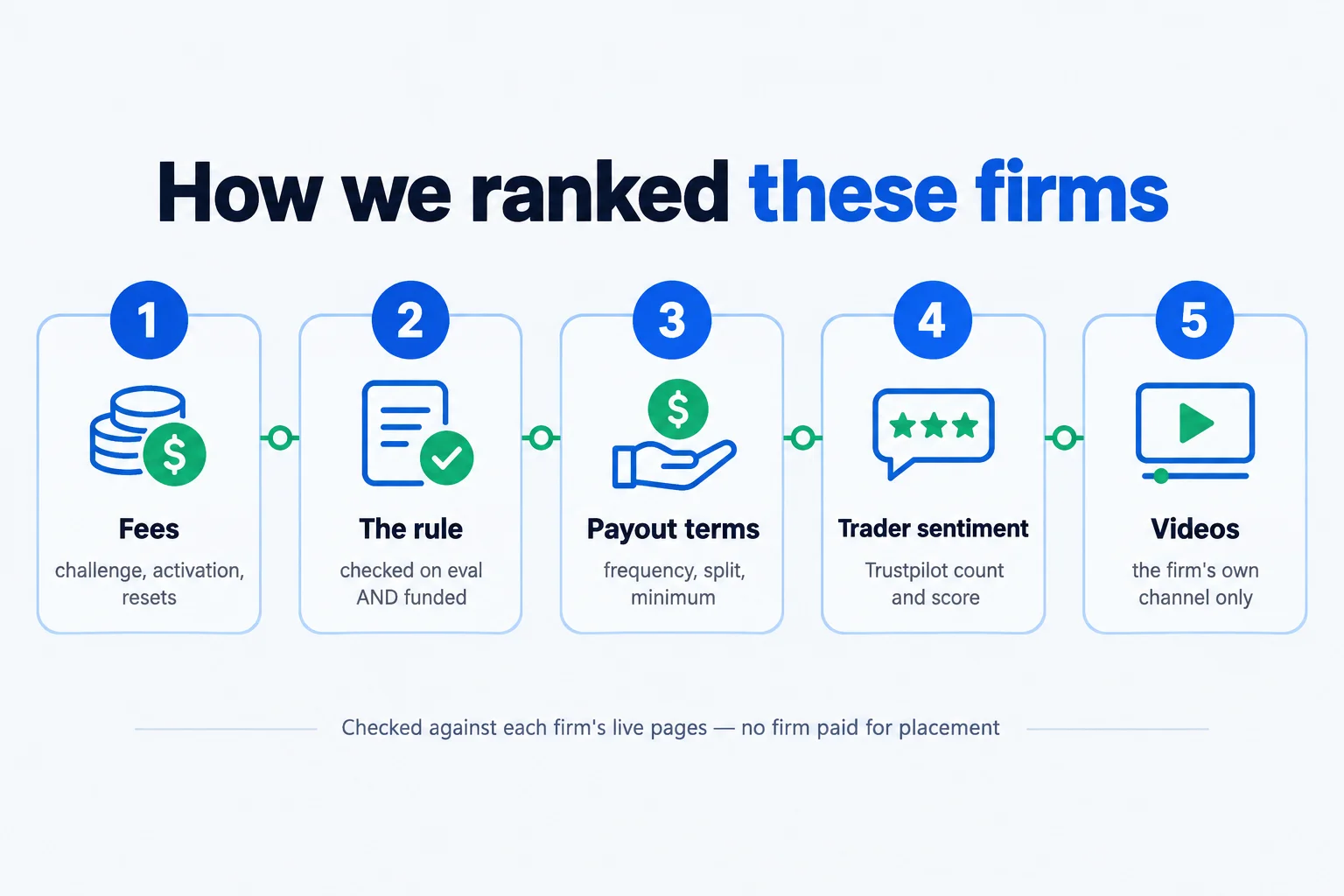
We examined 18 firms including the unranked Bulenox baseline, preserving 136 named product/configuration comparisons. One outside product per firm can rank. Within each firm we first choose the lowest list-cost metric among standing, publicly evidenced, nonexcluded products that demonstrate at least one improvement. Only an exact cost tie is broken by score, then loss allowance and stable product name. Across selected firms, need score sorts descending and unrounded cost sorts ascending. Rounded display prices never control the order.
The four tests answer four different questions. First, can an ordinary continuing account support $1,000 trader cash after its published split and unavoidable quoted payout charges with less profit than Qualification’s $3,600? A surrender-only solution or a different explicitly named size earns only conditional credit. Second, is the funded best-day cap greater than 40% throughout the early cycles or expressly absent? A later relaxation can earn partial credit, but evaluation consistency does not answer funded payout consistency. Third, can the request occur with fewer than ten ordinary days after both explicit day rules and mathematical concentration requirements? A profitable-day threshold or calendar lock earns only partial credit. Fourth, is complete required cost demonstrably lower than Momentum’s $71.50† or at least Qualification’s $161.50†? Unknown required charges can prevent any cheapness credit.
The entry metric is (one paid list cycle + published activation) / smallest quantified overall loss allowance × $1,000. It never divides by a daily pause, retained reserve, nominal account balance, a contract cap or a broker minimum balance. Published activation of $0 is retained as $0; an unpublished fee is not turned into $0. For incomplete live or temporary-stage allowances, we say that the denominator only covers known stages. A number can still be useful as a clearly marked lower bound without proving a cheaper full account.
This conservatism affects every ranked row. Builder’s $76.50†, Flex’s $89.33† and Launch’s $79.00† do not earn a cheapness point because unidentified required charges can reverse the comparison. Phidias additionally lacks the future live allowance. Purdia’s known-stage $162.63† is already above Qualification, so unknown charges cannot turn that lower bound into a demonstrated bargain. Hidden review scores and discretionary live moves do not add or subtract need-score points. A live move is the first watch-out, not an exclusion by itself.
Public product pages and positive exact-size purchase/API evidence support a public offering, not an executed transaction, a tax-inclusive total or country approval. A login/registration/CAPTCHA landing does not prove the same exact purchasable configuration. Nor does in-stock wording override an explicit nonpurchasable API value. We apply that distinction equally to Lucid, Tradeify, Topstep, Apex, FXIFY and every other firm. No signup, cart, payment or identity check was performed.
An independent serious rule finding is different from incomplete purchase evidence. Applicable current overall-floor contradictions, an account-ending daily loss rule and the named intraday funded trailing path are explained in the unranked section. Alpha Futures’ own acknowledged Premium payout queue is another specific reason for caution. We do not convert a website error into closure, a mandatory live move into a disqualification, or a futures arm into its CFD counterpart.
These are educational comparisons, not evidence that a strategy will pass or a payout will be approved. Fees, slippage, contract sizing, day distribution and commissions affect actual outcomes. The examples use profit after trading commissions, no intervening losses and the named product’s conditions. Unknown receiving charges remain outside the cash target. Before buying, confirm that today’s exact account and your residence, identity, payment method and platform qualify under the firm’s terms.
MyFundedFutures Builder is the Bulenox alternative for looser concentration
First watch-out is the mandatory live transition. Builder’s fifth payout can trigger the move, and the firm says a selected trader cannot reject it and remain simulated. That matters especially if you planned to treat the simulated stage as a permanent income setup. The rules for Rapid’s reserve/consolidation and Pro’s allocation are not automatically Builder’s balance treatment; confirm the exact transition allocation before accumulating a balance. Read the current live-account FAQ, checked October 8, 2026.
Builder Default 50K suits a trader whose main problem is Qualification’s 40% funded concentration plus ten ordinary request days, not someone seeking completely rule-free funding. The current $153 one-time entry has no activation fee and 365-day access. Its $3,000 evaluation target, one-day evaluation minimum and no evaluation consistency are distinct from funded conditions. The four-mini/40-micro cap and $1,000 daily soft pause still constrain size. The $2,000 overall allowance is published across evaluation, simulated funded and live. $153 / $2,000 × $1,000 gives $76.50†. Exact selected-platform data and later live charges were not completely itemized, so that is not an all-in cost assurance. Builder’s own 50K guide and current official product configuration supply the matched product facts.
The ranked Default plan’s funded best-day cap is 50%, looser than Qualification’s 40%, not absent. Its first-cycle net-profit denominator includes the cleared $2,100 buffer. Two ordinary trading days are required, with a separate 48-hour condition after the first trade. That calendar lock prevents full fewer-days credit even though the ordinary-day count is lower. The early split is 80% to the trader. A $500 minimum gross request pays only $400, so using the minimum payout as a $1,000 example would be wrong.
For the actual cash target, $1,000 / 80% = $1,250 gross. Add the $2,100 retained buffer and the required profit is $3,350. Two equal $1,675 net days meet the 50% cap while the 48-hour condition must also have elapsed. With no later trading loss or unknown receiving fee, $1,250 × 80% = $1,000 trader cash; $2,100 remains above the starting reference, leaving $2,000 above the $100 locked simulated floor. This continuing-account example improves on Qualification’s $3,600, but retains less surplus risk room than that baseline example. Buffer size and actual loss room should never be used interchangeably.
Subsequent requests require two fresh trading days, $500 new profit and 50% consistency calculated on the new cycle. The $2,000 gross request cap means a maximum $1,600 trader share at the 80% split. Payout approval can be rapid, but the policy’s manual review estimate of 6–12 business hours on weekdays is not bank arrival. The exact request cutoff and applicable receiving costs were not established. Read the payout policy rather than interpreting the firm’s general fastest-payout language as a guaranteed delivery clock.
The general platform catalog includes NinjaTrader, Tradovate, TradingView, Hyperprop, Quantower, Volumetrica, DeepChart/DeepDom and ATAS. It does not prove every platform is assigned at every stage. Choose the actual platform on the exact product configuration; live entitlements are not established by a general list. Builder permits news trading and requires daily position closure. Rapid/Pro have different news conditions. Although floor movement is EOD, the general EOD explanation and Builder wording differ on breach timing; conservatively protect the threshold during open trades. Platform overview and EOD explanation describe those distinctions.
Builder allows one funded account, so permitted own-account copying does not create a five-account Builder stack. The firm’s other, higher-cap plans cannot supply Builder’s cap. KYC uses Sumsub before simulated funded trading, with identity, selfie and separate recent address evidence; account/card details must match the current payment rules. The $153 reset is a separate purchase cost, not proof of automatically renewing one-time access. CLUB was documented at $76.50 with no end date shown, but the original promo read date was not established. It is not treated as a verified current offer or used for rank. No refund is assumed before first cash. Copy-trading conditions explain why technical copying access and the available account stack must be checked separately.
The Trustpilot profile showed 4.9/5 from 22,267 reviews on October 8, 2026, and stated that the company had not replied to negative reviews. It was a claimed, paid profile inviting reviews. Those labels do not prove a payout problem or guaranteed support quality. Current sentiment sampling was not established. An official plans video from July 5, 2026 was identified, but not verified as a current Builder payout guide, so we do not embed it as present-day instruction. Builder earns 2.5 demonstrated points: lower first-cash profit, looser concentration and partial earlier-days credit. Complete cheapness remains unresolved.
FundedNext Futures Flex is the Bulenox alternative without funded consistency
First watch-out is the profile-level live review. The current route shortlists traders around 15 rewards across the profile, with discretion and product-specific wording differences. Moving live replaces eligible funded accounts and closes active evaluations without refund. The new 50K live deposit is $2,000, not the full simulated balance. Treatment of every remaining simulated profit dollar is not expressly settled in the current evidence, so the older Legacy allocation scheme is not used to fill the gap. Read the current road-to-live terms, checked October 8, 2026.
Flex 50K offers the strongest ranked first-cash improvement for a continuing $50K route: $2,105.28 supports at least $1,000 trader share before unknown payout-rail charges. Its $133.99 entry is one-time with no activation fee. The $2,500 evaluation target and 40% evaluation consistency imply at least three positive evaluation days, despite no explicit minimum-day count. There is no advertised fixed pass deadline in the current model rules; inactivity and closure conditions remain separate. The three-mini/30-micro contract cap is fixed from creation in both evaluation and funded trading. Flex challenge rules and Flex funded rules were checked October 8, 2026.
The funded stage expressly has no best-day cap. It still requires five benchmark days of at least $200 net, $500 cycle profit, a $250 minimum gross request and a withdrawal of no more than 50% of profit. Its 95% trader split is different from Bulenox’s supported early 100% split. Divide $1,000 by 95% and round the gross request upward to cents: $1,052.64. The 50% profit cap then requires $2,105.28 profit. Five equal net days of about $421.06 meet the benchmark count and exceed each $200 threshold. The $1,500 gross cap permits this request, with a maximum $1,425 trader share per cycle at that split.
The example leaves $1,052.64 of profit after the gross debit. Against the published locked $50,100 floor, the account has $952.64 of loss room. That is the price of withdrawing half the earned profit close to first eligibility, not a promise of $1,500 continuing risk room after each payment. Even the $250 minimum pays only $237.50 at 95%; a mathematical $500 eligibility balance would leave $150 above the locked floor, though satisfying five $200 benchmark days without losses entails earning more than that minimal balance. Day conditions and balance conditions must both hold.
Every repeat cycle needs five new benchmark days and the current cycle-profit test. A new trade on the wallet-transfer day introduces next-eligibility friction under the rule. General 24-hour processing language is not a guarantee of bank receipt, and the live stage has a different 2–5-business-day estimate. Exact current withdrawal methods and rail costs were not enumerated in the inspected policy, so no cheapest receiving route is invented. Reward withdrawal instructions describe the workflow, not guaranteed funds in a bank account.
Flex has $1,500 evaluation/sim loss allowance and $2,000 initial live allowance. Its metric is $133.99 / $1,500 × $1,000 = $89.33†. Daily loss limits are absent on this selected route, but EOD maximum-loss movement still has open-equity enforcement. The separate live trail’s update frequency was not established; live reward shares also differ from Flex’s simulated split. Optional Level 2 data is priced through Tradovate rather than a verified universal firm charge. The $77.99 reset and nonrefundable purchase/reset policy are separate from the initial bill. FNFLEX displayed $69.99 with no end date shown when check