
Key takeaways
We checked 16 futures prop firms against four specific, sourced problems from Apex Trader Funding’s own current rules pages: an unscoped High Frequency Trading ban, a discretionary live-account move the trader cannot decline, a hard 6-payout account closure, and a 30-day rolling inactivity rule.
Read the full summary
We checked 16 futures prop firms against four specific, sourced problems from Apex Trader Funding’s own current rules pages: an unscoped High Frequency Trading ban, a discretionary live-account move the trader cannot decline, a hard 6-payout account closure, and a 30-day rolling inactivity rule. Phidias and Purdia come closest to fixing all four. Lucid Trading, Alpha Futures, Bulenox, Take Profit Trader, Elite Trader Funding, and BluSky each fix some of the four while keeping a real watch-out. Eight more firms, including the well-known names Topstep, Tradeify, and MyFundedFutures, replicate most of Apex’s own pattern and are named here honestly rather than recommended.

Freshness: checked October 3, 2026. Firms change terms without notice; re-check before you buy. Each firm’s Trustpilot figure carries the date we read it. Futures only: Apex Trader Funding is a futures-only firm, so pure forex/CFD firms (FTMO, The5ers, FundingPips, Goat Funded Trader, City Traders Imperium, E8 Markets) are excluded from this comparison; where a brand runs both a forex and a futures arm, only the futures arm is checked here.
Editorial disclosure. BestProps has no affiliate or sponsor relationship with any firm in this post (Purdia, Phidias Prop Firm, Lucid Trading, Alpha Futures, Bulenox, Take Profit Trader, Elite Trader Funding, BluSky, Top One Futures, DayTraders.com, Topstep, TradeDay, Tradeify, MyFundedFutures, Earn2Trade, FundedNext Futures, or Apex Trader Funding), and has received no money from any of them. Codes shown are uncompensated and firm-published only. No firm paid for placement or reviewed this post before publication. Full policy: affiliate disclosure.
Quick picks among Apex Trader Funding alternatives
- Fixes all four: Phidias and Purdia. Phidias has no call-up stage at all; Purdia’s live move is rule-triggered.
- Cheapest that fixes most: Bulenox, $63.56 per $1,000 of loss room, fixes payouts and inactivity, scopes its automation ban to algorithms with no numeric threshold.
- Best for automated traders: Lucid Trading, explicitly names and permits Automated Strategies by name.
- Best if you never want a forced live move: Phidias (no call-up stage exists) or BluSky (a declinable cash-buyout option).
- Most established name checked here: Topstep, though it replicates two of Apex’s four problems exactly.
A live call-up is a fact to weigh, never an automatic disqualifier: some firms in this post make the move rule-triggered instead of a firm pick, skip the stage by letting the trader click when ready, or let the trader decline for cash. Read the exact mechanics in each firm’s block below before assuming any alternative is automatically better on this one point.
Why traders leave Apex Trader Funding
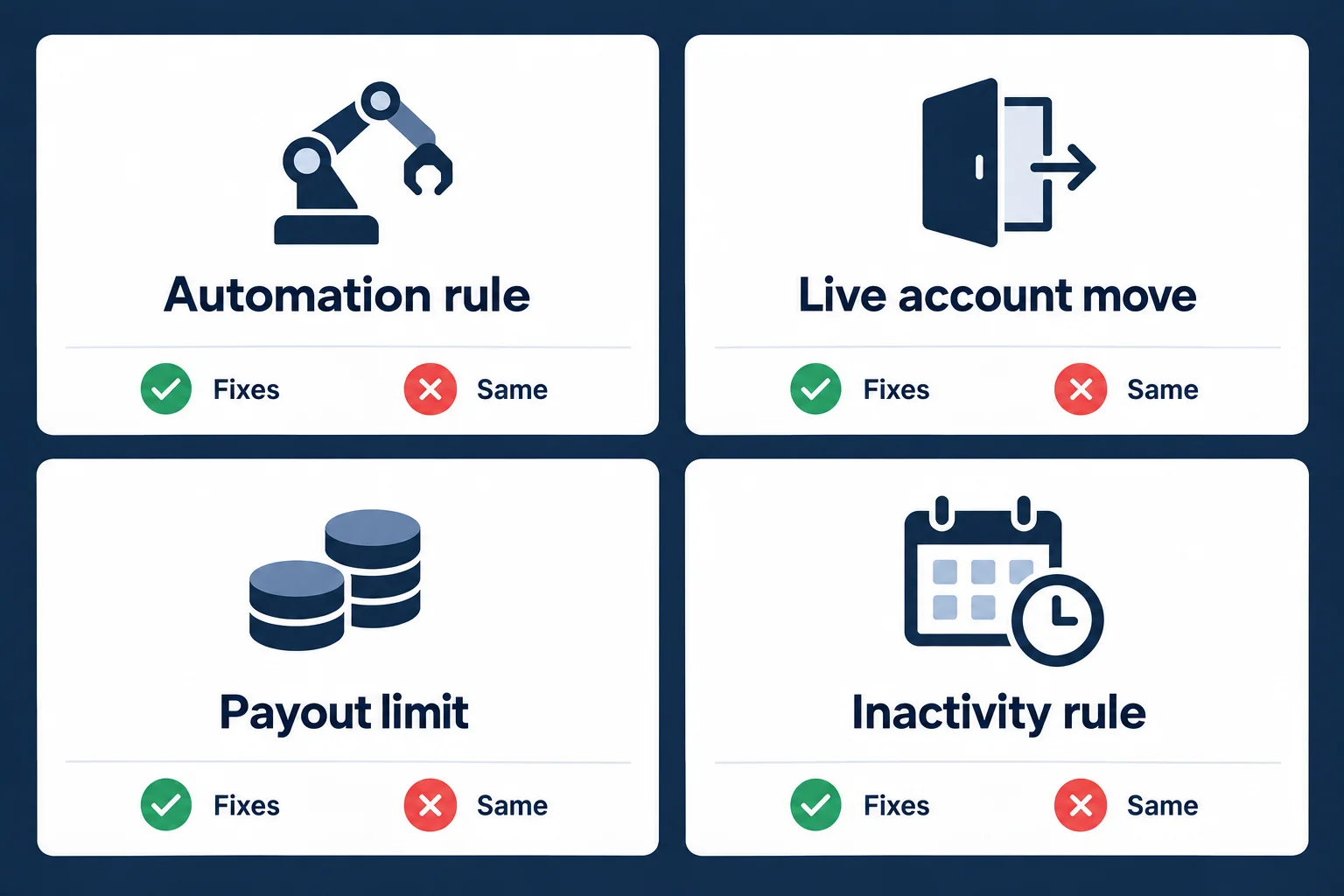
Apex Trader Funding’s own current rules pages, read October 3, 2026, name four specific problems that drive traders to look for an alternative:
- An unscoped automation ban. its Prohibited Activities page bans “High Frequency Trading (HFT) or any other exploitative strategies” as simulated-market manipulation: no numeric trade-count, order-rate, or hold-duration threshold, and no language scoping the ban to automated execution only.
- A discretionary, non-declinable live call-up. “Apex may move a trader into live trading at any time based on trading style, P&L, account count, speed of simulated profit accumulation, and trader history with Apex.” The trader cannot decline; the sim/Bonus Vault balance is forfeited, and a flat $3,000 is paid instead.
- A hard payout-count account closure. The funded Performance Account closes after exactly 6 payouts, regardless of how much total profit is still being made.
- A 30-day rolling inactivity closure. Without at least 2 trading days of $50+ net profit in any rolling 30-day window, the account is permanently closed.
Every alternative in this post is tested against the same four points, quoting the alternative firm’s own current pages, never Apex’s pages and never a third-party review site.
How we tested these Apex Trader Funding alternatives
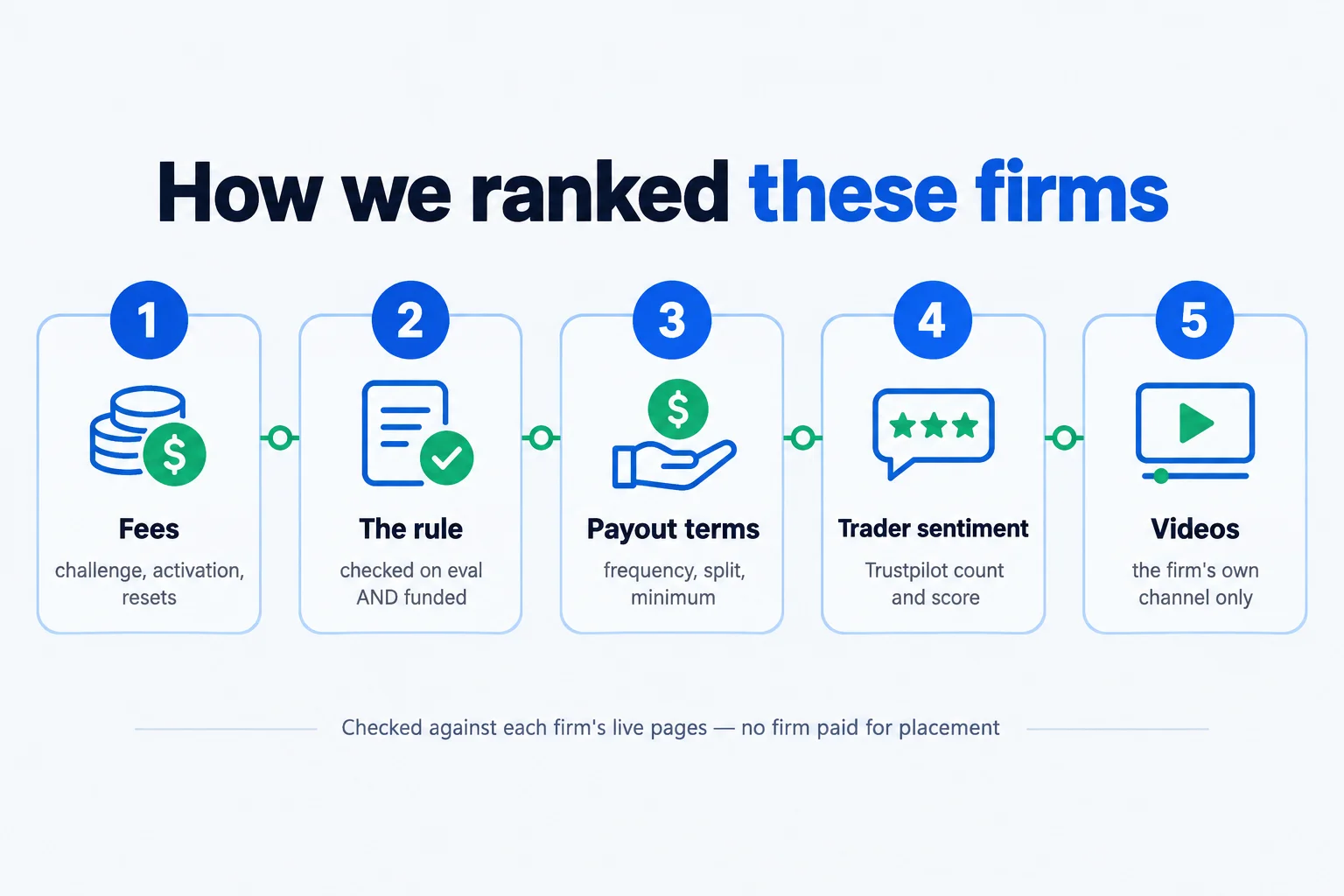
- Sources: each firm’s help centre, FAQ, rules, and terms pages, read October 3, 2026; never a bot vendor’s list or a competing roundup.
- Per product: we grade the specific product (not the whole brand) against each of Apex’s own four named pain points, quoting the alternative firm’s own current pages.
- Classification: each point is scored fixes (the firm’s own current pages genuinely solve the problem), partly (a real, nameable difference that is not a clean fix), or same as Apex (the firm’s own pages replicate the identical shape).
- Ranking rule: firms with no serious watch-out beyond the four tested points rank first, then watch-out firms ordered by how many of the four they fix, then by cost per $1,000 of loss room at the $50K size or nearest size sold, using the list price plus activation fee, never a coded or promotional price.
- Arms: a forex/CFD arm and a futures arm of the same brand are separate listings; only the futures arm of each brand is checked here.
A live call-up is a fact to weigh, never a reason to rank a firm lower on its own: several ranked firms in this post have one. Nothing in this post replaces reading the firm’s own current rules before you buy; firms change terms without notice.
Apex Trader Funding alternatives compared, checked October 3, 2026
| Rank and firm | Automation rule | Live move | Payout limit | Inactivity rule | Cost/$1,000 | Trustpilot |
|---|---|---|---|---|---|---|
| Phidias Prop Firm Express to Live | Fixes: no numeric gap, scoped | Fixes: trader’s own click only | Fixes: no closure found | Fixes: no rule found | $656.92† | rating hidden (“breach of our guidelines” banner), 336 reviews |
| Purdia Evaluation 50K | Fixes: scoped, oversight allowed | Fixes: rule-triggered, keeps funds | Fixes: no closure found | Partly: 14 or 30 days, pages disagree | $154.50 | 3.8/5 on 88 reviews |
| Bulenox Momentum 50K, Option 2 EOD | Partly: scoped, no number | Partly: declinable, closes either way | Fixes: no closure found | Fixes: no rule found | $63.56 | 4.7/5 on 1,800 reviews |
| Alpha Futures Standard 50K | Partly: numbered, catches manual too | Partly: declinable, same outcome | Fixes: 5 cycles triggers review only | Fixes: any trade in 10 days resets | $64.50 | 4.4/5 on 6,048 reviews |
| Lucid Trading LucidPro Evaluation 50K, DLL ON | Fixes: scoped, auto named allowed | Same: no decline option published | Fixes: payout 5 is one of several triggers | Fixes: $1 trade in 30 days resets | $73.00 | 4.3/5 on 6,052 reviews |
| Elite Trader Funding Static 50K Evaluation | Partly: 10-sec floor, all trades | Partly: non-declinable, pays formula | Fixes: 5 payouts is one of 3 triggers | Fixes: login every 30 days, weekly trade | $337.00 | 3.8/5 on 1,154 reviews |
| Take Profit Trader Trading Test 50K | Fixes: all automation banned, scoped | Same: $5,000 frozen on call-up | Fixes: no withdrawal cap published | Partly: weekly, no profit required | $150.00 | 4.4/5 on 10,770 reviews |
| BluSky Propel 50K | Fixes: no HFT ban at all | Partly: declinable for a buyout | Fixes: $10k triggers review only | Same: 30 days, same window | $1,600.00* | 4.7/5 on 898 reviews |
Notes on this ranking: * BluSky carries a high cost-per-$1,000 figure because its smallest published max-loss floor is unusually small relative to its list price (a $100 static Sim Funded floor against a $160 monthly price); it still ranks on the strength of fixing or partly fixing three of Apex’s own named pain points. † Phidias’s cost cell uses the Express to Live Evaluation path ($278 list plus $149 activation on pass, on a $650 floor), the cheaper of Phidias’s two Express to Live variants that pass all four tests above and the same product the tests are run on; the Express to Live One-Time Payment path costs $1,112.31 per $1,000 instead. Phidias’s separate Fundamental plan costs $125.20 per $1,000 at list but carries a discretionary move to a live account, so it does not fix Apex’s live-move problem: Fundamental’s terms of use give Phidias the right to move a trader to a live account after 5 payouts or $100,000 cumulative profit, decided by the Company alone, a clause Express to Live is explicitly carved out of. Purdia’s own pages disagree on its inactivity window (14 days on the Knowledgebase versus 30 days plus a reactivation period on the Trading Policy); this post ranks on the stricter 14-day figure. Bulenox’s cost cell likewise uses its cheapest $50K plan, Momentum 50K ($143 one-time, no activation fee, on a $2,250 floor); its separate Qualification-to-Master path costs $323 all-in on a $2,500 floor ($129.20 per $1,000) for a trader who wants that differently-named funded account instead. Every cost figure uses the firm’s published list price plus any activation fee, never a coded or promotional price; Lucid Trading’s $146 list price has a $90.20 VAULT-code figure that never changes its rank, and Phidias’s $278 Express to Live Evaluation list price is never swapped for a coded or promotional figure in this post’s ranking either.
Ranked Apex Trader Funding alternatives
Eight firms come closest to fixing Apex’s own four named pain points. Ranked by how many of the four they fix, then by cost per $1,000 of loss room, cheapest first within each group.
Phidias has no call-up stage at all, because the trader’s own click is the only trigger
Verdict: First: this post’s single cleanest structural fix to Apex’s live-call-up problem. There is no live-transition stage for Phidias’s own discretion to invoke at all on the product tested below; the trader clicks a button when ready, full stop. It ranks ahead of Purdia because it fixes all four of Apex’s own pain points cleanly, with no partial score, even though its ranked cost per $1,000 of loss room is higher than Purdia’s.
Video: “Why You Keep Failing Your Prop Firm Evaluation (50,000 Traders Data),” Phidias Prop Firm official YouTube channel, 2026-07-29. Source type: vendor-produced. Why selected: Phidias’s own explainer of the E2L path; no HFT- or inactivity-specific official video exists.
Phidias’s rules state: “3. No Automated / HFT Trading: The use of robots, fully automated trading algorithms, or any other form of automated trading is not permitted. Only semi-automated software is permitted, provided the trader actively monitors and manually adjusts all trades.” No numeric trade-count or hold-duration threshold exists, matching Apex’s own gap, but the sentence is explicitly scoped to automated execution and names the manually-monitored carve-out Apex’s page never offers. On the live move: “no call-up stage exists for this product: when the trader reaches the profit target and clicks ‘Switch to Live,’ a predefined fixed bonus is automatically credited to the Phidias Wallet… and the account is converted to a LIVE account.” The trader’s own click is the only trigger; Phidias itself never initiates or declines the move. No sentence on Phidias’s rules, terms of use, or rendered help-centre article states a maximum number of payouts after which an account closes, and the same three sources contain zero mentions of the words “inactive,” “inactivity,” or “dormant” anywhere.
- Product: Express to Live (E2L) 50K, Evaluation path ($278 list plus $149 activation on pass, $427 all-in): the cheaper of Phidias’s two Express to Live variants that pass this post’s four tests, and the product priced below. The One-Time Payment path tests identically but costs $1,112.31 per $1,000 on the same formula
- Automation rule: Fixes: scoped to automated execution; manually-monitored semi-automated software is explicitly allowed.
- Live account move: Fixes: no call-up stage exists; the trader’s own click to “Switch to Live” is the only trigger.
- Payout limit: Fixes: zero hits for a payout-count-triggered closure across rules, terms of use, and the help-centre article.
- Inactivity rule: Fixes: zero mentions of “inactive,” “inactivity,” or “dormant” anywhere on any current page.
- Cost per $1,000 of loss room: $656.92 per $1,000 (($278 list plus $149 activation) / $650 floor x 1,000, on the Evaluation path, Phidias’s cheapest Express to Live variant that passes all four tests above and the same product the tests are run on). Phidias’s Fundamental plan costs $125.20 per $1,000 at list but carries a discretionary move to a live account, so it does not fix Apex’s live-move problem: its terms of use give Phidias the right to move a trader to a live account after 5 payouts or $100,000 cumulative profit, decided by the Company alone, a clause Express to Live is explicitly carved out of.
- Best for: A trader who wants zero discretionary live-transition risk at all on either Express to Live entry path.
- Trustpilot: rating hidden (“breach of our guidelines” banner), 336 reviews. No dedicated BestProps profile exists for this firm yet.
Purdia’s move to live is rule-triggered, not a discretionary pick the trader can’t refuse
Verdict: Second: the cleanest rule-triggered fix to Apex’s live-call-up problem, at a lower cost per $1,000 of loss room than Phidias’s Express to Live plan, though Phidias ranks first because it fixes all four of Apex’s own pain points with no partial score while Purdia’s inactivity rule is only a partial fix. Purdia’s transition to a Live Funded Account happens only after the Sim Funded stage is cleared and a $10,000 profit cap is hit, never at the firm’s own discretionary pick of trader, style or speed, and nothing is forfeited along the way.
Video: “Purdia Capital: Live Q&A Session and Future Vision,” Purdia official YouTube channel, 2024-10-26. Source type: vendor-produced. Why selected: Purdia’s own explainer of how the Sim Funded Account stage works; no automation- or inactivity-specific official video exists.
Purdia’s Risk Management page states plainly: “Semi-automated trading tools may be allowed when traders maintain active oversight, understand the strategy logic, and continuously monitor all trades and positions. Fully automated trading is strictly prohibited.” That carve-out is scoped to automated execution only, not to how fast a human clicks. The move to live is rule-triggered: “Once a trader successfully completes the Sim Funded Account (SFA) stage, they will be prompted through the Purdia Dashboard to begin the Live Funded Account onboarding process,” and “trading in the Temp SFA is optional and is not required in order to proceed into a Live Funded Account.” No sentence anywhere on Purdia’s Knowledgebase, Terms, or Trading Policy pages ties account closure to a number of payouts; the only cap found is the $10,000 Temp SFA profit total, which graduates the account rather than ending it. On inactivity, Purdia’s own pages genuinely disagree: the Knowledgebase gives a 14-day absolute window for accounts bought on or after October 1, 2026 (“An account that reaches 14 consecutive calendar days without an executed trade will be permanently closed”), while the Trading Policy gives 30 days to a notice plus 30 more days to request reactivation. We rank on the stricter 14-day figure.
- Product: Evaluation 50K ($179/month list + $130 activation = $309 all-in)
- Automation rule: Fixes: semi-automated tools allowed with active human oversight; fully automated trading banned, scoped to execution, not speed.
- Live account move: Fixes: rule-triggered at SFA completion plus a $10,000 cap, never a discretionary firm pick; nothing is forfeited.
- Payout limit: Fixes: no sentence anywhere ties closure to a payout count; the $10,000 cap graduates the account instead of ending it.
- Inactivity rule: Partly: 14 days on the Knowledgebase (new accounts) vs. 30 days plus a reactivation window on the Trading Policy; the firm’s own pages disagree, ranked on the stricter 14-day figure.
- Cost per $1,000 of loss room: $154.50 per $1,000 ($309 all-in / $2,000 overall max-loss floor x 1,000, per Purdia’s own 50K EOD Evaluation article).
- Best for: A trader whose main complaint about Apex is being forced into live trading without a choice and without being told why.
- Trustpilot: 3.8/5 on 88 reviews. Purdia profile, payouts.
Bulenox allows bots and copiers by name, then separately bans scalping algorithms with no number
Verdict: Third: a firm that genuinely improves on Apex’s automation wording while keeping a near-identical live-transition shape, and on its cheapest $50K entry product, the single lowest cost per $1,000 of loss room of any firm ranked in this post, clean or watch-out.
Video: no official Bulenox video addresses automation, the live move, or inactivity specifically.
Bulenox’s FAQ says “Bots, algorithms and trade copiers are permitted” for user-built tools, but its Terms of Use separately ban ‘scalping’ algorithms, the DTC Protocol Bridge API, and opening “hundreds or thousand of rapid trades by using any trading algorithms,” with no numeric threshold: every banned item is explicitly qualified by the words “algorithms” or “automated,” a real automation-only carve-out Apex’s own wording lacks, but still no satisfiable number. On the live move: “after completing three successful payouts on your active Master Accounts, your accounts may be considered for transition to a Funded Account. The transition is completed at Bulenox’s discretion and is not automatic,” technically declinable, but declining closes the Master-level account with no further reward, functionally identical to Apex’s forfeiture, just reached a different way. No article anywhere states a maximum number of payouts before the funded account closes, and no inactivity or dormancy article exists in Bulenox’s 48-item Help Center or 18-item FAQ.
- Product: Momentum 50K, Option 2 EOD ($143 one-time, no activation fee)
- Automation rule: Partly: every banned item is scoped to “algorithms” or “automated,” but no numeric trade-count threshold exists.
- Live account move: Partly: technically declinable, but declining closes the Master-level account either way, no further reward.
- Payout limit: Fixes: no article anywhere states a maximum number of payouts before the funded account closes.
- Inactivity rule: Fixes: no inactivity or dormancy article exists anywhere on the Help Center or FAQ.
- Cost per $1,000 of loss room: $63.56 per $1,000 ($143 all-in / $2,250 EOD floor x 1,000; Bulenox’s separate Qualification-to-Master path costs $323 all-in on a $2,500 floor, or $129.20 per $1,000, for a trader who wants that differently-named funded account instead).
- Best for: A trader who wants bots and copiers named as explicitly allowed and can tolerate the same discretionary-review shape as Apex.
- Trustpilot: 4.7/5 on 1,800 reviews. Bulenox profile, rules.
Alpha Futures publishes a numeric automation threshold, then lets the trader decline the live move
Verdict: Fourth: a named, verifiable numeric automation threshold most firms do not bother publishing, at one of the lowest costs per $1,000 of loss room among this post’s watch-out firms.
Video: “Futures Trader Makes $30,000 Pay-out From a $150 Challenge,” Alpha Futures official YouTube channel, 2025-11-30. Source type: vendor-produced. Why selected: Alpha Futures’s own account walkthrough; no automation- or inactivity-specific official video exists separate from this one.
Alpha Futures publishes a verifiable number: “restricts the use of automated systems designed for high-frequency trading (HFT), particularly those resulting in over 100 trades per day,” but the team states it is “not interested in working with strategies taking 100+ trades per day, automated or not,” catching manual pace too, better than Apex’s zero-number ban but not a clean automation-only fix. On the live move, a trader “may be reviewed or called to live immediately if they have met one or more of the following conditions: 5 performance fees on a single Qualified Account…”, technically declinable, unlike Apex, but the financial outcome on decline matches Apex’s forfeiture: the trader loses relations with the Alpha Group and does not keep the Qualified Account’s sim profit either way. On payouts, reaching 5 payout cycles or $40,000 payable triggers only a discretionary review for an optional move to Alpha Prime; the Qualified Account itself keeps paying out indefinitely, unlike Apex’s hard 6-payout cap. On inactivity, trading platforms archive data after 10 inactive trading days, but any size trade, not a profitable day, resets the clock, and the stated consequence stops at archiving, never an explicit permanent-closure, forfeiture statement.
- Product: Standard 50K ($129/month list, no activation fee)
- Automation rule: Partly: a published 100-trades/day number, but explicitly catches manual pace too, not automation-only.
- Live account move: Partly: technically declinable, but the financial outcome on decline matches Apex’s own forfeiture.
- Payout limit: Fixes: 5 payout cycles or $40,000 payable triggers only a review; the account itself keeps paying out indefinitely.
- Inactivity rule: Fixes: any size trade in 10 days resets the clock, and the consequence stops at archiving, not closure.
- Cost per $1,000 of loss room: $64.50 per $1,000 ($129 all-in / $2,000 EOD trailing floor x 1,000).
- Best for: A trader who wants a published, verifiable automation threshold instead of guessing at Apex’s unscoped wording.
- Trustpilot: 4.4/5 on 6,048 reviews. Alpha Futures vs Apex comparison.
Lucid Trading names and permits automated strategies by name, then keeps a non-declinable live move
Verdict: Fifth: the firm in this post that fixes the most individual Apex pain points (three of four), but its live-transition shape is a lookalike worth naming honestly, not a fix.
Video: “The Closet Within: The Lucid Trading Story,” Lucid Trading official YouTube channel, 2026-05-13. Source type: vendor-produced. Why selected: Lucid Trading’s own explainer of the LucidPro Evaluation path; no HFT-specific official video exists separate from this one.
Lucid’s Prohibited: High Frequency Trading article explicitly scopes its ban to “a type of automated trading strategy… typically powered by algorithms,” and the firm goes further by naming and permitting both manual “Genuine Scalping” and automated “Automated Strategies” outright. On the live move, Lucid’s New Live Structure article states traders “enter the live review pool when one or more of the following conditions are met: after receiving the final payout (Payout 5)…” with no published decline mechanism anywhere, and no alternative cash reward on decline the way Apex at least offers its flat $3,000; a lookalike, not a fix, and arguably a worse shape for a decliner. On payouts, “Payout 5 represents the maximum payout level, not a guaranteed minimum for live eligibility”, one of several alternate entry conditions into the same live-review pool, not a standalone closure rule. On inactivity, Lucid’s own policy requires only a single trade netting as little as $1 of profit or loss in any 30-day window, materially looser than Apex’s requirement of 2 trading days of $50+ net profit.
- Product: LucidPro Evaluation 50K, DLL ON ($146 one-time list, no activation fee)
- Automation rule: Fixes: explicitly scopes the ban to automated strategies and separately names manual scalping as allowed.
- Live account move: Same: no published decline option anywhere, and no alternative cash reward on decline, unlike Apex’s flat $3,000.
- Payout limit: Fixes: Payout 5 is one of several alternate entry triggers into the same live-review pool, not a standalone closure.
- Inactivity rule: Fixes: a single $1 trade in any 30-day window resets the clock, looser than Apex’s 2-day/$50+ bar.
- Cost per $1,000 of loss room: $73.00 per $1,000 ($146 all-in / $2,000 EOD trailing floor x 1,000; a $90.20 VAULT-code price exists but is never the ranking basis).
- Best for: A trader who specifically wants automated trading named and permitted, and can accept Apex’s own live-transition shape unchanged.
- Trustpilot: 4.3/5 on 6,052 reviews. Lucid Trading profile, payouts.
Elite Trader Funding’s non-declinable call-up pays a formula instead of Apex’s flat $3,000
Verdict: Sixth: the live-transition shape matches Apex’s non-declinable pattern, but the payout formula on decline is materially better at realistic balances, worth quoting precisely.
Video: “Pay Once for Elite Accounts!,” Elite Trader Funding official YouTube channel, 2023-07-24. Source type: vendor-produced. Why selected: Elite Trader Funding’s own LIVE ELITE explainer; no automation- or inactivity-specific official video exists separate from this one.
ETF’s Prohibited Activities clause bans “trading strategies that utilize high-frequency trading (HFT) or other similar strategies that leverage technology to gain advantages execution speeds… All trades executed [under] a 10-second hold are flagged.” A trader can verify in advance that any trade held 10+ seconds is safe, better than Apex’s zero-number ban, but the rule applies to “all trades” regardless of how they were placed, so a human manually closing positions fast is caught too, not just automated execution. On the live move: “ETF reserves the right, at its sole discretion, to convert a Trader to a LIVE ELITE Account at any time,” the same non-declinable shape as Apex, but “you get 3 business days to accept a LIVE ELITE offer. If you decline, you still get paid for the work: 5% of your earnings up to $12,500, plus 2% above that threshold”, on $20,000 of earnings, a decliner nets roughly $1,025 more than Apex’s flat $3,000 would pay on the same balance; on larger balances the gap widens further. The “5 payouts” figure is one of three alternate triggers (5 payouts / 50 active trading days / $25,000 cumulative) for the same transition event, not a separate closure rule. On inactivity, ETF requires only a login every 30 days plus one trade per calendar week, no $50+ net-profit threshold like Apex’s bar.
- Product: Static 50K Evaluation ($497 for one 30-day cycle + $177 one-time activation = $674 all-in)
- Automation rule: Partly: a verifiable 10-second hold floor, but applies to all trades regardless of execution method, not automation-only.
- Live account move: Partly: non-decli