
Cross-market buyer comparison · official documents checked August 6, 2026
Blueberry Funded vs Apex Trader Funding buyer scorecard
Quick verdict: This is primarily a market and risk-engine decision. Blueberry’s reviewed programs are built around forex and CFD instruments with percentage-based loss rules. Apex’s current EOD path is built around futures contracts, account-size thresholds, a Daily Loss Limit, and an EOD drawdown floor. Choose the market first, then compare the exact account path.
| Decision point | Blueberry Funded | Apex Trader Funding |
|---|---|---|
| Matched scope | Current 2-Step and Instant Access Sim documents | Current EOD Evaluation and EOD Performance Account documents |
| Primary market | Forex and CFDs, including indices, metals, commodities, and crypto products listed by the firm | Futures contracts with account-size contract limits |
| Loss framework | Program-specific percentage limits; the reviewed 2-Step path lists 5% daily loss and 10% static maximum loss | Account-size EOD threshold plus a fixed Daily Loss Limit for the session |
| Evaluation pace | The reviewed 2-Step path lists three minimum trading days in each phase | The current EOD Evaluation lists no minimum trading days and 30 calendar days of access |
| Reward or payout check | Use the selected program’s active-day, minimum, split, review, and payout-cycle rules | Current EOD PA rules list five qualifying days, a $500 minimum, 50% consistency, and a maximum of six payouts |
| Cost check | Verify live checkout, activation, data, add-ons, taxes, and promotions for the exact product. Do not compare a temporary coupon as if it were a permanent rule. | |
Official sources: Blueberry 2-Step guide, Blueberry Instant guide, Blueberry current strategy policy, Apex EOD Evaluations, and Apex EOD payouts.
TL;DR: Blueberry Funded vs Apex Trader Funding is mostly a forex and CFD style versus futures style decision. Based on official pages checked on August 6, 2026, Blueberry Funded offers 1-Step, 2-Step, and Instant Access Sim routes with an 80% profit split on the account types reviewed, static drawdown on its 1-Step and 2-Step challenges, 1:30 to 1:50 account leverage depending on stage, restricted third-party copy trading, and a 30-day inactivity limit. Apex Trader Funding’s EOD materials cover 25K, 50K, 100K, and 150K futures accounts, fixed EOD evaluation profit targets, Daily Loss Limit controls, EOD drawdown, up to 20 active Performance Accounts, a stated 100% approved payout split on EOD PAs after eligibility requirements, 5 qualifying payout days, a $500 minimum payout request, and a 50% consistency requirement. Blueberry may fit traders who want forex or CFD-style instruments and percentage-based risk rules. Apex may fit traders who want futures contracts, contract limits, multiple PAs, and a ruleset built around EOD thresholds, DLL, and payout consistency.
Blueberry Funded and Apex Trader Funding can both look attractive if you are comparing prop firms by payout marketing alone. That is the wrong starting point. The better question is whether your trading style fits each firm’s rule engine.
Blueberry Funded is closer to a forex and CFD-style evaluation model. Apex Trader Funding is a futures-focused model with account-size tables, contract limits, EOD drawdown, Daily Loss Limit rules, and Performance Account payout requirements. Those differences affect how you size trades, how quickly you can pass, how you manage open risk, and what can block a payout request.
This comparison uses official Blueberry Funded and Apex Trader Funding rule pages checked on August 6, 2026. It also uses the current Google page-one SERP pattern for this query, which shows that searchers want a side-by-side answer, payout context, drawdown differences, scalping context, and a practical alternative angle. Fees, discounts, and checkout prices change often, so this page intentionally leaves current checkout pricing as a verification item rather than guessing.

Quick comparison
| Category | Blueberry Funded | Apex Trader Funding |
|---|---|---|
| Best fit | Forex and CFD-style traders who want percentage-based evaluation rules | Futures traders who already think in contracts, daily loss controls, and session resets |
| Main account routes covered here | 1-Step Challenge, 2-Step Challenge, Instant Access Sim | EOD Evaluation and EOD Performance Account |
| Evaluation format | 1-Step has one phase, 2-Step has two phases, Instant Access has no profit target listed in the official Instant guide | EOD Evaluation has one assessment with account-size profit targets |
| Risk framework | Daily and maximum drawdown percentages, static drawdown on 1-Step and 2-Step, trailing lock on Instant Access | EOD drawdown threshold, Daily Loss Limit, contract limits, and PA scaling |
| Payout split | Official Blueberry guides list 80% on funded accounts and Instant Access Sim | Official Apex EOD PA guide says approved payouts are issued at 100% payout split |
| Payout minimum | Blueberry 1-Step and 2-Step guides list $100 realized profit minimum | Apex EOD Payouts lists $500 minimum payout amount |
| Payout day requirement | Blueberry 1-Step and 2-Step guides list 3 active trading days per payout cycle, Instant Access lists 5 active days | Apex EOD Payouts lists 5 qualifying trading days with account-size minimum daily profit |
| Consistency rule | Blueberry 1-Step and 2-Step guides say no consistency rules | Apex EOD Payouts applies a 50% consistency requirement |
| Scalping and HFT | For accounts bought on or after March 12, 2026, Blueberry no longer lists excessive scalping as prohibited, but latency arbitrage, HFT, and tick scalping remain prohibited; older accounts retain their original rules | Apex’s prohibited activities page prohibits HFT and exploitative simulation strategies |
| Jurisdiction and access | Verify current eligibility directly with Blueberry before checkout | Verify current restricted countries and platform access directly with Apex before checkout |
| Current fees | Check the live official checkout for the selected product; fees and promotions can change. | Check the live official checkout for the selected product; fees and promotions can change. |
The short version: Blueberry Funded may be the cleaner fit if your edge is built around FX pairs, indices, metals, crypto CFDs, or similar products and you prefer percentage-based drawdown rules. Apex may be the cleaner fit if your edge is specifically in futures and you are comfortable with contract limits, daily loss pauses, and account-size payout thresholds.
How we compared the firms
This page compares only the account types named in the official pages reviewed: Blueberry Funded’s 1-Step Challenge, 2-Step Challenge, and Instant Access Sim materials, plus Apex Trader Funding’s EOD Evaluation, EOD Performance Account, EOD Payouts, Daily Loss Limit, EOD Drawdown, and Prohibited Activities materials. It does not verify live checkout pricing, discounts, taxes, platform fees, data fees, or whether either firm is available in every reader’s country.
Treat jurisdiction as a first-step filter. If your country, payment method, broker access, platform provider, or identity documents are not supported, the rest of the comparison does not matter. Always verify eligibility directly with the firm before paying for any account.
What Blueberry Funded is better suited for
Blueberry Funded fits traders who want a forex and CFD-style prop account structure. Its official 1-Step Challenge guide lists simulated allocations from $5,000 through $200,000, a 10% profit target in the challenge phase, 4% max daily drawdown, 6% max total drawdown, static max drawdown, 3 minimum active trading days, 1:30 account leverage, and an 80% profit split in the funded stage.
The official 2-Step Challenge guide is more forgiving on drawdown but requires two phases. It lists a 10% phase-one target, a 5% phase-two target, 5% max daily drawdown, 10% max total drawdown, static max drawdown, 3 active trading days in each phase, 1:50 account leverage in the challenge phases, 1:30 in the funded stage, and an 80% funded-stage profit split.
Blueberry’s Instant Access Sim guide is different again. It lists Instant Lite and Instant Elite, 80% profit split, 5 minimum active trading days, a one and a half percent max risk per trade idea, 30 max inactivity days, no third-party copy trading, and 1:30 account leverage. Instant Lite lists a 2% max daily drawdown and 4% max total drawdown. Instant Elite lists no max daily drawdown in the table and a 10% max total drawdown, with trailing lock drawdown mechanics.
That means Blueberry is not one single ruleset. It is a menu. The right Blueberry plan depends on whether you want a one-phase target, a two-phase buffer, or an instant-access style account with more emphasis on funded-account behavior.
What Apex Trader Funding is better suited for
Apex Trader Funding fits futures traders who already trade contracts, session-based risk, and account-size thresholds. The official Apex EOD Evaluation guide lists 25K, 50K, 100K, and 150K account sizes. It lists profit targets of $1,500, $3,000, $6,000, and $9,000 for those sizes, with EOD max drawdowns of $1,000, $2,000, $3,000, and $4,000.
Apex’s EOD Evaluation guide also says there are no minimum trading days required for the EOD evaluation and that a trader may pass as soon as the profit target is reached, provided all rules are respected. That is attractive for traders who can hit a futures target quickly without breaking the EOD threshold. It is also risky if a trader treats the absence of minimum days as an invitation to oversize.
Once passed, the EOD Performance Account follows the same size as the evaluation account and adds PA-specific controls. Apex’s official EOD PA guide lists no intraday trailing drawdown, EOD drawdown calculated once per day at market close and enforced intraday, Daily Loss Limit enforcement, tier-based scaling, and a stated 100% payout split on approved payouts after eligibility requirements are met. It also says a trader may hold up to 20 active PAs across PA account types. Because payout pages are high-churn policy pages, verify the current payout limits and payout split language on Apex’s official page before treating that number as final.
For more futures-focused context, BestProps has a separate guide to the best prop firm for futures day traders and a direct Topstep vs Apex Trader Funding comparison.
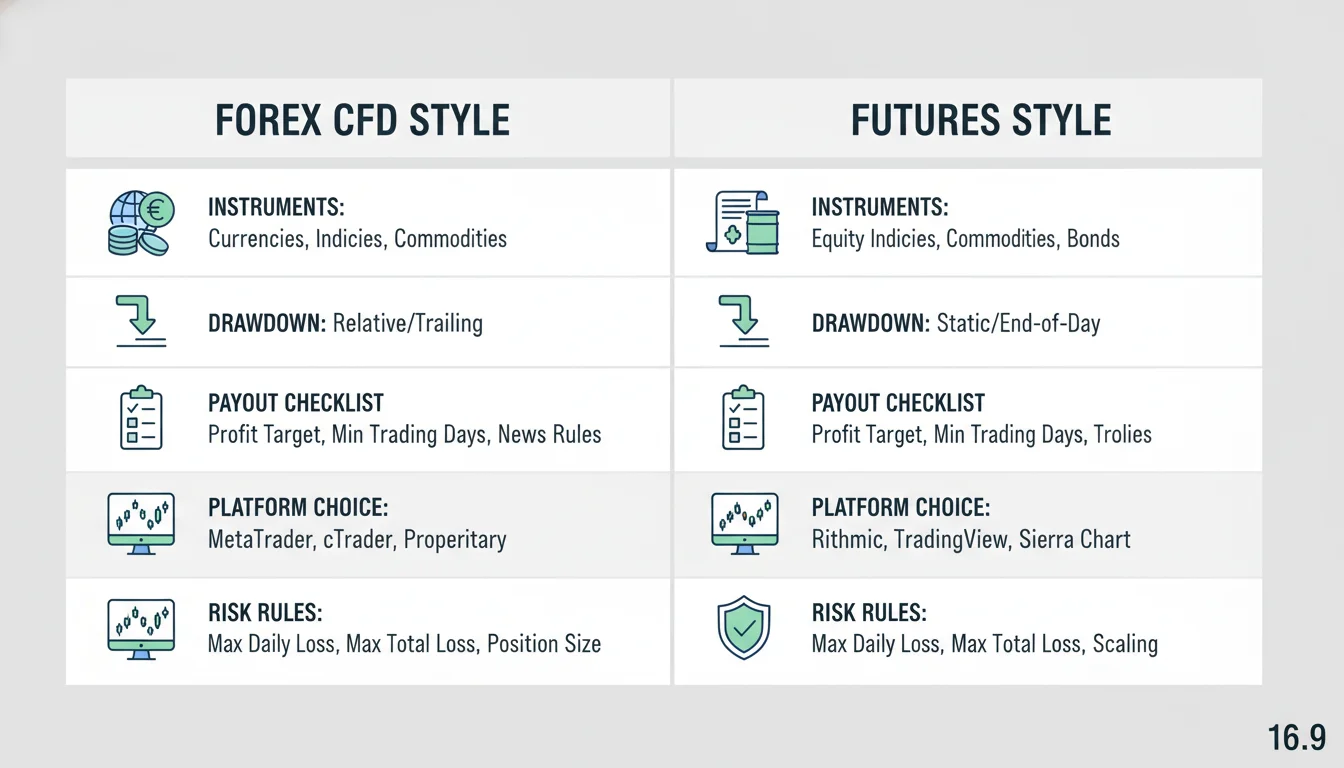
Drawdown rules compared
Blueberry Funded’s drawdown model is mostly percentage-based. In the 1-Step Challenge, the official guide lists 4% max daily drawdown and 6% max total drawdown. In the 2-Step Challenge, it lists 5% max daily drawdown and 10% max total drawdown. Both guides describe static max drawdown. The daily drawdown calculation uses the higher of end-of-day equity or balance.
That static maximum loss structure can be easier to understand for traders who think in percentages. On a 2-Step account, the official guide’s own example says a $100,000 account has a $90,000 maximum loss floor. Profits do not move that total drawdown floor upward.
Apex’s EOD drawdown works differently. Apex says EOD drawdown is calculated once per trading day at market close based on the EOD balance, then enforced in real time during the next trading session. Apex also says the EOD threshold moves up after a new EOD balance high and never moves down after losing days. If the EOD threshold is touched, the evaluation fails or the PA closes.
Apex also separates EOD drawdown from the Daily Loss Limit. Apex says DLL controls how much an account can lose in one trading day, is monitored intraday, and pauses trading for the rest of the session if reached. Apex’s Daily Loss Limit guide says hitting DLL does not fail the account by itself, while hitting the EOD threshold does.
If your strategy uses multiple intraday entries and sometimes recovers after early losses, Apex’s DLL can end the session before your EOD drawdown is hit. If your strategy depends on wide CFD swings, Blueberry’s percentage-based rules may be more intuitive, but the daily drawdown and funded risk-per-trade rules still need constant attention.
Payout rules compared
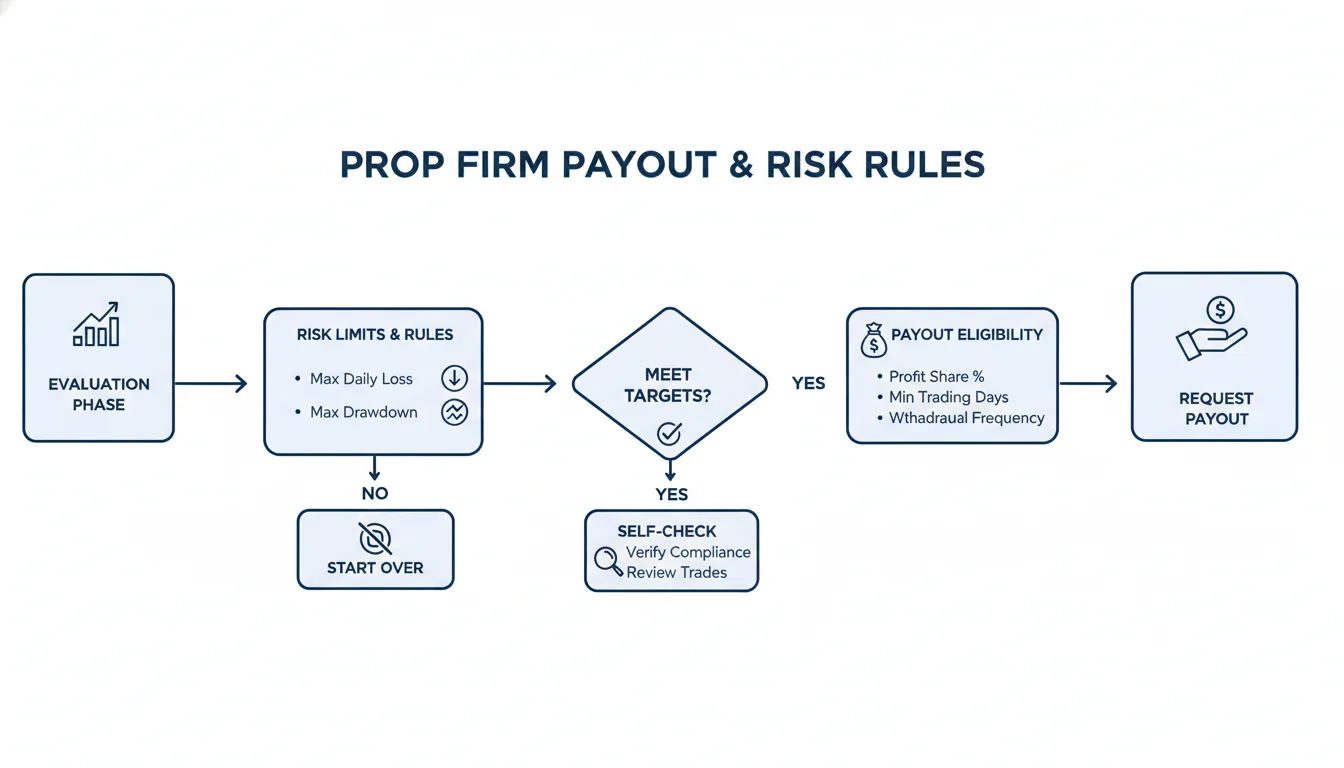
Blueberry Funded’s official 1-Step and 2-Step guides list an 80% profit split in the funded account stage, a $100 realized profit minimum to request a payout, and 3 active trading days per payout cycle. The 2-Step guide lists payouts every 14 days and says a 7-Day Payout Add-On or On-Demand Payout Add-On can change that timing. The Instant Access Sim guide lists 80% profit split and 5 active trading days.
Apex’s official EOD Payouts guide lists up to weekly payouts, a 100% payout split on approved payouts, 5 qualifying trading days, a $500 minimum payout amount, a 50% consistency rule, and a maximum of 6 payouts per Performance Account. It also lists account-size minimum daily profit requirements and minimum balances to request a payout.
That makes Apex more exacting around payout eligibility. For example, the EOD Payouts guide says qualifying days need minimum profit amounts tied to account size. It also says no single profitable trading day may account for 50% or more of total profit earned since the last approved payout. If the account is above that threshold, the payout request option is not available until the ratio improves.
For traders who care most about fast withdrawal mechanics, read BestProps’ broader guide to the best prop firm for fast payout preference and the guide to hidden consistency rules that cause prop firm payout denials. Those articles are useful because payout access is often more about eligibility math than headline split percentage.
Instruments, platform, and access fit
The biggest practical difference is product type. Blueberry Funded may be the better fit if your strategy is built around forex and CFD-style trading. Its rules use account leverage, percentage drawdown, and account sizes that look familiar to many FX and CFD traders.
Apex may be the better fit if you trade futures contracts. The Apex EOD Evaluation guide lists max contracts by account size, with 4 contracts on 25K, 6 on 50K, 8 on 100K, and 12 on 150K during evaluation. The EOD PA guide lists lower starting max contracts in PAs, then tier-based scaling.
This matters because sizing behavior does not transfer cleanly. A trader who is used to lot sizing, account leverage, and percentage drawdown may need time to adapt to contract caps, DLL pauses, EOD thresholds, and futures session behavior. A futures trader who is used to ES, NQ, CL, GC, or similar contracts may find Blueberry’s CFD-style account rules less natural.
Access can also decide the comparison before rules do. Apex has an official restricted-countries page and futures platform requirements. Blueberry’s availability can depend on its own onboarding, country rules, payment acceptance, and platform access. This article does not determine eligibility for you. Confirm that you can open, verify, fund, and trade the exact account type before comparing payout terms.
Rule friction and trader behavior
Blueberry’s current guides distinguish accounts by purchase date. For accounts bought on or after March 12, 2026, its prohibited-strategies policy no longer lists excessive scalping, grid trading, position stacking, or one-sided betting as prohibited, while latency arbitrage, external hedging, HFT, and tick scalping remain prohibited. Copying between your own Blueberry accounts remains permitted, and funded accounts covered by the newer rules use the 1.5% risk-per-trade-idea limit. Accounts bought before March 12 keep the earlier rule set, so the purchase date matters. The named program guide still controls news, inactivity, and payout-cycle conditions.
Apex’s prohibited activities page is broader. It prohibits account sharing, bad-faith disputes, false documents, identity masking, abusive use of services, trading without stop losses or risk management, certain high-risk strategies, using the trailing threshold as a stop loss, stockpiling evaluations, unsustainable strategies, simulation manipulation, account and resource sharing, multiple account creation, holding open positions through market close, automation or algorithm usage, non-directional news gambling, hedging, HFT, and other exploitative simulation strategies.
That list matters. Apex is not just asking whether you hit the target. It is also judging whether the trading style fits its risk and conduct rules. Blueberry has strict rules too, but the official challenge tables are easier to scan because the core restrictions are expressed directly in the plan parameters.
Which firm fits which trading style
Consider Blueberry Funded if your edge is built around percentage risk, FX pairs, indices, metals, crypto CFDs, or a trading platform setup that maps cleanly to those products. It may also fit traders who prefer static max drawdown on 1-Step or 2-Step accounts and want the reviewed Blueberry funded split without Apex-style payout consistency math.
Consider Apex Trader Funding if your edge is built around futures contracts and you already manage trades around session resets, contract counts, and hard daily loss controls. Apex may fit traders who want to operate multiple PAs, understand EOD drawdown, and can keep payout days consistent enough to satisfy the 50% rule.
Avoid choosing either firm based only on the largest advertised account size, the biggest discount, or a social media payout screenshot. The better test is whether your normal strategy can pass the evaluation and remain eligible for payouts without changing into a riskier version of itself.
This visual summarizes the article’s existing decision checks; it is not official Blueberry Funded or Apex Trader Funding documentation.
Decision checklist
Use this checklist before buying either evaluation or simulated account access.
- Can you explain the exact drawdown rule without looking at the sales page?
- Does your strategy fit the product type, either forex and CFDs for Blueberry or futures for Apex?
- Do your normal losing days stay below the daily loss rule?
- Can you meet payout trading day requirements without forcing trades?
- Can your best winning day stay below any consistency threshold that applies?
- Are you comfortable with the firm’s copy trading, hedging, automation, and news rules?
- Does your strategy trigger scalping, HFT, automation, hedging, market-close, or news-trading restrictions?
- Are you eligible to buy, verify, and trade the account from your country and preferred platform?
- Have you verified current checkout fees, resets, activation fees, subscriptions, add-ons, and discounts from the live official checkout?
- Have you read the current help-center page for your exact account type, not just a comparison article?
For a broader cost framework, use BestProps’ guide to how much funded trading programs cost. It explains why evaluation price, reset behavior, add-ons, and payout access should be considered together.
Current checkout fee verification
Current checkout pricing and promotions can change. Compare the exact Blueberry and Apex products in their live official checkout flows, including evaluation access, activation, data, add-ons, taxes, and any account-specific charges. This comparison does not preserve a temporary sale price as a durable fact.
Before you buy, verify the current official checkout pages for both firms and update this section with only primary-source facts. Do not rely on coupon pages, social posts, old screenshots, or third-party tables for current fees. If pricing cannot be verified cleanly, keep this section as a note telling readers to confirm live checkout pricing before buying.
FAQ
Is Blueberry Funded better than Apex Trader Funding?
Neither is automatically better. Blueberry Funded is usually the more natural fit for forex and CFD-style traders who want percentage-based account rules. Apex Trader Funding is usually the more natural fit for futures traders who understand contract