TL;DR: Prop firm payout denials stem from consistency rule violations (Apex’s 30% single-day profit cap, Topstep’s 5 winning days at $150 minimum), prohibited “gambling” strategies (FundedNext’s 70% margin ceiling), IP address flags, or retroactively enforced rules. Topstep requires 5 $150+ winning days; Apex forbids any single day exceeding 30% of total profit; FTMO enforces 1% risk per “trade idea” and monitors for identical strategies; FundedNext bans 70%+ margin utilization. Combat denials by documenting all trades, requesting formal written explanations, escalating to compliance officers, and filing disputes with The Prop Association (TPA) for independent arbitration. Preventive measures include standardizing device/IP usage, using hard stop losses, maintaining 1-2% per-trade risk limits, requesting early small payouts, and diversifying across multiple firms. Legal recourse exists through local regulatory authorities (Czech Trade Inspection Authority for FTMO) and public platforms.
For retail traders evaluating proprietary trading firms, the prospect of trading large amounts of institutional capital is highly attractive. However, the operational reality of this industry is complex. The proprietary trading sector operates with significant regulatory gray areas, meaning the relationship between a firm and a trader is governed almost entirely by private Terms of Service agreements. When disputes arise, specifically when a prop firm payout denied scenario occurs, traders often find themselves stuck in a labyrinth of ambiguous rules, automated risk management flags, and unresponsive customer support channels.
This guide provides an expert-level analysis of the structural reasons why prop firms deny payouts, firm-by-firm comparative data, actionable risk management advice, and a step-by-step dispute resolution process.
The Reality of Having a Prop Firm Payout Denied
The business model of retail proprietary trading firms relies heavily on evaluation fees. While top-tier firms do pay out successful traders, they also enforce strict risk management parameters to protect their simulated or live capital. Unfortunately, this framework can sometimes be weaponized. In recent years, an increasing number of profitable traders have reported having a prop firm payout denied due to alleged rule violations that were either poorly defined or retroactively enforced.
Understanding the mechanisms behind these denials is paramount for any retail trader. A denied payout is not just a loss of anticipated income; it represents a loss of time, emotional capital, and the initial evaluation fee. By identifying the common pitfalls and understanding the specific contractual obligations of major firms, traders can optimize their strategies to ensure compliance and protect their earnings.
Common Reasons Prop Firms Deny Payouts
When a prop firm denies your payout, the justification typically falls into one of several distinct categories. Understanding these categories is the first step in preventative risk management.
Consistency Rule Violations
Consistency rules are designed to ensure that a trader’s profitability is the result of a replicable strategy rather than a single lucky trade. However, they are frequently cited in payout denials. For example, a firm might stipulate that no single trading day can account for more than 30% of your total profit. If a trader catches a massive trend or a “runner” that generates a windfall, they may inadvertently breach this threshold. If the trader requests a payout while their highest-earning day exceeds this percentage, the payout is typically denied until further trading dilutes the percentage.
Prohibited Strategy Enforcement (The “Gambling” Clause)
Many firms include clauses that prohibit “gambling” or “exploitative” strategies. This is one of the most subjective and heavily debated rules in the industry. Activities categorized under this umbrella often include:
- One-Sided Betting: Blindly holding positions in a single direction without market structure analysis, or aggressively scaling into a losing position.
- Grid Trading and Tick Scalping: High-frequency strategies that exploit simulated feed latency rather than live market mechanics.
- Margin Utilization: Using an excessive percentage of available margin (for example, above 70%) on a single trade, which firms interpret as reckless over-leveraging.
News Trading Violations
While some firms allow news trading, many prohibit executing trades within a specific window (for example, 2 minutes before and after) of high-impact macroeconomic releases (like Non-Farm Payrolls or CPI data). Straddling the market by placing buy and sell stop orders simultaneously to catch the news spike is almost universally banned and will trigger an automatic payout rejection.
KYC and IP Address Issues
Know Your Customer (KYC) compliance is mandatory for anti-money laundering (AML) regulations. However, some firms have used IP address flags to deny payouts, accusing traders of utilizing account management services, copy trading across forbidden accounts, or sharing devices. For instance, logging into a funded account from a smartphone, a laptop, a tablet, and a work computer across different geographic locations can trigger an automated flag for unauthorized account sharing.
Rule Ambiguity and Retroactive Enforcement
The most frustrating scenario for retail traders is the retroactive application of hidden rules. Traders have reported instances where a firm introduced a new risk parameter (such as a strict 1% risk limit per “trade idea”) and applied it to past trades to justify a payout denial. Vague terms give firms unlimited discretion; if a firm lacks the cash flow to honor a payout, they may exploit broad clauses to indefinitely delay or deny the withdrawal.
Firm-by-Firm Comparison of Payout Pitfalls
To effectively assess the prop firm industry, traders must understand the specific rules enforced by individual companies. Below is a detailed comparison of major firms and the specific rules that commonly lead to a prop firm payout denied status.
Prop Firm Payout Rule Comparison Table
| Prop Firm | Primary Payout Hurdle | Specific Metrics & Constraints |
|---|---|---|
| Topstep | 5 Winning Days Rule | Traders must accumulate 5 winning days of $150+ net P&L to request a standard payout. The 40% consistency path requires 3 days. |
| Apex Trader Funding | 30% Consistency & Negative P&L | No single day can exceed 30% of total profit. Traders also face a 30% negative P&L (MAE) limit, restricting intraday drawdowns. See our detailed guide on drawdown rules for more context. |
| FTMO | Trade Idea Risk Limits & IP Flags | Recent enforcement of a 1% max risk per “trade idea” (grouping trades taken within a short window). Prohibits identical strategies across traders. Learn more in our FTMO payout trust profile. |
| FundedNext | 70% Margin & “Gambling” Limits | Prohibits utilizing more than 70% of available margin. Flags all-in-one trades and cross-account copy trading. |
| Funding Pips | “Trading, Not Gambling” Policy | Shifted from a strict zero-denial policy to enforcing bans on reckless trading, citing the need for capital preservation. |
Deep Dive: Specific Firm Examples
FTMO: FTMO is widely considered an industry standard, but it has recently faced backlash over payout denials related to its interpretation of risk management. A trader with a $100k account reported a payout denial after risking 0.9% on two trades and entering another trade 37 minutes later. FTMO grouped these as a single “trade idea” exceeding the 1% threshold, a rule traders claim was enforced retroactively. Furthermore, FTMO strictly monitors copy trading; if your support and resistance strategy perfectly mirrors another trader on their platform, you risk an account breach. Check our FTMO payout trust profile for processing details and verification standards.
Topstep: Topstep offers a structured path, but its payout policy requires strict adherence to daily P&L metrics. To request a standard Express Funded Account payout, a trader must log 5 winning days with a net P&L of at least $150 per day. If a trader violates the maximum loss limit, the account is closed. Topstep has also been known to deny payouts and close accounts if their automated systems detect hedging.
Apex Trader Funding: Apex is known for allowing traders to hold up to 20 funded accounts, but their consistency rules are highly restrictive. The 30% consistency rule mandates that no single day can make up more than 30% of your total requested profit. If a trader has a massive windfall day, they must continue trading smaller sizes until that day constitutes less than 30% of the total balance. Additionally, they enforce a 50% contract scaling rule, forbidding traders from utilizing maximum allowed contracts until they have traded past the buffer zone.
FundedNext: FundedNext has a robust list of prohibited strategies. They explicitly ban “gambling behavior,” which they define as utilizing 70% or more of available margin, overleveraging, or risking close to the daily loss limit on a single trade. Some traders have alleged that FundedNext allowed these strategies while profits were small, only to deny payouts and enforce the margin rules once profits scaled to larger, five-figure amounts.
Funding Pips: Historically, Funding Pips marketed a “Zero Payout Denial Policy.” However, the firm recently updated its stance to combat what it deems “unprofessional trading behaviors” and “gambling.” Traders who abuse the master accounts with reckless, high-risk strategies now face payout denials, as the firm prioritizes capital management and profit preservation over guaranteed payouts.
Red Flags to Watch For
Before you ever reach the withdrawal stage, there are critical warning signs that a firm may lack the capital or integrity to honor your earnings. Recognizing these red flags can save you from a prop firm payout denied scenario.
- Repeated Delays and Vague Excuses: If a firm states payouts take 1-3 business days, but you are met with responses like “we are experiencing high volume” or “your account is under routine compliance review” for weeks, this often signals a cash flow problem.
- Sudden Rule Changes: If a firm alters its Terms of Service, introduces new risk parameters, or adjusts its consistency rules after you have passed the evaluation phase, they are likely attempting to weed out profitable traders.
- Hostile or Unresponsive Customer Support: A firm’s support quality reflects its operational health. If support tickets are ignored or met with automated, unhelpful responses regarding payout criteria, the firm is utilizing poor support as a barrier to capital extraction.
- Inconsistent Payout Certificates: Some lesser-known firms have resorted to issuing “payout certificates” acknowledging a trader’s profit, but delaying the actual wire transfer of real monetary funds indefinitely.
Step-by-Step Dispute Resolution Process
If you find yourself facing a payout denial, reacting emotionally will only harm your case. Prop firms operate strictly on data and contractual terms. To fight a denial, you must escalate the issue methodically.
Request a Formal Explanation
Do not accept a generic “Rule Violation” email. Reply to support and demand a specific, granular breakdown of the denial. Ask for the exact timestamp of the trade in question, the specific clause in the Terms of Service that was violated, and the mathematical formula they used to determine the breach.
Compile Your Documentation
Prop firms will use data against you; you must use data to defend yourself. Gather the following documentation:
- Complete MT4, MT5, or cTrader HTML statements showing all executed trades.
- Screenshots of your trading dashboard prior to the denial.
- A written summary of your trading strategy to prove it does not rely on latency arbitrage or prohibited “gambling.”
- Screenshots of all email and live chat correspondence with customer support.
Escalate to a Manager or Compliance Officer
Tier-1 customer support agents usually do not have the authority to overturn a denied payout. Request that your ticket be escalated to the firm’s compliance department or risk management team. Present your documented evidence calmly, demonstrating that you remained within the parameters of their publicly stated rules.
Utilize Third-Party Dispute Resolution (The Prop Association)
If internal escalation fails, the prop trading industry has recently developed self-regulatory bodies. The Prop Association (TPA) offers an independent External Dispute Resolution (EDR) mechanism. TPA provides non-binding arbitration by experts with regulatory backgrounds. Traders can register for a free account, file a complaint, and upload their documentation to initiate a formal review of the firm’s decision. While non-binding, firms that are members of TPA face immense public pressure to abide by the committee’s rulings.
Consider Legal and Regulatory Action
If the firm is based in a jurisdiction with strong consumer protection laws, you can file a complaint with local authorities. For example, traders dealing with FTMO (based in the Czech Republic) have reported escalating disputes to the Czech Trade Inspection Authority (CTIA). As a last resort, public exposure on platforms like Trustpilot, Reddit, and Twitter can sometimes force a firm’s hand, as they are highly protective of their marketing reputation.
How to Protect Yourself Before Requesting Withdrawals
The best defense against a denied payout is proactive risk management and careful adherence to the firm’s unique operational quirks. Implement the following preventive measures to safeguard your earnings.
Read the Fine Print and Master the Consistency Rules
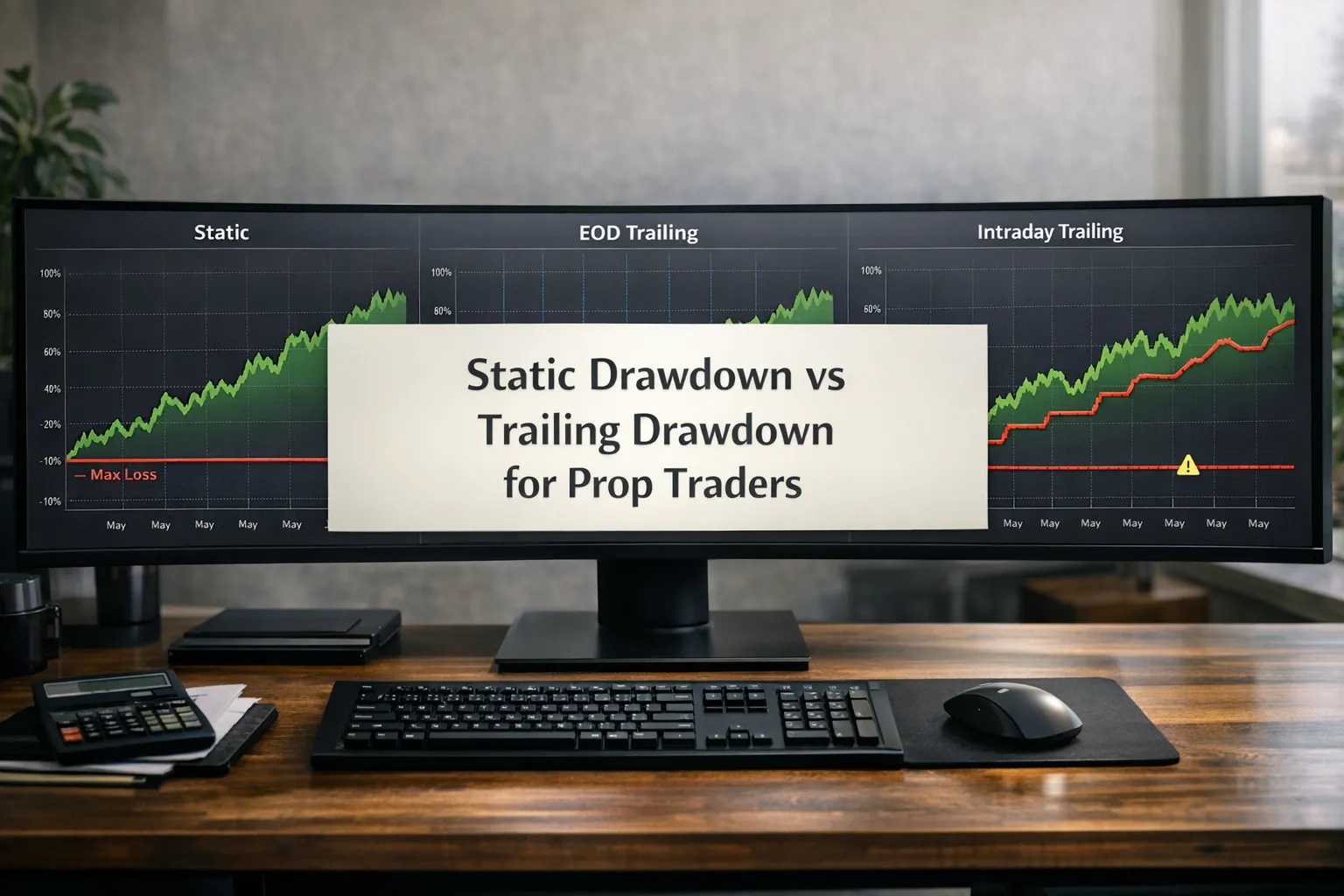
Never assume that a “No Minimum Trading Days” marketing slogan means there are no consistency rules. Calculate your own 30% rule limits manually. If you are trading with Apex, for instance, track your daily P&L closely. If you have a windfall day that exceeds 30% of your total profit, do not request a payout immediately. Instead, trade minimal sizes for a few additional days to dilute the percentage and bring your account into compliance. For detailed guidance on static versus trailing drawdown rules, see our comparison guide.
Standardize Your IP and Device Usage
Firms log every IP address and MAC address that accesses their servers. To avoid automated flags for account management or sharing:
- Trade from a single, dedicated device (for example, your primary laptop).
- Avoid logging in from public Wi-Fi networks, VPNs, or VPS services unless explicitly permitted by the firm.
- Do not cycle between your phone, tablet, and computer multiple times a day.
Avoid the “Gambling” Label
To prevent the firm’s risk team from labeling your trading as gambling:
- Always use hard stop losses.
- Do not risk more than 1% to 2% of your account balance on a single setup, even if the firm’s maximum daily loss limit is 5%.
- Avoid “Dollar Cost Averaging” (DCA) into losing positions aggressively, as many firms view this as a margin-abusive strategy.
- If your account is in drawdown, do not “All-In” to quickly recover the losses.
Test the Waters with Small Payouts
Do not let your profits compound indefinitely within the prop firm ecosystem. The larger your withdrawal request, the more scrutiny your account will face. Request a payout as soon as you meet the minimum eligibility criteria (for example, after the 5th winning day on Topstep). Extracting small, consistent payouts proves that the firm is solvent and validates your trading style against their compliance algorithms. Learn more about daily on-demand payout options to understand which firms offer flexible withdrawal schedules.
Diversify Your Firm Exposure
Never keep all your funded capital with a single firm. If your goal is to trade $400,000 in capital, pass challenges across four different $100,000 firms. If one firm abruptly shuts down or denies a payout due to a technicality, your income stream is protected by your other accounts. Explore the best futures prop firms to find firms that complement your trading style.
Conclusion
The proprietary trading industry offers immense upside, but it requires traders to be as disciplined in their legal and administrative compliance as they are in their technical analysis. A “prop firm payout denied” notification is a harsh reality of this space, often resulting from misunderstood consistency rules, automated risk flags, or subjective interpretations of strategy.
By choosing reputable firms, documenting your trading activity, understanding the exact parameters of payout eligibility (such as Topstep’s $150 winning day rule or Apex’s 30% consistency rule), and knowing how to use bodies like The Prop Association, you can drastically reduce your risk. Treat your prop firm accounts as temporary scaling tools, extract your capital regularly, and transition those profits into your own personal brokerage accounts to secure true financial independence. For traders ready to transition to live trading, explore our demo-to-live guide for best practices on scaling your account.
Frequently Asked Questions
Can a prop firm deny my payout for no reason?
Legally, prop firms rely on their Terms of Service to deny payouts. While it may feel like it is “for no reason,” they will always cite a specific clause (often vague ones like “gambling,” “improper risk management,” or “latency abuse”). This is why thoroughly reading the fine print is vital.
What is a consistency rule, and why does it cause payout denials?
A consistency rule ensures that your total profit isn’t derived from one lucky trade. For example, Apex Trader Funding requires that no single trading day accounts for more than 30% of your total requested profit. If you make $10,000 total, but $4,000 was made on a single Tuesday, you violate the 30% rule and your payout will be denied until you trade more days to balance the ratio.
Does The Prop Association (TPA) actually help recover denied payouts?
TPA provides a structured, non-binding arbitration process for disputes. While they cannot legally force a firm to release funds, member firms are highly incentivized to comply with TPA rulings to maintain their industry certification and public trust. It is currently one of the strongest advocacy tools available to retail traders.
Why do firms care if I use multiple devices to trade?
Firms actively monitor for “account sharing” or “pass-your-challenge” services. If you log in from a laptop in New York, and an hour later your account is accessed from a smartphone on a different IP address, the firm’s security algorithm may flag the account for unauthorized third-party management, leading to a payout denial.
How do I avoid being flagged for “gambling” by firms like FundedNext?
To avoid the gambling label, maintain strict risk management. Do not use more than 20% to 30% of your margin at any given time (FundedNext explicitly bans utilizing 70% or more). Avoid risking large percentages of your account on a single trade, use stop losses, and do not hold massive positions through high-impact news events.