Key takeaways
Futures gaps form when an asset’s price jumps between the close and open of an exchange session, creating a visible void on candlestick charts.
Read the full summary
Futures gaps form when an asset’s price jumps between the close and open of an exchange session, creating a visible void on candlestick charts. CME Bitcoin futures gaps fill roughly 77% of the time, with gaps under $500 filling at 85% within 1-2 weeks and gaps under $700 filling at 92% within 30 trading days. Four gap types exist (common, breakaway, runaway, exhaustion), each requiring different trading strategies. Common and exhaustion gaps fill with high probability while breakaway and runaway gaps often stay open for months. Prop firm drawdown type matters for gap trading because intraday trailing drawdowns (used by Apex Trader Funding) can stop you out during normal retracements, while End-of-Day (EOD) drawdowns (used by Tradeify and Topstep) give gap trades room to develop. Tradeify Select offers a $50K account with a $2,500 profit target, $2,000 EOD trailing drawdown, 4 minis or 40 micros, 3-day minimum, 40% consistency rule on eval only, $0 activation fees, 90% profit split, and Elite Accelerator Reward Pools worth $4,000-$12,000 per live account.
The Reality of Trading Futures Gaps

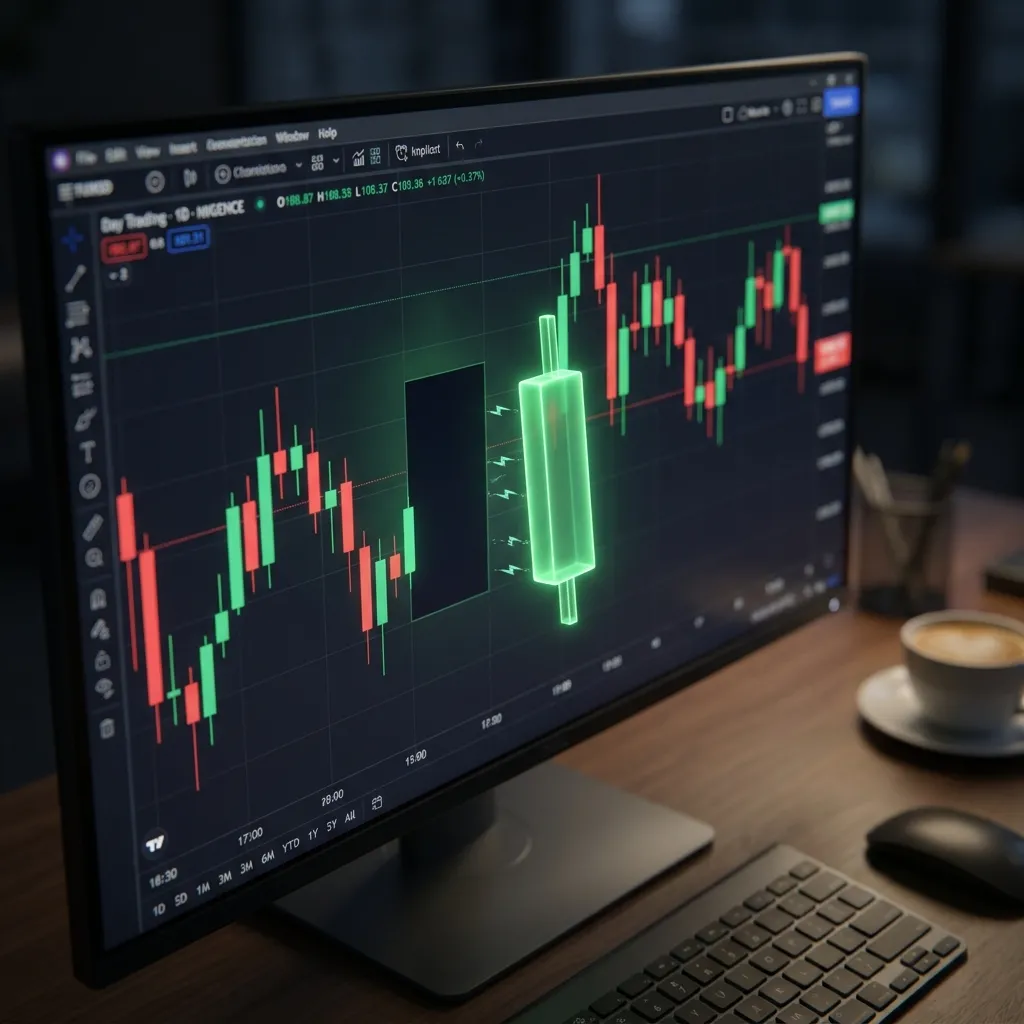
You are staring at your charts on a Sunday evening. The market has been closed since Friday afternoon. You have your coffee ready, your trading platform open, and you are waiting for the bell to ring. Suddenly, the market opens, and the price jumps $700 higher than where it closed on Friday. You are looking at a massive blank space on your candlestick chart.
You just spotted a futures gap.
For retail traders, gaps can look like terrifying chart anomalies. For professional futures traders, gaps look like pure opportunity. Gaps represent a dislocation in price, an area where supply and demand became so imbalanced during off-hours that the market had to leap to a new price level just to find equilibrium.
If you are trading futures markets (whether you are scalping the E-mini S&P 500, swinging crude oil, or handling the wild swings of Bitcoin futures) you have to understand how gaps form and what causes gaps in the first place. More importantly, you need to know how to trade them. Trading gaps requires capital, conviction, and a proprietary trading firm that gives your trades room to breathe.
In this guide, we are breaking down everything you need to know about futures gaps. We will cover the mechanics of how they form, the statistics behind why they fill, and how you can use a prop firm like Tradeify to turn these chart anomalies into consistent payouts.
What Futures Gaps Are and How They Work

A gap in trading is simply a break or space between two trading periods where no trading activity took place on that specific exchange. It happens when an asset opens at a significantly different price level than its previous closing price.
To understand why gaps happen in the futures markets, you have to understand the clock.
Traditional financial markets operate on strict schedules. The Chicago Mercantile Exchange (CME), which hosts the most heavily traded futures contracts in the world, is not open 24/7. Generally, CME futures start trading every Sunday at 5:00 PM Central Time (CT) and close the following Friday at 4:00 PM CT. During the week, there is a daily 60-minute maintenance break from 4:00 PM to 5:00 PM CT.
A lot can happen while the CME is closed.
Geopolitical events occur. Earnings reports drop. Weekend news breaks. Cryptocurrency spot markets continue to trade aggressively. When the CME finally reopens, the price must immediately adjust to account for all the new information and trading activity that occurred globally while its doors were shut.
If the new fair market value is vastly different from the Friday closing price, the opening print will jump. That jump creates a visible blank space on your candlestick chart. That is your futures gap.
The Four Main Types of Futures Gaps

Not all gaps are created equal. If you try to trade every single gap the exact same way, you are going to destroy your account. Before you risk a single dollar of prop firm capital, you must be able to classify the gap you are looking at.
Market technicians categorize gaps into four distinct types.
Common Futures Gaps
Common gaps are exactly what they sound like: common and largely uneventful. They frequently appear in range-bound futures markets or during periods of very low trading volume.
A common gap might form when a stock goes ex-dividend, or when there is a minor overnight price fluctuation that does not fundamentally alter the market’s structure. These gaps are also referred to as “trading gaps” or “area gaps.”
Here is the most important thing to know about common gaps: they almost always get filled, and they usually get filled quickly. Because they do not represent a major shift in market sentiment, the price action tends to drift back and cover the empty space within a few hours or a few days. If you are a day trader using a $50,000 Tradeify account, fading a common gap for a quick scalp is a bread-and-butter setup.
Breakaway Futures Gaps
Breakaway gaps are the ones that destroy amateur traders.
A breakaway gap occurs when the price violently jumps over a major support or resistance level. This is not a random weekend fluctuation. This is a massive shift in market psychology, usually triggered by a major news event, a surprise economic data release, or heavy institutional volume stepping into the futures markets.
When a breakaway gap forms, it signals the start of a brand new trend. The gap point itself instantly turns into a new structural support or resistance level.
Do breakaway gaps get filled? Usually, no. The breakaway gap is the one type of gap that typically does not get filled immediately. The price trades aggressively away from the gap. The larger the breakaway gap, and the stronger the subsequent trading volume, the more violent the new trend will be. If you try to fade a breakaway gap expecting a quick fill, you will likely hit your maximum loss limit and fail your prop firm evaluation.
Runaway Futures Gaps
Runaway gaps, also known as continuation or measuring gaps, happen right in the middle of an established, powerful trend.
Imagine the Nasdaq is in a massive, multi-week uptrend. Buyers are in total control. Suddenly, overnight, positive economic news hits. When the futures market opens, the price gaps up yet again, accelerating in the direction of the underlying trend. That is a runaway gap.
Runaway gaps confirm that the current trend has incredible strength and that institutional volume is still aggressively pushing the market. Trying to trade a gap fill on a runaway gap is incredibly high-risk and should be avoided. Instead, smart traders use runaway gaps as confirmation to add to their winning positions or to enter trend-following trades.
Exhaustion Futures Gaps
Exhaustion gaps are the final gasp of a dying trend.
These gaps occur at the very end of a massive directional move, often near extreme support or resistance levels. After weeks of buying, the last remaining retail traders finally give in to the FOMO (Fear Of Missing Out) and buy aggressively at the open, causing the price to gap up.
However, the “smart money” uses this sudden spike in liquidity to unload their positions. You will often see an exhaustion gap form, immediately followed by a Doji candle or a pinbar, signaling massive rejection. The trend stalls. Shortly after, the price reverses entirely.
Exhaustion gaps almost always get filled, and they serve as an incredible warning sign that a massive market reversal is imminent.
The CME Bitcoin Futures Gap Phenomenon

If you want to see gap theory play out in real-time with massive volatility, you need to look at Bitcoin futures. The “CME Bitcoin Gap” has become one of the most famous and highly debated technical phenomena in modern trading.
Bitcoin is a unique asset because the underlying spot market operates 24 hours a day, 7 days a week, 365 days a year. Crypto exchanges never close. However, institutional investors trade Bitcoin through traditional futures contracts on the CME.
As established earlier, the CME closes on Friday at 4:00 PM CT and does not reopen until Sunday at 5:00 PM CT. During that 49-hour weekend window, the Bitcoin spot price can move thousands of dollars. When the CME finally boots up its matching engines on Sunday evening, the futures price has to instantly teleport to match the current spot price.
This creates massive, highly visible gaps on the CME Bitcoin futures chart.
CME Bitcoin Futures Gap Fill Statistics
Traders obsess over CME Bitcoin gaps because they represent highly actionable trading targets. The “Gap-Filling” theory suggests that Bitcoin has a magnetic tendency to eventually return to the exact price level where the gap formed.
Is this a myth, or is it statistical reality? The numbers speak for themselves.
Data tracking all CME Bitcoin futures gaps from 2018 through 2026 reveals that approximately 77% of all CME Bitcoin gaps eventually get filled. That means the price eventually retraces to cover the empty space left on the chart.
However, gap size matters enormously for fill speed.
- Gaps under $500: These are incredibly high-probability setups. Data shows an 85% fill rate, typically closing within 1 to 2 weeks. Normal market volatility easily covers this distance.
- Gaps under $700: These represent the sweet spot for swing traders. Between 2020 and 2025, gaps under $700 filled at an astonishing 92% rate within 30 trading days.
- Gaps over $2,000: These are much lower probability. Massive gaps usually form during extreme trending markets (like the October 2025 rally to $126,000) and can remain open for months, or potentially never fill at all. The remaining 23% of gaps that do not fill quickly fall into this category.
Real-World Example of a CME Futures Gap
Consider the market action from March 2026. The CME Bitcoin futures closed on Friday afternoon near $67,000. Over the weekend, the spot market slowly drifted downward. By Sunday morning, the spot price was hovering around $66,500.
When the CME reopened on Sunday at 5:00 PM CT, it opened at the new spot price. This created a highly visible $500 gap down. Because this was a small gap (under $500), professional traders instantly knew there was an 85% statistical probability that Bitcoin would eventually rally back up to $67,000 to fill that empty space.
Alternatively, consider the massive $730 gap that formed in March 2025. This gap represented roughly 1% of Bitcoin’s price at the time and immediately caught the attention of global trading desks. Institutional traders used this exact gap to assess their weekend risk exposure and adjust their hedging strategies for the upcoming week.
Even more extreme are the massive structural gaps that form during bear markets. In late 2024, crypto analysts actively monitored a massive unfilled CME gap sitting between $77,000 and $80,000. Analysts noted that a standard 25% market correction from cycle highs could easily drag the price back down to the $77,000 level specifically to fill this historic liquidity void.
Why Futures Gaps Get Filled
If 77% of Bitcoin gaps and a massive majority of common equity gaps get filled, we have to ask the obvious question: why does this happen? Is it magic? Is it coincidence?
No. It is market mechanics, liquidity, and human psychology.
The Liquidity Vacuum Behind Futures Gaps
During off-hours and weekends, market liquidity is extremely thin. When you trade on a Sunday morning on a crypto spot exchange, there are far fewer buyers and sellers than on a Tuesday afternoon. Because the order books are thin, it takes less capital to move the price significantly.
When Monday morning rolls around and heavy institutional liquidity returns to the market, the weekend price action is often deemed illegitimate or overextended. The heavy institutional volume easily pushes the price back toward Friday’s closing levels to restore balance and true price discovery.
Algorithmic Trading and Futures Gap Fills
We trade in the era of the machines. Institutional trading algorithms are specifically programmed to identify price dislocations and trade toward equilibrium.
A futures gap is a textbook price dislocation. When a gap forms, the density of algorithmic trading in assets like Bitcoin and the S&P 500 means automated systems start firing orders almost immediately. These algos know the statistics. They know the probabilities. They systematically execute trades designed to push the price back into the gap to capture the spread.
Self-Fulfilling Expectations in Futures Gap Trading
Finally, gaps fill because everyone expects them to fill.
Trading is largely a game of mass psychology. Because so many traders (both retail and institutional) know about the 77% fill rate, they actively set their limit orders right at the edges of the gap. This massive concentration of order flow creates real, physical support and resistance exactly where the gap sits.
If thousands of traders are buying a dip specifically because they expect it to rally and fill a gap above, that exact buying pressure is what causes the rally to happen. It is a self-fulfilling prophecy executed by the market order book.
Trading Futures Gaps Using Prop Firm Capital

Now that you understand what gaps are and why they form, we need to talk about execution.
Trading gap fills is a highly profitable strategy, but it requires enduring volatility. When a market opens with a gap, the first hour of trading is usually chaotic. The price might push aggressively in the wrong direction before finally reversing to fill the gap.
If you are trading with your own personal capital, a $1,000 drawdown while waiting for a gap to fill might induce panic. This is why smart traders use proprietary trading firms. Prop firms give you access to simulated capital (anywhere from $25,000 to $150,000) allowing you to trade larger position sizes without risking your personal savings. Some firms even offer instant funding with no evaluation required.
However, choosing the right prop firm is a matter of life and death for a gap trader. You must understand the difference between End-of-Day (EOD) trailing drawdowns and Intraday trailing drawdowns. Risk management, including setting stop-loss orders, is crucial when trading futures gaps with prop firm capital.
The Intraday Trailing Drawdown Trap for Futures Gap Traders
Many popular prop firms, like Apex Trader Funding, utilize an Intraday Trailing Drawdown.
With an intraday trailing drawdown, your maximum loss limit trails your highest open equity in real-time, tick-by-tick. If you enter a gap-fill trade and the price spikes $1,500 in your favor, your drawdown floor instantly moves up by $1,500.
If the market then pulls back $1,000 (a perfectly normal retracement in a volatile morning session) you could breach your trailing drawdown and lose your funded account, even if the trade ultimately goes on to hit your profit target and fill the gap. Intraday trailing drawdowns punish traders for making money and offer zero breathing room for normal price action.
The End-of-Day (EOD) Drawdown Advantage for Futures Gap Trades
If you are trading gaps, you need an End-of-Day (EOD) drawdown. Firms like Tradeify and Topstep use this model.
With an EOD drawdown, your maximum loss limit is calculated solely based on your account balance at the close of the trading day. It does not trail your unrealized open profits tick-by-tick.
This means you can enter a gap trade, experience normal intraday drawdowns, endure the morning volatility, and let the trade play out. As long as you manage your risk and recover before the market closes at 5:00 PM ET, your account is perfectly safe. EOD drawdowns give gap traders the ultimate operational freedom to survive volatility.
Comparing Top Prop Firms for Futures Gap Traders

To trade gaps effectively, you need a firm with straightforward rules, EOD drawdowns, and fast payouts. Here is how the three major players (Tradeify, Topstep, and Apex Trader Funding) stack up in the current 2026 futures markets.
| Feature / Firm | Tradeify (Select Plan) | Topstep | Apex Trader Funding (Intraday) |
|---|---|---|---|
| Drawdown Type | End-of-Day (EOD) | End-of-Day (EOD) | Intraday Trailing |
| Activation Fees | $0 (Free upgrade) | $149 one-time | ~$85 – $145 |
| Daily Loss Limit | None on evaluation | Strict Daily Limits | None |
| Consistency Rule | 40% (Eval only, None on Flex Funded) | None on Funded | 30% (Applies to Funded) |
| Max Accounts | Up to 5 | Up to 5 | Up to 20 |
| Profit Split | 90% to Trader | 100% of first $10k, then 90% | 100% of first $25k, then 90% |
The data clearly points to Tradeify Select as the optimal environment for traders looking to fade futures gaps. Topstep offers a solid EOD model but requires a hefty $149 activation fee to transition to a funded account. Apex offers incredible scaling with 20 accounts, but the intraday trailing drawdown and the 30% consistency rule on funded accounts act as massive hurdles for volatile gap trading.
Tradeify eliminates the activation fee entirely and offers a zero daily loss limit during the evaluation phase, allowing maximum intraday flexibility.
Tradeify Account Breakdown and Rules for Futures Gap Trading

If you are serious about applying gap theory to live futures markets, Tradeify’s Select evaluation is currently the most trader-friendly path to funding.
The Select program uses a unique “evaluate first, commit later” approach. You pass a single-phase evaluation using a unified rule set, and only after passing do you choose your permanent payout structure.
Here are the specific parameters for the highly popular $50,000 Select Account:
- Profit Target: $2,500
- EOD Trailing Drawdown: $2,000
- Max Contracts: 4 Minis or 40 Micros
- Minimum Trading Days: 3 days
During the evaluation, you must adhere to a 40% Consistency Rule. This means no single trading day can account for more than 40% of your total required profit. If you crush a massive breakaway gap and make $2,000 in one day on a $50k account, you simply continue trading smaller sizes on subsequent days to bring your consistency percentage down.
The End-of-Day Futures Gap Drawdown Math
It is crucial to understand exactly how Tradeify calculates the $2,000 EOD drawdown.
The drawdown trails your highest end-of-day balance. If you start a $50,000 account, your initial failure floor is $48,000.
- If you have a great day and close the session at $51,500, your new floor moves up to $49,500 ($51,500 – $2,000).
- The drawdown permanently locks once your end-of-day balance exceeds your starting capital plus the drawdown amount plus $100. For the $50k account, the drawdown stops trailing at $50,100.
Once locked, you effectively have a fixed floor, giving you massive psychological relief to trade aggressively.
Choosing Your Funded Path After the Futures Gap Evaluation
Once you hit the $2,500 profit target and pass the evaluation, Tradeify upgrades you to a Funded Sim account for $0 in activation fees. At this point, you make a permanent choice between two payout policies:
- Select Flex Policy: This is for the aggressive trader. There is zero daily loss limit, and the consistency rule is completely removed. You can request payouts every 5 winning days. Payout caps apply for the first few withdrawals (e.g., $3,000 max per payout on a $50k account).
- Select Daily Policy: This is for the steady, systematic trader. You can request payouts on a daily basis once you build a specific buffer ($2,100 above starting balance for the $50k account). However, this policy introduces a $1,000 Daily Loss Limit to enforce strict risk management.
Tradeify Elite and Loot Pools for Futures Gap Traders
If you consistently pull profits out of the market using gap strategies, Tradeify moves you to Stage 3: Tradeify Elite. After taking 5 payouts, you transition from simulated funds to real live capital.
Tradeify recently launched the Elite Accelerator Reward Pools for their live traders. This system is heavily gamified and highly lucrative. Every live account gets its own dedicated “Loot Pool” based on account size.
- A $50K Elite Live account gets a $4,000 Loot Pool.
- A $100K Elite Live account gets an $8,000 Loot Pool.
- A $150K Elite Live account gets a $12,000 Loot Pool.
To access this extra capital, you simply have to pass a monthly “vibe check” by achieving 5 profitable days of at least $250 each and maintaining your balance above your max drawdown threshold. If you have five $150k accounts, you are looking at a total available loot pool of $60,000 in pure bonus capital.
Actionable Futures Gap Trading Strategies

Having the right prop firm account is only half the battle. You need a mechanical strategy. Here are the two most reliable ways to trade futures gaps, each useful for predicting market trends based on gap behavior.
Strategy 1 for Futures Gaps: The High-Probability Fade
Fading the gap is the classic approach. You are betting that the gap is a Common Gap and that the price will revert to the previous Friday close.
The Setup: 1. Identify a gap that is relatively small (e.g., under $500 on Bitcoin, or under 20 points on the ES). Small gaps have an 85% fill rate. 2. Wait for the initial 15-minute opening chaos to subside. 3. Look for a reversal candlestick pattern (like a pinbar or engulfing candle) pushing back in the direction of the gap.
Worked Example on a $100k Tradeify Select Account:
- The Market: CME Bitcoin Futures.
- The Gap: Friday close was $65,000. Sunday open is $64,300. The gap is $700 down.
- The Execution: You wait for the first 30 minutes. Price dips to $64,100 and violently rejects, leaving a long lower wick.
- The Entry: You buy 1 BTC contract at $64,300.
- The Risk: You place your stop-loss below the low of the rejection candle at $63,900. Your risk is $400. Because your Tradeify $100k account has a $3,000 EOD drawdown, you are risking a very safe 13% of your allowed drawdown.
- The Target: You place your limit order at $65,000 (the exact gap fill).
- The Result: The algorithmic trading pressure kicks in, filling the gap on Tuesday afternoon. You exit at $65,000 for a $700 profit per contract.
Strategy 2 for Futures Gaps: The Breakaway Continuation
If a gap jumps completely over a major daily resistance level and is accompanied by massive volume, it is a Breakaway Gap. Do not fade this. Trade with it.
The Setup: 1. Identify a massive gap (e.g., over $1,500 on Bitcoin) that breaks a multi-week consolidation range. 2. Wait for a pullback to the gap’s edge. The top of the gap will now act as extreme structural support. 3. Buy the retest.
Breakaway gaps signal violent new trends. By waiting for the retest of the gap edge rather than blindly buying the open, you secure an excellent risk-to-reward ratio while keeping your Tradeify drawdown incredibly safe.
Important Rules for Futures Gap Trading on Tradeify

While Tradeify is highly flexible, they have strict operational rules you must follow when hunting gap fills.
You Cannot Hold Over the Weekend To trade a Sunday open gap, you cannot hold a position from Friday. Tradeify requires all positions to be completely closed by 4:59 PM ET every single trading day. You cannot hold trades through the 5:00 PM to 6:00 PM ET daily maintenance window, and you absolutely cannot hold over the weekend.
If you hold a position past 4:59 PM ET, it is a hard breach and you will fail your evaluation. To trade the CME gap, you must wait for the Sunday 5:00 PM CT / 6:00 PM ET open and execute your entries then.
Watch the Microscalping Rule If you are fading a gap, let the trade breathe. Tradeify enforces a microscalping rule which requires that more than 50% of your trades must be held for longer than 10 seconds. Algorithmic gap fills can take hours or days to materialize. Let the market do the work.
Frequently Asked Questions About Futures Gaps

What causes a futures gap to form?
Futures gaps occur when fundamental news, economic data, or continuous spot market trading causes the underlying value of an asset to change while the futures exchange is closed. When the exchange reopens, the price immediately jumps to reflect the new market value, leaving a blank space on the chart.
Why do futures gaps happen?
Futures gaps happen because exchanges like the CME operate on fixed schedules while global markets and news cycles run around the clock. Any event that shifts supply and demand during off-hours (earnings, geopolitical developments, weekend crypto spot trading) forces the opening price to adjust, creating a gap.
Do all futures gaps eventually get filled?
No. While common gaps and exhaustion gaps fill with extremely high probability, breakaway gaps and runaway gaps often go completely unfilled for months or even years. For example, approximately 77% of CME Bitcoin gaps eventually fill, meaning roughly 23% remain open for extended periods or never fill at all.
What is a CME gap in crypto?
A CME gap in crypto refers to the price difference between the Friday close and Sunday open of CME Bitcoin futures. Because Bitcoin spot markets trade 24/7 but CME futures close on weekends, price movements during those 49 hours create visible gaps on the CME Bitcoin futures chart that traders use as targets.
How do you find the current CME gap?
Traders typically identify the current CME gap by comparing the Friday 4:00 PM CT closing price of CME Bitcoin futures with the Sunday 5:00 PM CT opening price. Charting platforms like TradingView display CME Bitcoin futures (ticker BTC1!) where gaps appear as blank spaces between candlesticks.
Will CME gaps still exist after May 2026?
The CME has announced extended weekend trading hours beginning May 2026, which could reduce the size and frequency of weekend gaps. However, daily maintenance breaks and holiday closures will still create smaller gap opportunities in the futures markets.
What is the difference between End-of-Day (EOD) and Intraday Trailing Drawdowns?
An End-of-Day trailing drawdown calculates your maximum loss limit based solely on your account balance at the close of the trading day. An intraday trailing drawdown calculates your loss limit based on your highest unrealized open profit in real-time. EOD drawdowns provide significantly more room to survive normal market volatility.
Can I hold trades overnight or over the weekend on Tradeify to capture a gap?
No. Tradeify has a strict position closure rule. All open positions must be closed by 4:59 PM ET every weekday. You cannot hold positions through the daily maintenance window, and you cannot hold over the weekend. You must initiate new trades after the market reopens to play the gap.
What is the consistency rule on Tradeify?
During the Tradeify Select evaluation, there is a 40% consistency rule. This means no single trading day can represent more than 40% of the total cumulative profit required to pass. Once you pass the evaluation and choose the Select Flex funded account, the consistency rule is completely removed.
How long does it take for a CME Bitcoin gap to fill?
It depends heavily on the size of the gap. Gaps under $500 tend to fill very quickly, usually within 1 to 2 weeks, with an 85% fill rate. Gaps under $700 have filled at a 92% rate within 30 trading days based on recent data. Larger gaps over $2,000 can take months to fill.
Futures Gap Trading Key Takeaways

Futures gaps are not random chart errors; they are high-probability roadmaps left behind by institutional algorithms and liquidity imbalances. When the traditional markets close and the real world keeps turning, that trapped energy has to be released at the opening bell.
Here is what you need to take away to start trading futures gaps effectively:
- Classify the gap. Before executing a trade, determine if you are looking at a Common, Breakaway, Runaway, or Exhaustion gap. Fade the common gaps; trade with the breakaway gaps.
- Respect the statistics. If you are trading Bitcoin, know that 77% of CME gaps fill, and small gaps under $500 are your highest probability targets. Do not bet the farm on filling a massive $2,000 breakaway gap.
- Choose the right drawdown. Trading gaps requires enduring intraday volatility. Prop firms with Intraday trailing drawdowns will stop you out prematurely. You must trade with an End-of-Day (EOD) drawdown firm to give your gap strategies room to breathe.
- Use Tradeify. With zero activation fees, a $2,000 EOD drawdown on their $50k Select account, and the removal of the daily loss limit during evaluations, Tradeify currently offers the most mathematically forgiving environment for gap traders.
The next time you pull up your charts on a Sunday evening and see a massive blank space staring back at you, you will not be confused. You will know exactly what the algorithms are planning, exactly where the liquidity is sitting, and exactly how to execute the trade. Size your contracts, respect your End-of-Day drawdown, and go fill the gap.