TL;DR: Prop firm drawdown rules set the maximum loss allowed on evaluation and funded accounts, typically $2,000 to $3,000 on $50K/$100K accounts. The two main types are daily drawdown (single-day loss cap, resets each session) and maximum drawdown (lifetime loss cap). Maximum drawdown can be static (fixed at starting balance) or trailing (moves up with your high-water mark, never moves down). Calculation methods include balance-based (closed trades only) vs equity-based (includes floating PnL), and intraday (real-time, tick-by-tick) vs end-of-day/EOD (floor updates only at session close). Top futures prop firms compared: Topstep ($2,000/$3,000 max, EOD trailing, daily limit enforced), Apex Trader Funding ($2,500/$3,000 max, intraday trailing, no daily limit), My Funded Futures ($2,000/$3,000 max, EOD trailing), Tradeify ($2,000/$3,000 max, EOD trailing, locks at initial balance + $100), FundedNext ($2,000/$2,500 max, EOD trailing). Key risk formulas: Risk Capital = Drawdown Limit x Risk %, and the 80% buffer rule (never risk more than 80% of your daily drawdown to absorb slippage, commissions, and fees). Withdrawals reset your drawdown floor at most firms, so always leave a profit buffer before requesting payouts.
If you are looking to secure a funded trading account, understanding the rules of the game is your first and most vital step. While most beginners focus entirely on profit targets, industry data suggests that the vast majority of evaluation failures happen because traders do not understand how prop firm drawdown rules are calculated. This comprehensive beginner’s guide to prop firm drawdown rules will walk you through exactly how these risk parameters work, using clear math and specific $50K and $100K account examples.
What Drawdown Means in Prop Firm Trading
In simple terms, a drawdown is the amount your trading account falls from a high point (a peak) down to a low point during a losing streak. In traditional personal investing, a drawdown is just a temporary paper loss that you wait to recover. However, in the proprietary (prop) trading industry, a drawdown limit is a strict, non-negotiable boundary.
Prop firms provide traders with capital (or simulated capital tied to real payouts). Because the firm is taking on the financial risk, they must establish guardrails to ensure that traders are using proper risk management rather than treating the account like a casino. If your account balance or equity drops below the firm’s specified drawdown limit, your account is immediately “breached” (terminated), and you will lose your funded status or fail your evaluation challenge.
Firms set these limits for three primary reasons:
- Capital Preservation: Limiting the absolute maximum amount of money the firm can lose on any single trader.
- Evaluating Consistency: Ensuring that a trader relies on a repeatable strategy rather than getting lucky on a massive, over-leveraged gamble.
- Psychological Testing: Observing how a trader handles the emotional pressure of a shrinking safety net.
When you purchase a $50K or $100K evaluation, you do not actually have $50,000 or $100,000 to risk. Your true “account size” is actually your drawdown limit. If you have a $50K account with a $2,000 maximum drawdown, your real purchasing power and risk capacity is $2,000. Recognizing this reality is the first step to mastering prop firm risk management.
Daily Drawdown vs Maximum Drawdown Rules
Most prop firms employ two distinct layers of risk management: the Daily Drawdown and the Maximum Drawdown. You must survive both limits simultaneously. Breaching either one will result in a failed account.
Daily Drawdown Rules
The Daily Drawdown restricts the maximum amount of money you are allowed to lose in a single 24-hour trading session. This limit usually resets every day at midnight (or at the start of the new trading session, such as 5:00 PM EST for futures markets). The purpose of this rule is to prevent “tilt,” a psychological state where a trader takes consecutive emotional losses trying to win back their money in a single day.
$50K Account Example (Daily Drawdown):
Imagine your prop firm sets a 4% daily drawdown limit on a $50,000 account.
- 4% of $50,000 is $2,000.
- If you begin the day with exactly $50,000, your daily loss floor is $48,000.
- If you lose $2,001 on that day, your account is breached.
- Some futures firms use fixed dollar amounts instead of percentages. For instance, FundedNext sets a $1,000 daily loss limit on their $50K Bolt account. If your balance starts at $50,000, hitting $49,000 will breach the daily rule.
$100K Account Example (Daily Drawdown):
Assume a firm sets a 2% daily loss limit on a $100,000 account.
- 2% of $100,000 is $2,000.
- If you start the day at $105,000 (because you are in profit from previous days), your daily loss floor for that specific day is $103,000 ($105,000 – $2,000).
- If your account drops to $102,999 before the day ends, you fail the daily drawdown rule, even though you are still up $2,999 in total profit.
Maximum Drawdown Rules
The Maximum Drawdown is the absolute total loss your account is allowed to take over its entire lifespan. While the daily limit resets every 24 hours, the maximum drawdown spans across weeks and months.
$50K Account Example (Max Drawdown):
If you have a $50,000 account with a $2,000 maximum drawdown limit:
- Your permanent (or trailing) failure point begins at $48,000.
- You could lose $500 on Monday, $500 on Tuesday, $500 on Wednesday, and $500 on Thursday.
- Because you never lost more than $500 in a single day, you easily passed your daily drawdown rules. However, on Thursday, your total account balance hits $48,000. You have now breached the Maximum Drawdown rule and lost the account.
$100K Account Example (Max Drawdown):
If you have a $100,000 account with a $3,000 maximum drawdown:
- Your failure point starts at $97,000.
- If your daily limit is $2,000, and your max limit is $3,000, you have to be incredibly careful. One terrible day where you lose $1,900 means you survived the daily rule, but you now only have $1,100 of maximum drawdown breathing room left for the entire rest of your evaluation.
Static vs Trailing Drawdown in Prop Firms

The way a prop firm calculates your Maximum Drawdown dictates your entire trading strategy. The two primary methods used in the industry are Static Drawdown and Trailing Drawdown. Misunderstanding this distinction is the number one reason beginners fail.
How Static Drawdown Rules Work
A static drawdown is fixed to your initial starting balance and never changes, regardless of how much profit you make. It provides peace of mind because you know exactly where your failure point is from day one.
How it works step-by-step ($100K Account):
Let’s assume a $100,000 account with a 10% ($10,000) Static Drawdown limit.
- Day 1: Your balance is $100,000. Your static drawdown floor is $90,000.
- Day 5: You make $5,000 in profit. Your balance is now $105,000. Your static drawdown floor remains exactly at $90,000.
- Day 10: You make another $5,000. Your balance is $110,000. Your static floor is still $90,000.
Why it’s great: You now have a massive $20,000 buffer between your current balance and your failure point. You can trade with much less stress, scale up your position sizes, or take on wider swing trades.
How Trailing Drawdown Rules Work
A trailing drawdown moves upward as your account balance grows. It is designed to protect the firm by “locking in” your profit milestones and preventing you from making huge gains and then losing them all back to the market.
The trailing drawdown maintains a fixed dollar distance behind your highest recorded balance (the “high-water mark”). However, crucially, it only moves up; it never moves down.
How it works step-by-step ($50K Account):
Let’s assume a $50,000 account with a $2,500 Trailing Drawdown.
- Day 1: Your balance is $50,000. Your trailing floor is $2,500 behind that, meaning your failure point is $47,500.
- Day 2: You have a great day and make $1,000 in profit. Your new high balance is $51,000. Your trailing floor moves up by $1,000 to maintain the $2,500 gap. Your new failure point is $48,500.
- Day 3: You take a $500 loss. Your balance drops to $50,500. Your trailing floor does not move down. It remains frozen at $48,500.
Why it’s dangerous: Even though you are profitable overall (up $500 from your starting balance), your failure point has crept closer to your current balance. If you hit a losing streak, the trailing limit will catch up to you much faster than a static limit would.
Most futures prop firms feature a “Safety Net” or “Lock-in” rule. Once your trailing floor reaches your initial starting balance + $100, it stops trailing forever and becomes a static floor. For example, on a $50K account with a $2,000 drawdown, once your balance hits $52,100, the floor locks permanently at $50,100.
Balance-Based vs Equity-Based Drawdown Rules

If the static vs. trailing distinction is the most important concept to grasp, the difference between Balance-Based and Equity-Based calculations is a close second. This rule determines what numbers the prop firm is actually tracking.
How Balance-Based Drawdown Works
A balance-based drawdown limit only looks at closed trades. It completely ignores the temporary, floating profits or losses on open positions (known as unrealized PnL).
Why it matters for open trades:
If you have a $100K account with a $5,000 balance-based daily limit, your floor for the day is $95,000. You enter a swing trade, and momentarily, the trade goes against you by $5,500. Your floating equity is $94,500. However, the market reverses, you hold the trade, and you eventually close it for a $1,000 profit.
Under a balance-based system, you did not fail. Because the firm only checks your balance when the trade closes, your temporary dip into severe negative equity was ignored. This system gives traders incredible breathing room to let trades play out.
How Equity-Based Drawdown Works
An equity-based drawdown calculates your limits using both closed trades and floating, unrealized profits and losses in real-time.
The Unrealized Profit Trap:
Equity-based trailing drawdowns are notorious for failing traders who are actually having a great day.
Imagine you are trading a $50K account with a $2,000 equity-based trailing drawdown. Your starting floor is $48,000.
- You enter a trade. The trade immediately shoots up into a $1,500 floating profit.
- Your new peak equity is $51,500. Because your drawdown limit is equity-based and trails your peak, your new failure floor instantly drags upward to $49,500 ($51,500 – $2,000).
- The market suddenly reverses. You decide to close the trade at breakeven ($0 profit) to be safe. Your account balance is back to $50,000.
- Result: You failed the challenge. Why? Your account balance of $50,000 is now lower than your newly trailed equity floor of $49,500. You breached your drawdown limit without actually losing a single closed dollar.
Choosing a balance-based prop firm over an equity-based one simplifies risk management and vastly reduces trader stress.
Intraday vs End-of-Day Drawdown Rules
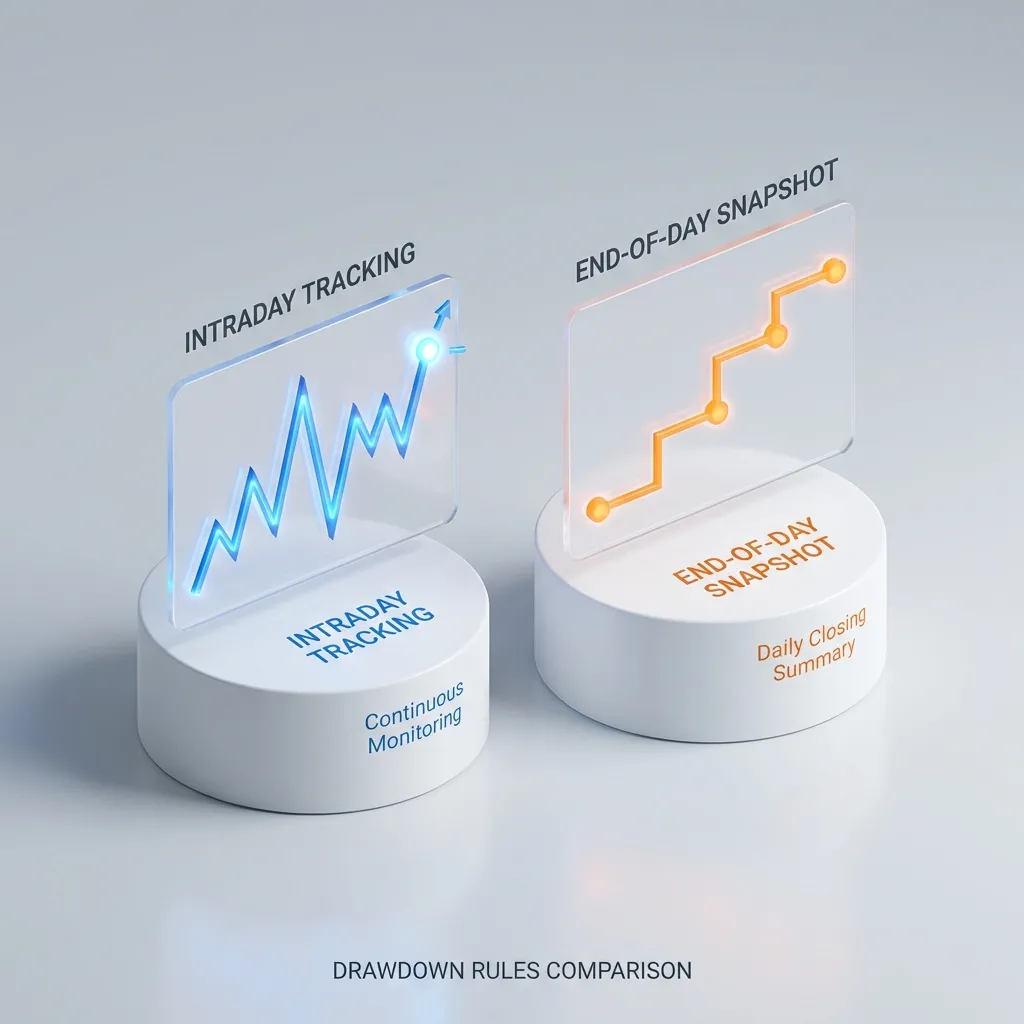
Timing is everything. Prop firms calculate their trailing and daily drawdowns on two different clocks: Intraday or End-of-Day (EOD).
How Intraday Drawdown Rules Work
An intraday drawdown is enforced in real-time, tick-by-tick. The trading software is constantly monitoring your open equity. If your floating balance touches your drawdown limit for even a microsecond at 10:14 AM, the prop firm’s automated software will instantly liquidate (close) your trades and terminate your account. Intraday trailing drawdowns punish normal market pullbacks and force traders into aggressive scalping behaviors to quickly lock in profits before the trailing floor catches up to them.
How EOD Drawdown Rules Work
An End-of-Day (EOD) drawdown is drastically more forgiving. The prop firm only measures your account’s high-water mark and updates your trailing floor at the close of the trading session (usually 4:59 PM EST for Futures).
$100K Account EOD Example:
- Start of Day: Balance is $100,000. EOD Trailing Max Drawdown is $3,000. Floor is $97,000.
- 11:00 AM: You take a massive trade that goes into $4,000 of floating profit. Your equity hits $104,000. Under an intraday model, your floor would instantly move to $101,000. But under an EOD model, your floor stays at $97,000 while you are trading.
- 2:00 PM: The trade pulls back significantly. You close it for a $1,000 profit. Your final balance is $101,000.
- 5:00 PM (Market Close): The firm’s software reviews your day. It sees your peak closed balance at the end of the day is $101,000. It now recalculates your trailing floor for the next day to be $98,000 ($101,000 – $3,000).
Why it’s better: EOD drawdown mirrors real market conditions, giving you the freedom to hold through normal intraday turbulence without the risk of an unrealized trailing stop snapping your account shut.
Crucial Note: While the EOD trailing floor only updates at the end of the day, the floor itself is still enforced in real-time. If your EOD floor is $98,000, and your intraday equity drops to $97,999 at noon, you will instantly fail. You cannot wait until the end of the day to recover below-floor losses.
How Slippage Eats Your Prop Firm Drawdown Buffer
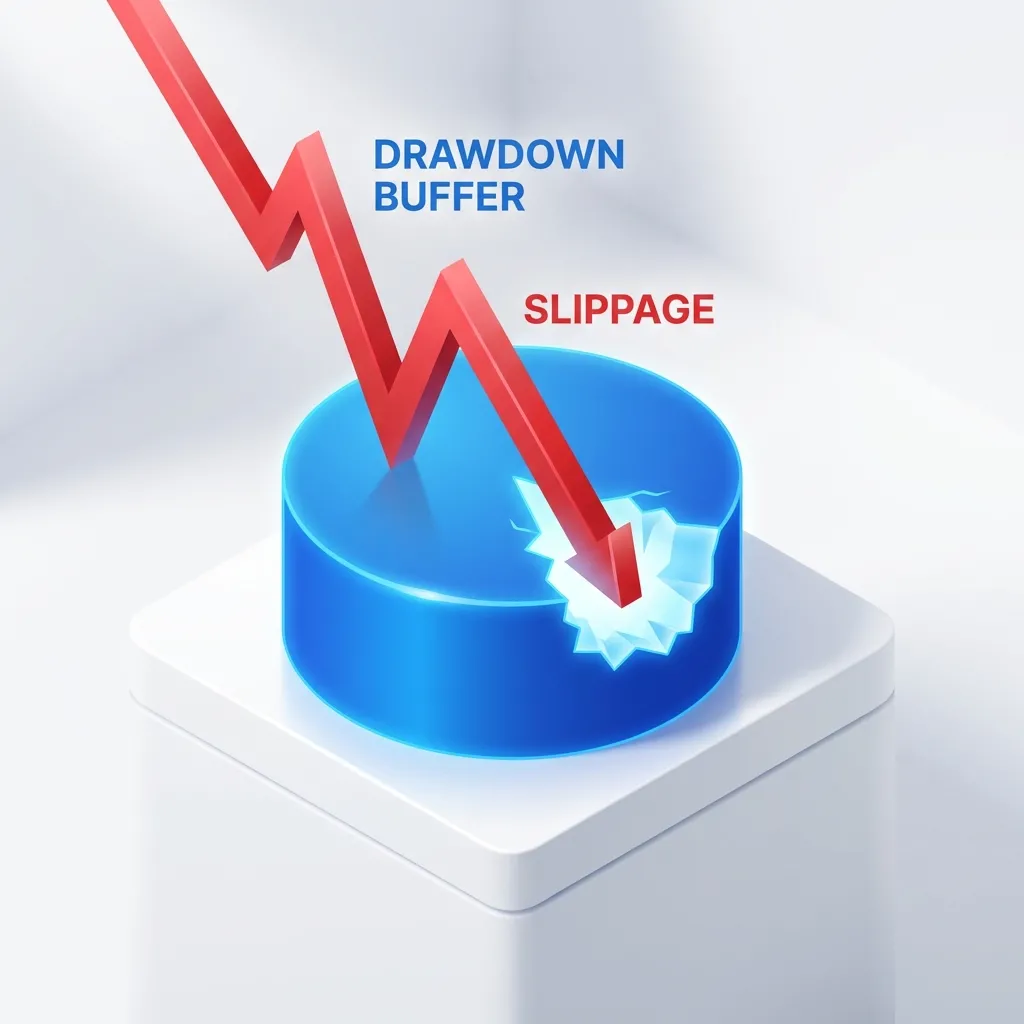
One of the most painful ways a beginner can fail a prop firm challenge is by breaching a drawdown limit due to slippage, even when they used a perfectly placed stop-loss order.
A stop-loss order is essentially an instruction that says, “If the price hits $X, turn this into a market order and sell immediately to stop my bleeding.” However, a market order simply takes the best available price at that exact millisecond. It does not guarantee you will exit exactly at $X.
How Fast Markets and Gap Risk Trigger Drawdown Breaches
During high-volatility events (such as the release of Non-Farm Payrolls, Federal Reserve interest rate decisions, or unexpected global news) liquidity dries up and prices move violently.
If you have a $50K account with a $1,000 daily drawdown limit, and you place a trade with a stop-loss calculated to lose exactly $950, you might feel safe. But if an economic report triggers a “gap” (the price instantly skips past your stop-loss level), your broker will fill your market order at the next available price. You might suffer $150 of negative slippage.
- Intended Loss: $950
- Actual Executed Loss: $1,100
- Result: You breached your $1,000 daily limit and lost your account.
The 80% Drawdown Buffer Rule
To survive slippage, professional prop traders use the 80% Rule. You should never risk more than 80% of your total daily drawdown allowance.
- If your daily limit is $2,000 (on a $100K account), your absolute maximum allowed loss across all trades for the day should be hard-capped at $1,600.
- The remaining $400 (20%) acts as an untouchable buffer to absorb spreads, commissions, exchange fees, and unexpected slippage.
How Commissions and Fees Eat Your Drawdown
Slippage is not the only hidden cost eating your drawdown buffer. Round-trip commissions on futures contracts typically run $3 to $5 per contract. If you are a scalper executing 20 round trips a day on 2 contracts each, that is $120 to $200 in commissions alone. Exchange fees (like CME NQ fees of roughly $2.36 per side per contract) add more. On a $1,000 daily drawdown limit, $200 in fees leaves you only $800 of actual trading room. Always factor total execution costs into your risk calculations before placing a single trade.
Position Sizing Formulas for Drawdown Rules

To properly manage your drawdown, you cannot rely on guesswork. You must use mathematical formulas to calculate your exact lot size (in Forex) or contract size (in Futures) before executing a trade.
The golden rule of prop trading is that you should calculate your risk percentage against your Drawdown Limit, not your total account balance.
The Base Formula:
Risk Capital = Drawdown Limit x Risk %
$50K Futures Account Example:
Assume you have a $50K account with a Max EOD Drawdown of $2,000. Following a conservative strategy, you decide you only want to risk 5% of your drawdown limit per trade.
- Risk Capital: $2,000 x 0.05 = $100 risk per trade.
- You want to trade the Nasdaq 100 E-mini (NQ). Each point on the NQ is worth $20 per contract.
- Your technical analysis shows you need a 25-point stop-loss.
- Cost of Stop-Loss for 1 Contract: 25 points x $20 = $500.
- One standard E-mini contract requires $500 of risk, which violates your $100 risk limit.
- You must trade Micro E-mini (MNQ) contracts instead. MNQ is $2 per point.
- 25 points x $2 = $50 per micro contract.
- Final Position Size: You can safely trade 2 MNQ contracts ($100 risk) to stay strictly within your drawdown management parameters.
$100K Forex Account Example:
Assume you have a $100K account with a $5,000 daily drawdown limit. You want to risk 10% of your daily limit on a single EUR/USD trade.
- Risk Capital: $5,000 x 0.10 = $500 risk per trade.
- Your stop-loss is 25 pips.
- Position Size Formula: Lot Size = Risk Capital / (Stop Loss in Pips x Pip Value).
- Assuming a standard lot pip value of $10:
- Lot Size = $500 / (25 x $10) = $500 / $250 = 2.0 Standard Lots.
- You can safely trade 2.0 lots without exposing your daily drawdown to severe risk.
How Top Prop Firms Compare on Drawdown Rules

Because drawdown rules dictate your likelihood of success, you must compare firms carefully. The table below highlights how top futures prop firms structure their drawdown rules for standard $50K and $100K evaluation accounts based on current industry data.
| Prop Firm | Account Size | Drawdown Type | Daily Limit | Max Limit | Calc. Timing | Locking Mechanism |
|---|---|---|---|---|---|---|
| Topstep | $50K / $100K | Trailing | $1,000 / $2,000* | $2,000 / $3,000 | End of Day (EOD) | Locks at Initial Balance |
| Apex Trader Funding | $50K / $100K | Trailing | None | $2,500 / $3,000 | Intraday (Real-Time) | Locks at Initial Balance + $100 (Safety Net) |
| My Funded Futures (MFFU) | $50K / $100K | Trailing | None | $2,000 / $3,000 | End of Day (EOD) | Locks at Initial Balance + $100 |
| Tradeify | $50K / $100K | Trailing | None | $2,000 / $3,000 | End of Day (EOD) | Locks at Initial Balance + $100 |
| FundedNext | $50K / $100K | Trailing | None** | $2,000 / $2,500 | End of Day (EOD) | Locks at Initial Balance |
| The Trading Pit | $50K / $100K | Trailing | $1,000 / $2,000 | $2,000 / $3,000 | End of Day (EOD) | Trailing (does not specify static lock) |
Notes:
- *Topstep Daily Limit: Topstep treats the Daily Loss Limit as an “Objective.” If you hit the $1,000 limit on a 50K account, it is a “soft breach,” meaning your positions are closed and you are locked out for the rest of the day, but your account is not failed.
- **FundedNext Limits: FundedNext’s “Bolt” challenges feature a daily loss limit (e.g., $1,000 on a $50K account) which also acts as a soft breach. Their “Rapid” challenges focus entirely on the Maximum Loss Limit.
- Apex uses an Intraday trailing drawdown by default. This is significantly harder to pass than the EOD models used by My Funded Futures, Tradeify, and Topstep. Apex does offer specific EOD accounts, but their flagship programs use real-time tracking.
Common Prop Firm Drawdown Mistakes Beginners Make

Even with a strong strategy, beginners frequently violate drawdown rules due to simple operational mistakes.
Over-Sizing Based on Account Balance: Trading a $100K account like you actually have $100,000 is a guaranteed path to failure. If your max drawdown is $3,000, risking 1% of your $100,000 balance means risking $1,000 on a single trade. You are effectively risking 33% of your true capital. Two bad trades and you fail. You must size positions based on the drawdown limit.
Ignoring Trailing Mechanics: Beginners will hold onto winning trades that eventually retrace back to breakeven, failing to realize that their equity peak dragged their trailing drawdown floor upward. In intraday trailing models, you must secure profits quickly.
Revenge Trading After a Loss: When a beginner takes a $500 loss early in the day, the psychological urge to “make it back” results in oversized, impulsive trades. This quickly breaches the Daily Drawdown limit.
Not Accounting for Commissions and Fees: Prop firm daily limits track your Net PnL, not your Gross PnL. This means broker commissions, data fees, and exchange fees count toward your daily loss limit. If you are a high-frequency scalper executing 50 trades a day, you might accumulate $150 in commissions. If your daily limit is $1,000, your actual trading loss limit is now only $850.
Trading Through High-Impact News Events: Beginners often leave positions open during major economic releases like FOMC announcements or jobs reports. These events create massive volatility spikes and wide spreads that can blow through your drawdown limit in seconds, especially on intraday-tracked accounts.
Prop Firm Drawdown Rules FAQ

How does prop firm drawdown work?
A prop firm drawdown is the maximum allowable loss on a funded or evaluation account. It acts as a safety mechanism for the firm. If your account balance (or equity) falls below the calculated drawdown threshold, the firm will automatically liquidate your open positions and terminate your account. Most firms enforce both a daily drawdown (single-day loss cap) and a maximum drawdown (total lifetime loss cap).
What is the 3-5-7 rule in trading?
The 3-5-7 rule is a widely respected risk management framework designed to protect traders from deep drawdowns. It mandates that you risk a maximum of 3% of your capital on any single trade. Second, you limit your total combined exposure across all open trades to a maximum of 5% of your capital. Finally, you target a minimum profit return of 7% (or a favorable risk-to-reward ratio) to ensure your winning trades outpace your losses. For prop trading, apply these percentages to your drawdown limit, not your account face value.
Is 20% drawdown bad?
Yes, in the context of prop trading, a 20% drawdown is exceptionally bad and impossible to sustain. Almost all prop firms set their maximum drawdown limits between 3% and 10%. A 20% drawdown indicates a severe lack of risk management. Even in personal trading, a 20% drawdown requires a 25% return just to get back to breakeven, which can take months to achieve.
What are the drawdown rules for funded firms?
Drawdown rules vary by firm but universally feature a Maximum Loss Limit (e.g., $2,000 on a $50K account). This limit can be Static (fixed from day one) or Trailing (moving up as you secure profits). Additionally, many firms implement a Daily Loss Limit, which caps your total losses within a 24-hour period. The calculation method (balance-based vs equity-based, intraday vs EOD) differs by firm and significantly impacts your trading experience.
Do prop firms reset your drawdown limit if you make a withdrawal?
Yes, and this is a critical rule to understand. When you take a payout, it directly affects your drawdown buffer.
- Topstep: After your first payout, your Maximum Loss Limit resets permanently to your starting balance. If you have a $50K account and you withdraw down to $50,000, your drawdown floor is $50,000. You have zero room for loss until you build the buffer back up.
- Tradeify / Apex: Payouts trigger the drawdown lock mechanism. Your trailing drawdown floor will permanently lock at your starting balance + $100 (e.g., $50,100). This gives you a thin but permanent safety margin.
- FundedNext: After the withdrawal of your first Performance Reward, your maximum loss limit resets to your exact initial account balance.
Always leave a healthy profit buffer in your account before requesting a payout. For a breakdown of which firms process withdrawals fastest, see our guide to daily payout futures prop firms.
Can slippage cause me to breach my daily drawdown even with proper stop losses?
Yes, absolutely. A stop-loss order converts to a market order when the price is triggered. During fast-moving markets or macroeconomic news releases, the market can gap past your stop-loss price. The broker will execute your trade at the next available price, which could result in a much larger loss than anticipated, instantly breaching your daily drawdown limit. This is why the 80% rule is mandatory for survival: never risk more than 80% of your daily drawdown allowance on actual trades. Keep 20% as a buffer for slippage, commissions, and fees.
Key Takeaways for Prop Firm Drawdown Rules

Understanding prop firm drawdown rules is the ultimate prerequisite to becoming a consistently funded trader. It is not enough to have a strategy that generates profits; you must have a strategy that generates profits within the constraints of the firm’s risk parameters.
Here are the key takeaways:
Know your exact floor. Whether it is a $1,000 daily limit or a $3,000 maximum trailing limit, base all of your position sizing on your drawdown budget, not the inflated face value of the $50K or $100K account.
Beware the trail. If your firm uses an Intraday Trailing Drawdown, you must secure profits proactively before pullbacks drag your account to failure.
Choose EOD when possible. End-of-Day drawdown calculations offer significantly more breathing room, allowing your trades to fluctuate naturally during the session without prematurely failing your account due to an unrealized high-water mark.
Protect yourself from slippage. Always leave a 20% buffer in your daily loss limit to account for overnight gaps, unpredictable news spikes, and broker commissions.
Compare firms before you buy. Not all drawdown rules are created equal. EOD trailing with a safety net lock (like Tradeify and MFFU offer) is far more forgiving than intraday real-time trailing. A few minutes of research can save you hundreds of dollars in failed evaluations. If you prefer to skip the evaluation entirely, check out instant funding futures prop firms.
By shifting your mindset from “How much money can I make?” to “How can I protect my drawdown limit?”, you will move beyond the beginner mindset and align your goals with the capital preservation logic of professional proprietary trading firms.