Instant funding promises fast access to capital but with hidden fees, stricter rules, and increased risk. Learn what to watch out for before diving in.
TL;DR: Instant funding futures prop firms let traders bypass the standard evaluation by paying a higher one-time fee and trading a funded account from day one. Top firms in 2026 include Tradeify (Lightning Funded, $25K–$150K, EOD trailing drawdown, progressive consistency rule starting at 20% for payout 1, relaxing to 25% then 30%, no activation fee, 5-day payout window), My Funded Futures/MFFU (Core/Rapid/Pro plans, 100% profit split on first $10K then 90/10, reset fees $227–$477, no automated trading), Purdia Capital ($25K/$50K/$100K instant accounts, EOD drawdown, 10-day minimum, 5 profitable days at $200+ required, transitions to a live brokerage account with static drawdown and daily on-demand payouts within 24 hours, no consistency rules post-graduation), and BluSky Trading (Direct 2 Funded, $749 one-time fee, $3,500 starting capital, $2,500 max drawdown, 50% split for first 30 days then 80%). FundingTicks ceased operations in January 2026 following retroactive rule changes. Instant accounts cost $400–$800 versus $150–$200 for evaluations of the same account size. Almost all instant accounts enforce trailing drawdowns from day one and daily profit consistency caps (20–40%), prohibit automated/HFT trading, and require KYC plus minimum trading days before any payout clears. Instant funding is suited for veteran traders with a proven, consistent edge; beginners will lose a $500–$800 fee far faster than a $100 evaluation reset.
Proprietary trading has evolved rapidly over the last few years. In 2026, many traders want to skip the testing phase entirely. They are turning to instant funding futures prop firms. This model offers a direct route to profit-sharing accounts. You bypass the evaluation, but you accept a different set of risks in exchange.
The market is currently crowded with these straight-to-funded offers. Some are excellent deals for proven, consistent traders. Others are expensive traps for beginners who are not ready for live market pressure. This guide breaks down how the no evaluation prop firm model actually works. It covers pricing structures, hidden risk parameters, and the top futures prop firms offering direct funding today.
What Is Instant Funding for Futures Prop Firms
Instant funding is exactly what it sounds like. You pay a higher upfront fee to the prop firm, skip the challenge, and start trading funded capital from day one. This is also commonly referred to as a straight to funded (S2F) account.
In a standard evaluation model, you must prove your trading skills before the firm trusts you with capital. You pay a monthly subscription fee and trade in a simulated environment. You are required to hit a specific profit target without breaching a maximum daily loss or trailing drawdown limit. This process usually takes weeks. Some firms require one step, while others require two distinct evaluation phases.
The instant funding model removes this entire barrier. You buy the account, receive your login credentials, and immediately begin trading as a funded trader. Every profitable trade you make from your first day counts toward your withdrawable balance.
However, “instant funding” does not mean “instant payout.” This is a critical distinction that many new traders misunderstand. You receive access to a funded account instantly, but you cannot withdraw cash on day one. Prop firms still enforce payout processing windows. You will have to trade for a minimum number of days, meet specific profit thresholds, and pass Know Your Customer (KYC) identity checks before any money hits your bank account. You are instantly funded, but your payout is still subject to the firm’s schedule.
Why Instant Funding Costs More Than an Evaluation
If you want to skip the evaluation, you must pay for the privilege. Instant accounts typically cost two to three times more than an evaluation account of the exact same size.
This price markup exists because the firm absorbs significantly more risk upfront. During a standard evaluation, the firm collects your monthly subscription fee while you trade simulated capital. Statistics show that the vast majority of traders fail their evaluations. The firm keeps the evaluation fees without ever risking a real funded payout.
With a straight-to-funded account, you start in the funded stage immediately. If you catch a massive market trend on your first day, the firm owes you a real profit split. They charge a higher entry fee to offset this immediate financial liability.
For example, a standard $50K evaluation account might cost $150 to $200 per month. A $50K instant funded account will likely cost $400 to $600 or more as a one-time fee. The cheapest futures prop firms are almost always evaluation-based because they rely on failure rates to subsidize the successful traders.
Furthermore, you must factor in reset fees. If you breach a rule on a standard evaluation, you can usually pay a small fee to reset the account. If you breach a rule on an instant funded account, there is rarely a cheap reset option. You generally have to pay the full premium price to buy a brand new account. Failing an instant account is a very expensive mistake.
What You Give Up to Skip the Evaluation
Prop firms do not give away money blindly. They protect their capital by applying stricter rules to instant accounts. You must clearly understand these tradeoffs before you pay the premium.
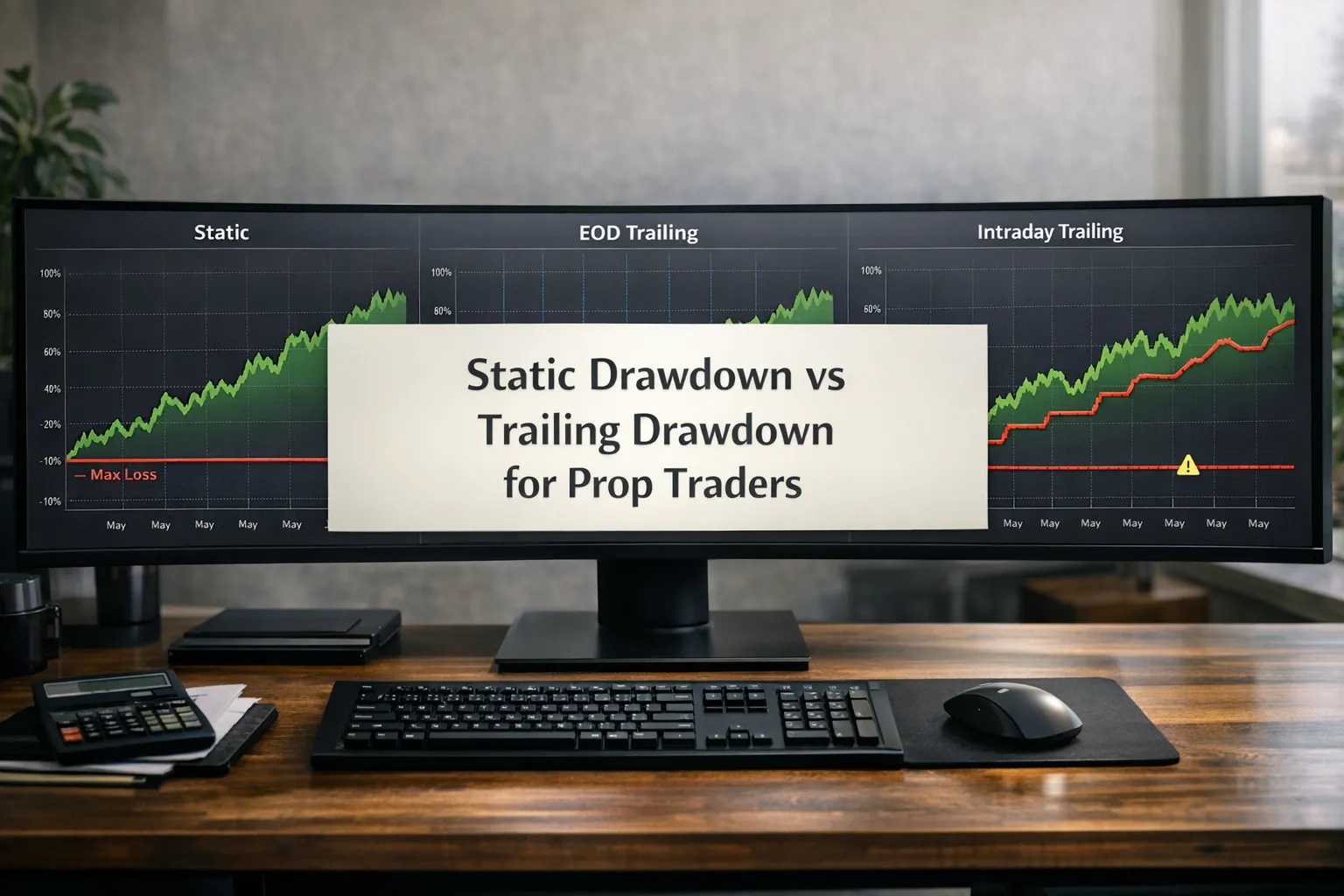
First, a trailing drawdown from day one is the industry norm for instant accounts. In many evaluations, your maximum loss limit stops moving once you reach your starting balance. This is known as a static drawdown, and it gives you permanent breathing room once you secure some early profits. In most instant accounts, the drawdown trails your highest account balance constantly. As your equity grows, your drawdown buffer shrinks. If you make $1,000, your loss limit moves up by $1,000. This forces you to trade defensively at all times and punishes wild swings in equity.
Second, instant accounts heavily utilize consistency rules. A consistency rule limits how much of your total profit can come from a single trading day. This acts as a daily profit cap. For example, if a firm has a 30% consistency rule, your best trading day cannot make up more than 30% of your total required profit. If you catch a huge move and make a massive profit, you cannot withdraw it immediately. You must trade for several more days to build up smaller profits until that single big day represents 30% or less of the total. This prevents gamblers from getting lucky once and cashing out.
Third, you will face stricter automation and high-frequency trading restrictions. Most instant accounts are designed exclusively for manual day traders. Algorithmic trading, copy trading, and high-frequency scalping bots are usually prohibited.
Finally, your maximum loss limits might be smaller compared to evaluation accounts. Some firms reduce the total drawdown room on their instant products to limit their exposure. You have far less room to find your rhythm before the rules bite. In an evaluation, a sloppy first week just means it takes longer to pass. In an instant account, a sloppy first week triggers a hard breach and a total loss of your high upfront fee. You must manage risk perfectly, which is why many traders rely on micro futures to keep their position sizing incredibly small during their first few weeks.
Top Instant Funding Futures Prop Firms in 2026
The market for direct funding changes rapidly. Below is an objective breakdown of the top firms offering instant funding in 2026, including their pricing, core rules, and who they fit best.
Tradeify Lightning Funded
Tradeify currently offers their Lightning Funded product alongside their standard Growth and Select evaluation accounts. The Lightning account is a pure no-evaluation model where you start earning simulated funded capital immediately.
Account sizes range from $25K to $150K. A major selling point is that Tradeify charges no activation fee once you purchase the Lightning account. You buy it, and you are ready to trade.
The defining feature of the Lightning account is its progressive consistency rule. Tradeify implements a strict 20% consistency rule for your first payout. This means your single best day cannot account for more than 20% of your total profit. If your profit goal is $3,000, your biggest day cannot exceed $600. However, this rule relaxes over time. It shifts to 25% for your second payout, and then permanently settles at 30% for your third payout and beyond.
Lightning accounts feature an end-of-day (EOD) trailing drawdown, which protects you from intraday market spikes. There are no minimum trading days required for payouts. You can request a payout as soon as you meet your profit goal and satisfy the consistency percentage. Once requested, the payout window is typically 5 days. This account is best for disciplined, methodical traders who hit daily base hits rather than home runs.
My Funded Futures (MFFU)
My Funded Futures provides straight-to-funded options alongside their standard evaluation tiers. In 2026, they reorganized their structure into Core, Rapid, and Pro plans. A significant improvement for traders is the removal of backend activation fees across all plans.
MFFU allows traders to scale their capital efficiently. They offer a 100% profit split on the first $10,000 you earn, before dropping to a standard 90/10 split. They strictly prohibit automated trading, high-frequency bots, and most copy trading software on their direct accounts.
The biggest risk with MFFU’s instant accounts is the cost of failure. Reset fees are expensive. Depending on your plan, resetting a breached S2F account can cost between $227 and $477. This effectively means you are paying the full account price again if you hit your drawdown limit. MFFU is best for highly experienced traders who rarely breach risk parameters and want to maximize their first $10,000 in withdrawals.
FundingTicks
FundingTicks was previously a popular choice for their “Zero” direct-funded accounts, offering day-one funded capital with fast approvals. However, FundingTicks officially ceased operations in January 2026.
The firm faced severe backlash in late 2025 after implementing retroactive rule changes. They introduced minimum trade hold times, reduced profit splits, and increased daily profit requirements without warning. Traders saw their previously valid profits erased overnight. Trust plummeted, and the firm ultimately shut down. The collapse of FundingTicks serves as a reminder for traders: always read the terms of service, and remember that prop firm capital is never truly yours until it reaches your personal bank account.
Purdia Capital
Purdia takes a unique, highly transparent approach to instant funding. They offer $25K, $50K, and $100K Instant Funding accounts featuring end-of-day drawdowns.
When you buy a Purdia instant account, you are placed into a Sim Funded Account. You must trade for a minimum of 10 days, achieve 5 profitable days making at least $200, and hit a specific profit target. Once you complete this phase, Purdia moves you into a true Live Funded Account with a real brokerage.
The profits you earned in the Sim phase are transferred to your Live account as your starting buffer. Once you are live, the rules drop away completely. There are no consistency rules, and your trailing drawdown converts to a much safer static drawdown. You also gain access to a true daily payout system, allowing you to withdraw funds on demand within 24 hours. Purdia is best for traders who want the safety of a real brokerage account and hate ongoing consistency rules.
BluSky Trading
BluSky Trading offers an instant funding route called Direct 2 Funded. This skips their standard Launch and Premium evaluation plans entirely.
The cost of entry is steep. The Direct 2 Funded option requires a one-time fee of $749. For this price, you get immediate trading access with $3,500 in starting capital, a $2,500 maximum drawdown, and a $2,000 maximum daily loss.
BluSky also implements a unique profit split for this direct account. You keep 50% of your profits for the first 30 days. After the first 30 days, your split increases to 80%. BluSky is best for well-capitalized traders who want immediate execution access and are willing to accept a lower initial profit split to avoid the evaluation grind.
Bulenox
Bulenox is a long-standing prop firm that occasionally runs instant funding promotions. However, they are generally known for their evaluation accounts. Their instant funding policies lack the deep transparency seen at firms like Tradeify or Purdia. When they do offer direct funding, it usually involves strict trailing drawdowns and specific withdrawal caps. Proceed with caution and verify their exact consistency rules before purchasing.
Instant Funding vs Evaluation
Deciding between evaluation vs funded paths comes down to your budget, your patience, and your win rate.
The most obvious difference is the cost to enter. Evaluations are cheap. You can easily find a $50K evaluation for under $150 a month, and heavy discounts are common among the best futures prop firms. Instant funding is a premium service. You will pay between $400 and $800 to bypass the test.
Drawdown types also differ heavily. Many modern evaluations now offer end-of-day trailing drawdowns or static drawdowns, giving you a wider margin for error. Instant accounts almost universally use aggressive trailing drawdowns from day one to protect the firm’s capital. Your buffer shrinks as your account grows, making it much harder to survive a normal string of losing trades.
Consistency rules are another dividing line. Evaluations rarely care how you hit the profit target. If you make it all in one day, you pass. Instant accounts strictly regulate your daily profits. You cannot request a payout if one lucky day accounts for 30% or 40% of your total gains. You must trade consistently over time.
Payout speed favors the instant model, but only slightly. In an evaluation, you might spend two weeks passing the test, then another two weeks trading the funded account before your first payout window opens. With instant funding, the evaluation time is erased. You can reach your first payout window in just five to ten days, depending on the firm’s specific schedule.
Ultimately, evaluations are designed for traders who need time to refine their edge and prefer to risk small amounts of capital. Instant funding is designed exclusively for veteran traders who already have a profitable system and view the higher upfront fee as a simple business expense to save time.
The risk of failure is the final separator. Failing an evaluation costs you a small monthly fee or a cheap reset. Failing an instant account costs you a massive premium fee.
Who Should Actually Use Instant Funding
The general consensus across trading forums and data platforms is that instant funded accounts cost roughly twice as much as evaluation accounts. Therefore, they are only useful if you have a rock-solid, proven strategy.
The best fit for an instant account is a veteran trader with a verifiable track record of consistency. If you know exactly what your maximum drawdown is, and you know it easily fits within the firm’s risk parameters, instant funding makes sense. You save weeks of unpaid labor in a simulated evaluation environment and get straight to earning your profit split.
Newer traders are the worst fit for instant funding. If you are still developing your strategy, dealing with emotional tilt, or struggling with risk management, do not buy an instant account. You will inevitably hit the trailing drawdown limit. When you do, you will lose a $500 to $800 upfront fee instead of a $100 evaluation fee. Traders who need a wide drawdown room to let trades breathe should also avoid this model. Finally, traders who rely on high-frequency algorithmic systems will find their accounts quickly banned under the strict manual-only rules of S2F programs.
Before you buy an instant account, ask yourself one brutally honest question: “Would I easily pass an evaluation if I took one today?” If the answer is yes, instant funding will save you valuable time. If the answer is no, instant funding will just drain your wallet faster.
What to Check Before Buying an Instant Funded Futures Account
Never buy a straight-to-funded account based solely on the price tag. The cheapest instant account usually has the worst rules. Use this checklist to analyze the firm’s policies before handing over your money.
First, check the drawdown rules. You must know if the drawdown is calculated on an intraday basis or an end-of-day basis. End-of-day is always safer. You also need to know if the drawdown trails your open equity or your closed balance, and at what point it stops trailing.
Second, read the fine print on the consistency rule. Find out if the rule resets after every single payout, or if it permanently applies to the lifetime of the account. A progressive rule, like Tradeify’s model that relaxes over time, is much better than a strict, permanent 20% cap.
Third, look at the payout schedule. Do not assume you can withdraw money on day two. Check the minimum trading day requirements, the maximum withdrawal caps for the first few months, and the available payment methods. If you value fast liquidity, look specifically for daily payout futures prop firms like Purdia.
Fourth, understand the exact cost of a reset. If you breach a daily loss limit, does the firm offer a discounted reset rate, or do you have to repurchase the entire instant account at full retail price?
Fifth, verify the automation policy. If you use a trade copier to mirror trades across multiple accounts, ensure the firm explicitly allows it on their instant funded tier. Many firms restrict copiers to evaluations only.
Finally, check if the firm offers a graduation path. The best prop firms will eventually move you out of a simulated funded account and into a real, live brokerage account once you prove your profitability.
FAQs
What is the difference between instant funding and straight-to-funded (S2F)?
There is no difference. These terms are used interchangeably in the prop firm industry. Both refer to an account model where you pay a higher upfront fee to bypass the evaluation phase and begin trading a funded account immediately.
Is instant funding worth it over an evaluation?
It is only worth it if you are an experienced trader with a proven, highly disciplined strategy. Because instant accounts cost two to three times more than evaluations and have stricter drawdown rules, beginners will lose money much faster. If you know you can easily pass an evaluation, instant funding saves you time.
Do instant funding accounts have consistency rules?
Yes, almost all of them do. Firms enforce consistency rules to prevent traders from getting lucky on a single high-risk trade. You are usually restricted by a daily profit cap, meaning your single best day cannot account for more than 20% to 40% of your total profits when you request a withdrawal.
Can you use automated trading strategies on instant funded accounts?
Generally, no. Most prop firms strictly prohibit high-frequency trading (HFT), algorithmic bots, and automated execution on their instant funded tiers. They require manual trading to ensure they are funding a skilled human, not a black-box algorithm. Always check the firm’s specific terms of service regarding trade copiers.
How fast are payouts on instant funding futures accounts?
Despite the name “instant,” payouts are not immediate. You still have to clear the firm’s processing windows. Some firms require 5 to 10 minimum trading days before your first request. Even after approval, KYC verification and bank processing can take an additional 24 to 48 hours.
What happens if I breach a rule on an instant funded account?
If you breach a maximum loss limit, a daily drawdown limit, or an unauthorized trading rule, your account will be immediately terminated. Unlike evaluation accounts which offer cheap resets, breaching an instant account usually means you have to buy a brand new account at full retail price to continue trading.