TL;DR: Futures trading myths cause beginners to blow accounts by misunderstanding margin exposure, risk management, and prop firm mechanics. Tradeify offers three funded account paths: Growth ($139/mo, 1-day pass, $3,000 target, $1,250 daily loss limit soft breach, fixed 5-day payout), Select ($159/mo, 3-day min, $2,500 target, no daily loss limit, 40% consistency rule, choose Daily or Flex payout after passing), and Lightning Funded ($469 one-time, instant funding, $1,250 daily loss limit). All plans use End-of-Day trailing drawdowns ($2,000 on $50K accounts) and a 90/10 profit split. Select Daily requires a $52,100 buffer before withdrawals ($1,000/day max), while Select Flex needs 5 winning days ($150 min profit on $50K) for payouts up to $3,000 (50% of profits). Traders can hold up to 5 funded accounts simultaneously, use Micro contracts (MES at $5/point) for risk control, and trade on Tradovate. After 5 successful payouts, traders upgrade to Tradeify Elite Live accounts backed by real institutional capital. Futures trading risks are real but manageable through proper R/R ratios (e.g., 2:1 on NQ yields net profit even at 40% win rate), and futures options provide additional hedging tools for advanced traders.
The world of financial markets is deeply clouded by misinformation, leading many newcomers to approach the charts with entirely skewed expectations. The allure of rapid wealth accumulation, amplified by social media highlights, creates a distorted reality for aspiring professionals. However, approaching this space requires a measured, informed commitment to risk and capital preservation. This report breaks down the most common futures trading myths in the industry, offering a practical look at modern proprietary funding models and the realities of executing a profitable strategy.
Why Futures Trading Myths Hold You Back

If you are stepping into the futures market for the first time, you have a massive target on your back. The internet is flooded with flashy screenshots, rented supercars, and self-proclaimed gurus selling you the dream of turning a few hundred bucks into a million-dollar portfolio by next Tuesday.
You have likely heard the noise. People tell you that trading is just gambling. They tell you that you need to max out your position size to make any real money. They tell you that proprietary trading firms are inherently rigged against you. These futures trading myths are not just harmless rumors. They are actively draining your mental capital, destroying your trading accounts, and keeping you stuck in a cycle of blown evaluations.
It is time to clear the air. We are going to break down the biggest misconceptions in the industry. We will look at the hard math, the specific dollar amounts, and the actual mechanics of how professional prop firms operate. Whether you are trading the E-mini S&P 500 (ES) or the Nasdaq (NQ), you need facts, not fiction. Specifically, we will look at how platforms like Tradeify have completely restructured the path to live funding, tearing down the old barriers that used to hold traders back.
Grab your coffee. Open your charts. Let us bust these myths and get you on the right side of the tape.
Myth That Futures Trading Is Just Glamorized Gambling

This is the most common phrase dropped by people who have never executed a successful trade in their lives. The general public looks at the rapid, intraday fluctuations of the market and assumes it is all just random chaos. They see a red candle, they see a green candle, and they assume you are just sitting at your desk pulling a virtual slot machine lever.
Here is the reality. Gambling thrives on sheer mathematical chance. In a casino, the house always has a built-in statistical edge. The longer you play roulette, the closer your probability of losing approaches 100 percent. Trading, however, is about identifying trends, evaluating intrinsic value, and executing a defined mathematical edge over an extended period.
When you treat futures like a casino, you will get casino results. If you are entering trades without a plan, blindly buying because a chart “looks low” or selling because it “went up too fast,” you are absolutely gambling. This is known as the “what goes up must come down” fallacy, and it destroys novice accounts every single day.
How the Math Behind Futures Trading Proves It Is Not Gambling
Professionals do not gamble. They play probabilities. Let us look at a worked example of how a professional uses risk-to-reward (R/R) ratios to eliminate the gambling aspect entirely.
Imagine you have a straightforward strategy. You risk 10 points on the Nasdaq 100 (NQ) to make 20 points.
- In standard NQ contracts, 1 point equals $20.
- Your risk per trade is $200.
- Your potential reward per trade is $400.
You take 10 trades. Because your strategy is not perfect, you only win 40 percent of the time. You have 6 losers and 4 winners.
- 6 losses at $200 each = -$1,200
- 4 wins at $400 each = +$1,600
- Net Profit = +$400
You lost more times than you won, yet you walked away with a profit. That is not gambling. That is statistical expectancy. The myth that futures trading is a game of chance completely ignores the reality of structured risk management. Over time, asset prices mirror their actual market value, and identifiable trends can be forecasted with precision.
Myth That You Must Max Out Position Size in Futures Trading
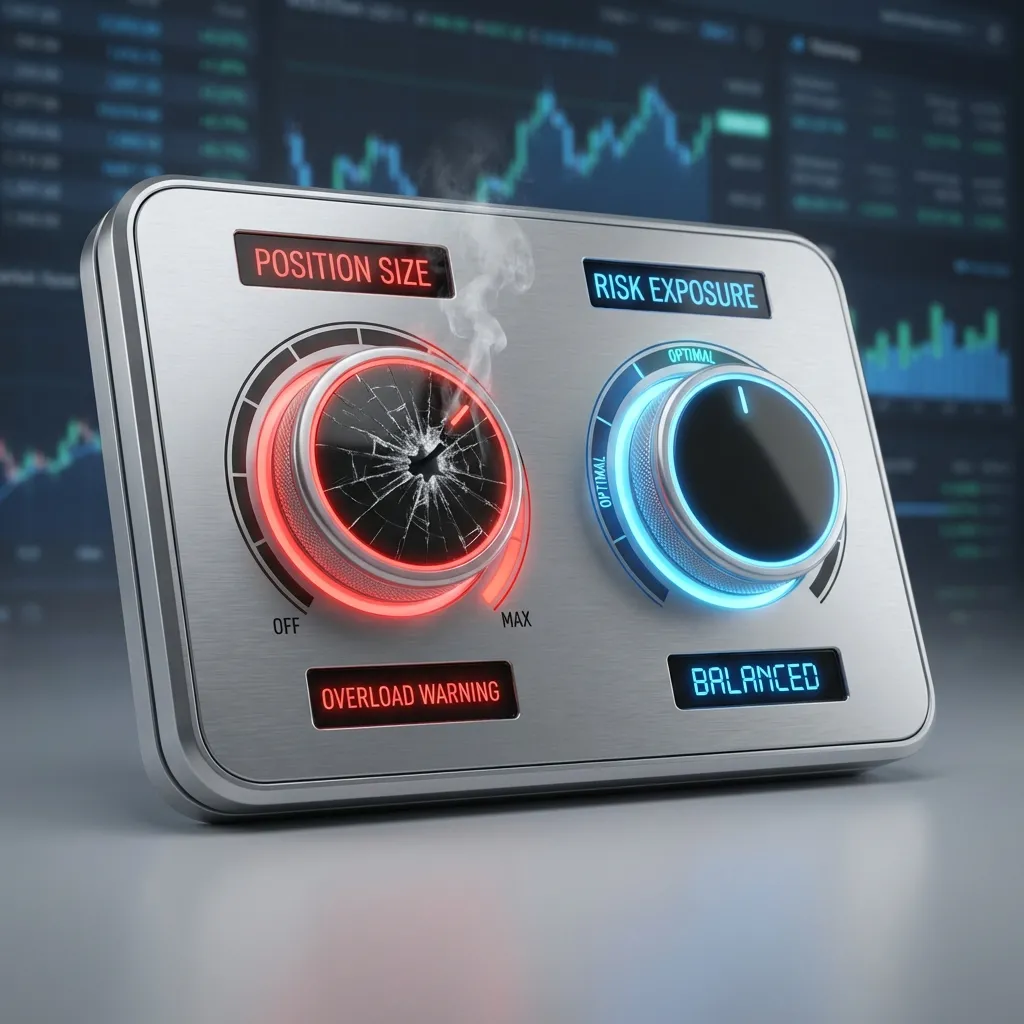
Margin exposure is the ultimate double-edged sword. It is neither intrinsically good nor bad; it is simply a mechanical tool. Futures are highly leveraged instruments by design. You can control a massive amount of an underlying asset with a relatively tiny margin deposit.
Beginners hear about margin and immediately think it is their golden ticket. They believe the myth that to make serious money, they need to trade the absolute maximum number of contracts their account allows. This is financial suicide, and it represents one of the biggest futures trading risks that new traders face.
The Fast Track to a Blown Futures Trading Account
Let us look at a standard $50,000 evaluation account. Many prop firms, including Tradeify’s Select Plan, allow you to trade up to 4 standard Mini contracts (like the ES) on a $50K account.
A beginner funds their account, sees the “Max 4 Contracts” limit, and decides to go all in.
- They buy 4 ES contracts.
- Every single point the ES moves is worth $50 per contract.
- With 4 contracts, every 1-point move in the market equals a $200 swing in their account equity.
The market opens, and economic news drops. The ES instantly wicks down 10 points.
- 10 points x $200 = -$2,000.
In approximately three seconds, this trader has hit their $2,000 maximum trailing drawdown limit and failed their evaluation. They blame the market. They blame the prop firm. But the reality is that their ignorance of position sizing wiped them out.
The Professional Approach to Futures Trading With Micro Contracts
You do not need massive position sizes to be highly profitable. The smartest traders scale their risk using Micro contracts. The Micro E-mini S&P 500 (MES) is exactly one-tenth the size of the standard ES. One point on the MES is worth $5.
Tradeify allows up to 40 Micro contracts on their $50K account. Instead of throwing on 4 Minis, a professional might scale into a trade with 4 Micros.
- 4 MES contracts = $20 per point.
- That same 10-point drawdown against them only results in a $200 unrealized loss.
- They have plenty of breathing room to let the trade develop, hit their target, and secure a consistent profit.
True profitability stems from managing market volatility with a rigorous commitment to risk management, not maxing out your buying power. Understanding these futures trading risks early on separates survivors from statistics.
Myth That Prop Firms Are Rigged Against Futures Traders

There is a loud subset of failed traders who claim that proprietary trading firms are scams designed entirely to collect evaluation fees. They believe the rules are rigged, the drawdowns are unfair, and the firms actively trade against them.
While it is true that some older, predatory firms used convoluted rules to trap traders, the modern prop firm world has evolved dramatically. Firms like Tradeify actually need profitable traders because they want to migrate successful users to live capital accounts (Tradeify Elite) where the firm takes a 10 percent cut of real market profits.
The biggest complaint you will hear involves the “Trailing Drawdown.” Beginners misunderstand how this works and claim it is rigged. To bust this myth, we must look at the difference between Intraday Drawdowns and End-of-Day (EOD) Drawdowns.
Intraday vs End-of-Day Drawdowns in Futures Trading
An Intraday Trailing Drawdown calculates your maximum loss limit tick-by-tick during an open trade. If your account goes up $1,000 in open profit, your drawdown floor follows you up immediately. If the trade then pulls back $500 before hitting your ultimate target, you might get stopped out and fail the evaluation just because of normal market breathing. This is a frustrating rule that many older firms still use.
Tradeify completely eliminates this trap by using an End-of-Day (EOD) Trailing Drawdown across all of its plans.
- How EOD Works: The drawdown is calculated based only on your account balance at the end of the trading session. It completely ignores intraday equity spikes.
- Worked Example: You are trading a $50,000 Tradeify Select account with a $2,000 EOD Drawdown. Your failure floor is $48,000.
- You enter a trade. It goes into $1,500 of open profit. Under an intraday rule, your floor would instantly move up to $49,500.
- The trade pulls back, and you close it for a modest $300 profit. Your account balance at the end of the day is $50,300.
- Because Tradeify uses EOD, your new drawdown floor only adjusts based on that $50,300 closing balance. Your new failure line is $48,300 ($50,300 – $2,000).
This gives you massive intraday flexibility. You can hold positions through normal market fluctuations without the constant anxiety of a tick-by-tick drawdown hunting your account. That is not rigged; that is trader-friendly.
Myth That Getting a Funded Futures Account Takes Months

Another massive myth is the timeline. Beginners believe that getting funded requires a grueling, month-long evaluation process where you have to trade perfectly for 30 consecutive days.
This used to be true. Today, the speed at which you can get funded is entirely up to your personal skill level and the specific evaluation track you choose. Tradeify currently offers three distinct pathways to funding, completely shattering the myth of the endless grind.
The Growth Plan for Fast Futures Funding
If you want to get funded as quickly as humanly possible, Tradeify offers the Growth Plan.
- Time to Pass: You can pass this evaluation in a single day.
- The Catch: To offset this speed, the Growth Plan enforces a Daily Loss Limit (a soft breach). If you hit this daily loss threshold, you cannot trade for the rest of the session, but your account is not failed. It also features a fixed 5-day payout structure once funded.
The Select Plan for Strategic Futures Traders
Launched in December 2025, the Select Plan is built for traders who want zero restrictions on their daily trading.
- Time to Pass: A minimum of 3 trading days.
- The Rule: It requires a 40 percent consistency rule during the evaluation. This means no single day can account for more than 40 percent of your total passing profit. If your target is $2,500, your best single day cannot exceed $1,000.
- The Benefit: There is absolutely no daily loss limit during the evaluation. You have total intraday freedom to swing for the fences, provided you stay above your EOD trailing drawdown.
Lightning Funded for Instant Futures Trading Access
If you despise evaluations and want to start earning immediately, the Lightning Funded account allows you to bypass the evaluation phase entirely. You pay a higher, one-time fee, and you are immediately placed into a simulated funded environment where your profits count toward actual payouts from day one.
Comparing Tradeify Plans for Futures Traders

To truly dispel the myths around prop firm evaluations, you need to look at the hard data. Choosing the wrong evaluation type for your specific trading psychology is the number one reason traders fail.
Here is a comprehensive comparison of the $50,000 account tier across Tradeify’s three distinct programs.
| Feature | Tradeify Select ($50K) | Tradeify Growth ($50K) | Lightning Funded ($50K) |
|---|---|---|---|
| Pricing | $159 / month | $139 / month | $469 one-time |
| Minimum Time to Pass | 3 Days | 1 Day | 0 Days (Instant) |
| Profit Target | $2,500 | $3,000 | N/A (Already Funded) |
| EOD Trailing Drawdown | $2,000 | $2,000 | $2,000 |
| Daily Loss Limit | NONE | $1,250 (Soft Breach) | $1,250 (Soft Breach) |
| Eval Consistency Rule | 40% Rule | NONE | N/A |
| Funded Payout Choice | Choose Daily or Flex | Fixed 5-Day Payout | Performance Milestones |
| Max Position Size | 4 Minis / 40 Micros | 4 Minis / 40 Micros | 4 Minis / 40 Micros |
If you are a volatile intraday trader who hates having your terminal locked out after a bad morning, the Select Plan is your best option because it has no daily loss limit. If you are a precision sniper who uses tight stops and wants to be funded by tomorrow afternoon, the Growth Plan is your weapon of choice.
Myth That You Must Choose Your Futures Payout Structure Early

Historically, prop firms forced you to sign up for a specific, rigid payout structure the moment you bought your evaluation. If you bought an account with restrictive payout rules, you were stuck with them forever.
Tradeify Select destroyed this myth by introducing the “evaluate first, commit later” model. When you purchase a Select evaluation, everyone trades under the exact same rules. It is only after you pass the evaluation and reach the funded stage that you choose your permanent payout structure.
You get to look at how you actually performed during your evaluation and choose the path that fits your data. You choose between Select Daily and Select Flex.
Select Daily for Fast Cash in Futures Trading
If you want access to your profits on a daily basis, you choose Select Daily. Tradeify is one of several daily payout futures prop firms that offer fast withdrawal cycles. However, to earn this right, you must build a safety cushion known as a “Buffer.”
- The Buffer Math: The buffer equals your starting balance, plus your maximum drawdown, plus $100.
- For a $50,000 account with a $2,000 drawdown, your buffer is $52,100 ($50,000 + $2,000 + $100).
- You must trade until your account balance exceeds $52,100. You cannot withdraw any money that drops your balance below this buffer line.
- Once above the buffer, you can request daily payouts.
- Limits: The minimum payout request is $250. The maximum daily payout cap for a $50K account is $1,000.
Example: You build your $50K account up to $53,500. Your buffer is $52,100. You have $1,400 in excess profit. You can request the maximum cap of $1,000 today. The remaining $400 sits in your account, ready to be grown or withdrawn tomorrow.
Select Flex for Steady Futures Trading Profits
If you do not want to deal with building a massive buffer, you choose Select Flex.
- No Buffer Required: You can request payouts immediately after completing the requirements, regardless of your overall account balance, as long as you stay above your drawdown floor.
- The Rule: You simply need to complete 5 “Winning Days.” A winning day is defined by a minimum profit threshold. For a $50K account, you must make at least $150 on a given day for it to count.
- Once you string together 5 winning days (they do not have to be consecutive), you can request a payout.
- Limits: You can withdraw up to 50% of your total profits, capped at $3,000 per payout for a $50K account.
Flex is perfect for consistency traders who want to hit base hits, take out substantial chunks of cash every week or two, and not worry about maintaining a high capital buffer.
Myth That Futures Trading Requires a Ten-Monitor Setup

Browse trading forums, and you will see beginners showing off absurd setups. Six curved monitors, three keyboards, dedicated news feeds, and charts that look like Jackson Pollock paintings covered in fifty different technical indicators.
There is a persistent myth that day trading futures requires you to watch six different timeframes across multiple asset classes simultaneously. The truth? If you cannot make sense of the market action on a single laptop screen, adding nine more monitors is not going to magically make you profitable. Overcomplicating your setup leads to analysis paralysis.
Professional futures traders often specialize in just one or two instruments, such as the E-mini S&P 500 or Crude Oil. They watch price action, volume, and perhaps a couple of key moving averages. Some traders also monitor managed futures performance data or futures options flow as supplementary context, but a single focused screen remains the foundation.
Modern platforms facilitate this minimalist approach. Reviewers consistently praise Tradeify for its ultra-clean dashboard and user-friendly interface. Instead of buying expensive third-party journaling software, Tradeify provides a built-in automated trading journal on the backend. You can seamlessly track your performance, log your emotional state, and review your daily PnL without ever leaving the platform. Keep it simple. A focused mind on a single screen will always outperform a chaotic mind staring at a command center.
Myth That Trading Futures Without a Stop Loss Prevents Stop Hunting

This myth is incredibly dangerous. Beginners will frequently place a trade, watch it go against them, and manually cancel their stop-loss order. Their logic? “The broker is hunting my stop. The market makers can see my order, and they are pushing the price down just to take my liquidity before it reverses.”
Let us unpack this. First, trading without the safeguard of a hard stop loss is the single fastest way to blow your account. When the market moves violently against a margin-heavy position, a manageable loss transforms into a catastrophic account-ending event in the blink of an eye. This is one of the most underestimated futures trading risks.
Second, the fear of “broker stop-hunting” is largely a relic of unregulated, offshore forex bucket shops. When you trade CME futures through a legitimate, regulated platform like Tradovate (which Tradeify uses exclusively for Select and Growth plans), you are trading on a centralized exchange.
The market makers are not hunting your specific 2-lot order. What they are hunting is liquidity. Beginners naturally place their stop losses in the exact same obvious, highly visible locations, typically right below an obvious support line or right above a double top. Institutional algorithms push price into these zones because they know thousands of retail stop orders are clustered there, providing the liquidity they need to fill their massive institutional positions.
You are not a victim of a targeted conspiracy. You are just placing your stops in terrible locations. Always use a stop loss, but learn to place them based on structural invalidation rather than obvious retail pivot points.
How Futures Trading Payouts Actually Work
Finally, we have to talk about getting paid. The myth is that prop firms make it impossible to withdraw, or that they take the lion’s share of your hard-earned profits.
When you get funded with Tradeify and request a payout, the process is streamlined and highly favorable to the trader. Across all Sim Funded accounts, Tradeify implements a strict 90/10 profit split.
- You keep 90 percent of your profits.
- Tradeify keeps 10 percent.
It is important to note that while some older reviews and legacy documentation might mention a rule where you keep 100% of the first $15,000, Tradeify’s updated, universal policy explicitly states that all payouts from Sim Funded accounts will be split 90/10 starting from your very first payout request, with no grace amount.
When you request a payout, the funds are processed rapidly, often landing in your Rise account within hours (a feature that consistently earns the firm 4.8-star ratings on Trustpilot). Furthermore, Tradeify’s ultimate goal is the Elite Live program. Once you successfully process 5 payouts in the simulated funded stage, you are upgraded to a Live Funded account backed by real institutional capital, completely removing sim profit caps.
You are not trading for pennies. You are proving your consistency in a simulated environment to earn the keys to a real, live institutional account.
Frequently Asked Questions About Futures Trading Myths
What does the 40 percent consistency rule mean during the evaluation?
The 40% consistency rule on the Select Plan ensures you are trading steadily rather than getting lucky on one massive gamble. It states that no single trading day can account for more than 40% of your total required profit target. For example, if your target is $2,500, your best day cannot exceed $1,000. If you make $1,500 in one day, you simply have to keep trading and increase your total overall profit until that $1,500 represents only 40% of the total. Note that once you are funded on the Select plan, consistency rules completely disappear.
What exactly is an End-of-Day trailing drawdown?
An End-of-Day (EOD) trailing drawdown is a risk management limit calculated exclusively at the close of the trading session. Unlike an intraday drawdown, which follows your highest open profit tick-by-tick and can stop you out during a winning trade that pulls back, an EOD drawdown ignores intraday fluctuations. It only updates based on your final account balance when the market closes, providing massive flexibility for your trades to breathe.
Can I use automated trading bots or algorithms on Tradeify?
Yes, Tradeify permits the use of automated trading bots, but with strict conditions to prevent fraud. You must be able to prove that you are the sole owner of the strategy, and you cannot use high-frequency trading (HFT) bots. Furthermore, copy trading between different traders is strictly prohibited, though you are allowed to use trade copiers across your own personal accounts.
How many funded accounts can I trade at the same time?
Tradeify allows traders to hold and manage up to 5 funded accounts simultaneously. You can mix and match different evaluation types (e.g., holding both Select and Growth accounts) up to this maximum limit, allowing you to diversify your strategies and compound your payout potential.
What is the minimum profit required to count as a Winning Day on the Select Flex payout plan?
For the Select Flex structure, you need 5 winning days to trigger a payout. The minimum profit required to qualify a day as “winning” scales with your account size. For a $25K account, it is $100. For a $50K account, it is $150. For a $100K account, it is $200, and for a $150K account, it is $250.
Are futures options available on prop firm accounts?
Most prop firms, including Tradeify, focus exclusively on futures contracts rather than futures options. However, understanding futures options pricing and Greeks can give you a deeper read on market sentiment and expected volatility, which many funded traders use as supplementary analysis when planning entries and exits on their futures positions.
Your Next Steps in Futures Trading
The futures market is a battleground of psychology, math, and execution. The traders who survive and thrive are the ones who strip away the noise, ignore the glamorous social media myths, and focus strictly on the data.
Futures trading is not gambling; it is the execution of a mathematical edge using proper risk-to-reward ratios. Maxing out your contracts is a trap. Use Micro contracts to scale your entries and protect your equity from rapid market swings. Prop firms are not your enemy. Modern models, utilizing End-of-Day drawdowns, are designed to give you the breathing room needed to execute professional strategies. You control your timeline. With programs like Tradeify’s Growth (1-day pass) or Select (3-day pass, no daily loss limits), you choose the evaluation that matches your specific trading style. Payouts are real and accessible. Whether you choose the daily liquidity of the Select Daily buffer system or the steady rhythm of the Select Flex 5-day cycle, you keep 90% of your profits.
Stop trading based on the myths you hear from failed retail traders. Stop viewing stop losses as an invitation for brokers to hunt you. Clear your charts, simplify your screens, and start treating your trading like the professional business it is. When you respect the market, manage your risk, and align yourself with transparent funding partners, the path to live capital becomes entirely achievable. Stay disciplined, protect your downside, and execute your edge.