
No Activation Fee Forex Prop Firms in 2026
Passed the challenge but hit with a surprise fee before your funded account goes live? We explain what activation fees are, why some firms charge them, which firms skip them entirely, and how to calculate the true cost of getting funded.
TL;DR Summary
- Activation fees are post-evaluation charges ($50–$500) some firms require before your funded account goes live. They’re separate from the challenge fee.
- No-Fee Leaders: FTMO, Funded Next, E8 Funding, MyFundedFX, FundingPips, The5ers
- Best Net Cost: Funded Next ($199, no activation, fee refunded on 1st payout = $0 net cost)
- Key Metric: Total cost after first payout – not the challenge fee alone. A $199 challenge with refund beats a $149 challenge + $150 activation with no refund every time.
- Red Flag: Any firm that doesn’t disclose activation fees on the pricing page before purchase
What Is an Activation Fee?
What Exactly Is an Activation Fee?
You’ve passed the challenge. You’ve hit every target, stayed within drawdown, met the minimum trading days. Then comes the email: congratulations, your funded account is ready – just pay a one-time activation fee to get started. For a lot of traders, that’s the moment the excitement deflates. You already paid for the evaluation. Now there’s another charge before you can actually trade?
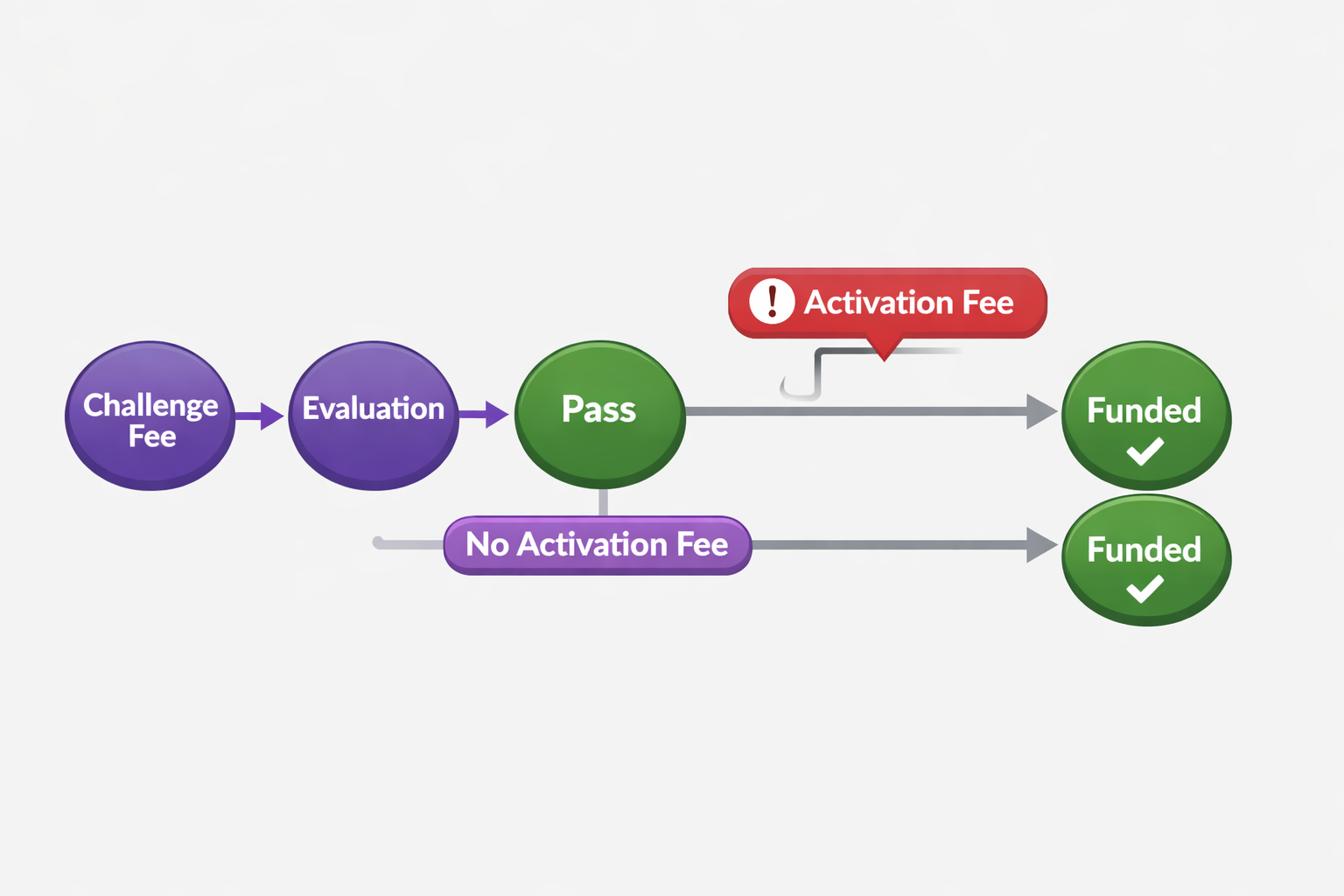
An activation fee is a one-time charge that some prop firms require after a trader successfully completes their evaluation phase. It’s separate from the challenge fee you paid upfront. Think of it this way: the challenge fee gets you into the evaluation, and the activation fee – where applicable – is the price of moving from “passed” to “funded.”
These fees typically range from $50 to $500 depending on the account size. Firms that charge them usually frame it as covering account setup costs, platform licensing, or risk management infrastructure. Whether that justification holds up is debatable. The reality is that many equally reputable firms manage to onboard funded traders without charging a cent extra.
Why Some Firms Still Charge Activation Fees?
To be fair, there are legitimate operational costs involved in provisioning a live funded account. Connecting a trader to real liquidity, setting up risk parameters, and configuring profit-split tracking all require backend work. Some firms pass a portion of that cost to the trader; others absorb it as a cost of doing business.
There’s also a less charitable explanation. Because the majority of traders don’t pass evaluations on their first attempt, the firms that do charge activation fees collect them from a relatively small pool of successful traders. It becomes an additional revenue line that most customers never even see during the sign-up process. By the time you encounter it, you’ve already invested time and the challenge fee – walking away feels harder than just paying.
How No Activation Fee Firms Work
The model is simple: you pay for the evaluation, and if you pass, your funded account is activated automatically with no additional charge. The evaluation fee is the only upfront cost. Some firms even refund the challenge fee with your first profit split, effectively making the entire process free if you perform well.
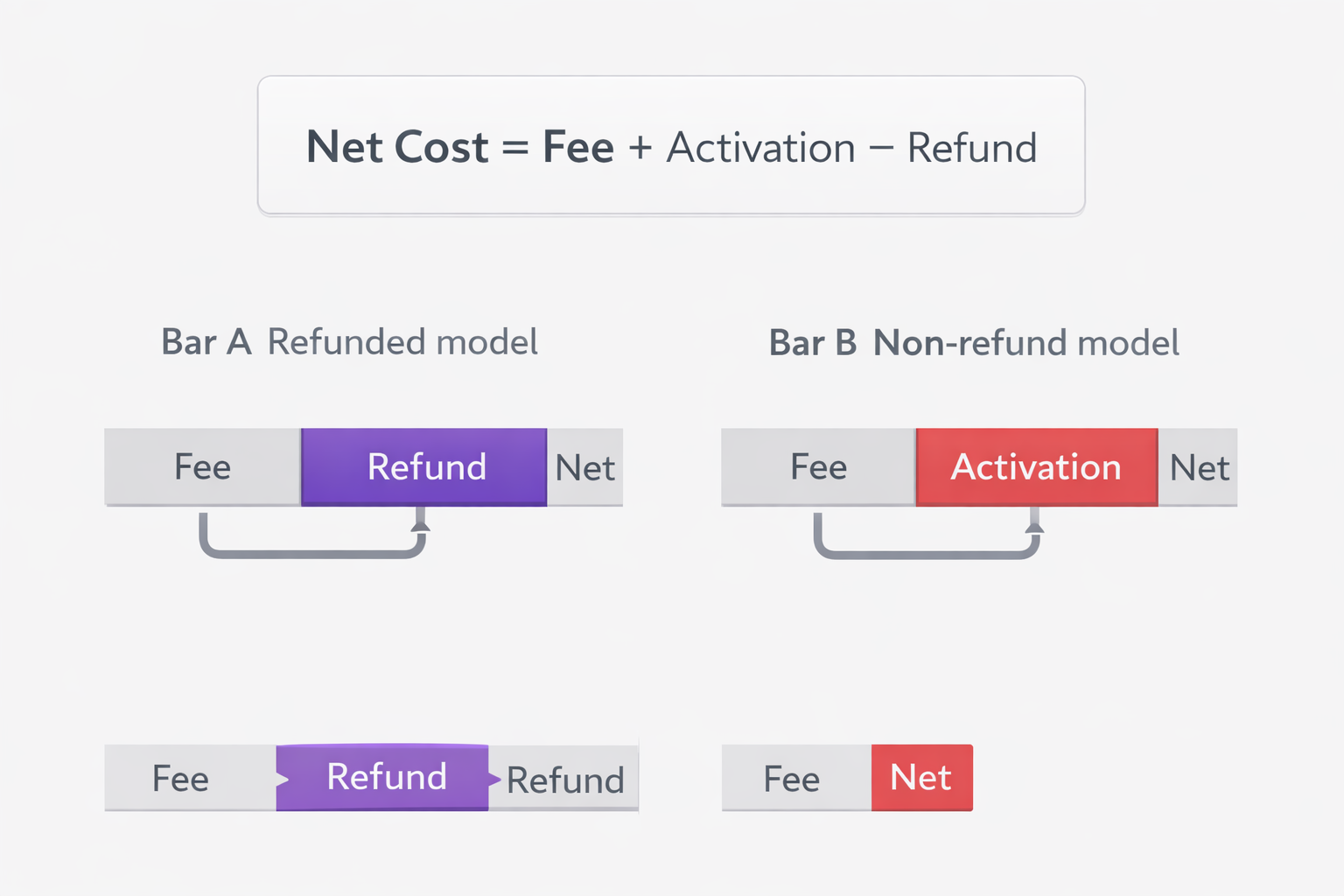
From the firm’s perspective, absorbing activation costs makes sense when you think about customer acquisition. Removing that last-step friction means:
- • Higher conversion from “passed” to “actively trading” – fewer traders abandon the process at the final hurdle when there’s nothing left to pay.
- • Stronger word-of-mouth reputation, which matters enormously in a market where traders talk constantly in forums, Discord servers, and social media.
- • Better long-term retention. A trader who feels respected from day one is more likely to scale up, buy larger accounts, or return after a blown challenge.
Top No Activation Fee Firms – Reviewed
These firms charge zero activation fees on all account sizes. Each review covers pricing, profit split, and what makes them worth considering.
FTMO
The most recognized name in prop trading and a firm that has never charged an activation fee. FTMO’s $50K challenge costs $299 with a full refund on first payout, bringing the net cost to $0 for successful traders. Profit splits start at 80% and scale to 90% through their scaling plan. The evaluation is a strict 2-step process – no 1-step shortcut available. FTMO’s higher upfront price is offset by its track record: years of verified payouts, a large and active community, and platform stability that newer firms are still working to match. If you’re willing to pay more upfront for confidence in payout reliability, FTMO remains the benchmark.
Funded Next
The value leader in this category. Funded Next offers a $50K evaluation for just $199 – the lowest among major firms – with no activation fee and a full challenge refund on first payout. Profit splits run 80–90% depending on your consistency track. Available in both 1-step and 2-step evaluation formats, plus an instant funding option. Static drawdown keeps the risk math clean. For traders who want the lowest possible barrier to funded trading without sacrificing payout reliability, Funded Next is hard to beat on total cost.
E8 Funding
A no-nonsense firm that keeps pricing clean and competitive. The $50K challenge is $228 with no activation fee and a challenge refund on first payout. Profit split is a flat 80%. E8 offers both 1-step and 2-step paths, and their 8% maximum drawdown is one of the more generous buffers in the space. They won’t attract attention with flashy features, but the fundamentals – transparent pricing, fair drawdown, and consistent payouts – are exactly what matter when you’re evaluating a firm on substance rather than marketing.
MyFundedFX
A newer firm that’s built a loyal following through aggressive pricing and straightforward terms. The $50K evaluation is $249, no activation fee, and the challenge fee is refunded on first payout. Profit split sits at 80% across the board. Available in 1-step and 2-step formats. Drawdown is static at 5%, which is tighter than some competitors but clearly defined. If you’re looking for a budget-conscious option from a firm with a growing track record and zero surprise fees, MyFundedFX delivers on that promise.
FundingPips
FundingPips has quietly become one of the more trader-friendly firms in the forex prop space. No activation fee, competitive challenge pricing, and profit splits that scale from 80% to 90% based on performance milestones. They don’t restrict the number of accounts a trader can hold and have integrated with cTrader for traders who prefer that platform. Static drawdown and no limits on trading style (news, overnight holds, EAs all permitted). The challenge fee isn’t refunded on first payout, which is the one trade-off compared to the other no-fee firms listed here.
The5ers
One of the longest-running prop firms, The5ers has operated without activation fees since launch. Their $50K account is priced at $260 with a challenge refund on first payout and an 80% profit split. Available in 1-step and 2-step formats with static drawdown. The5ers also offers a scaling plan that progressively increases your account size based on consistent performance. Their longest track record in the industry gives them a credibility edge, especially for traders who prioritize payout history over the lowest possible price.
Blueberry Funded
Backed by Blueberry Markets (an established retail broker), Blueberry Funded brings institutional infrastructure to the prop firm model. No activation fee, 80% profit split, and the evaluation fee is refunded on first payout. Their edge is platform quality – running on live broker infrastructure means tighter spreads and faster execution than many competitors operating on simulated feeds. A strong choice for traders where execution quality directly impacts strategy performance (scalping, news trading).
CHARGES FEE: True Forex Funds
Included for contrast. True Forex Funds charges a $149 activation fee on top of a $289 challenge fee for their $50K account – a total of $438 upfront with no refund. Profit split is 75–80%, the lowest among the firms listed here. The 2-step evaluation is the only available path. When compared directly to firms like Funded Next ($199 all-in, refundable) or E8 Funding ($228, refundable), the value gap is stark. True Forex Funds isn’t necessarily a bad firm, but the fee structure puts it at a significant competitive disadvantage for cost-conscious traders.
Full Comparison Table
All figures based on $50K account tier. Net cost assumes successful evaluation and first payout received.
*Net cost = total out-of-pocket if the trader passes and receives first payout with refund. $0 assumes successful challenge completion and first payout received.
The contrast is stark when you line them up. True Forex Funds costs $438 with no refund for a 50K account. Funded Next costs $199 all-in and refunds that on first payout. That’s a $438 swing in total cost before you’ve placed a single funded trade.
Among the $0 net cost firms, the differentiator becomes upfront cash flow. Funded Next at $199 requires the smallest initial outlay. FTMO at $299 is the priciest upfront but carries the strongest brand recognition and scales to 90% profit split. E8 Funding and MyFundedFX occupy the middle ground – competitive pricing with solid fundamentals. FundingPips is the outlier: no activation fee but no challenge refund either, making $245 your permanent cost regardless of performance.
The Bigger Picture: What Fee Transparency Signals
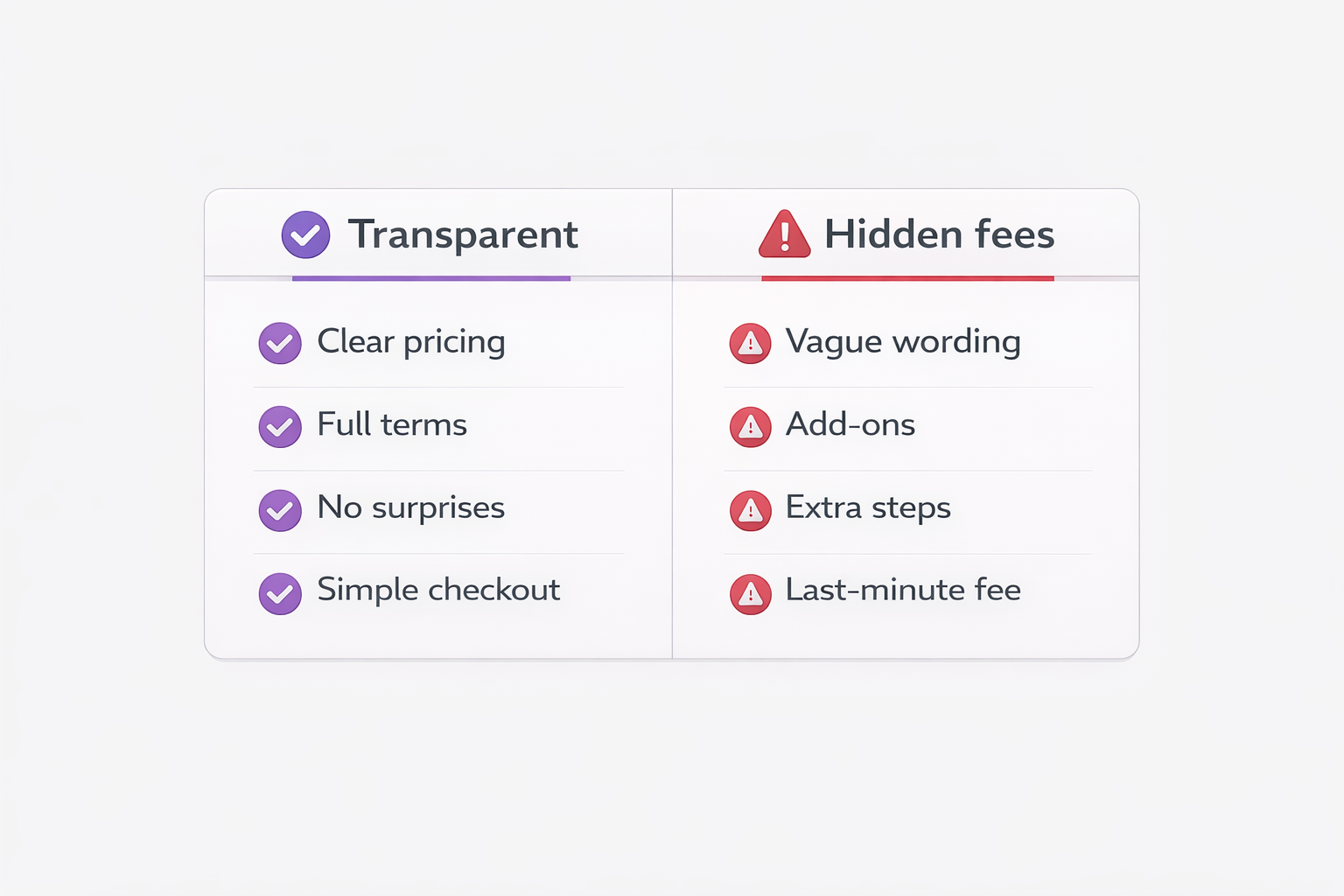
Whether or not a firm charges an activation fee might seem like a small detail in isolation. But it’s actually a useful proxy for something bigger: how the firm thinks about its relationship with traders. Companies that pile on hidden or semi-hidden fees tend to be optimizing for short-term revenue extraction. Firms that keep their pricing clean and predictable are usually playing a longer game – building retention, reputation, and scale.
The prop firm market is more competitive than it’s ever been, and traders have genuine leverage right now. If a firm’s fee structure feels opaque or leaves you calculating surprise costs, there are plenty of alternatives that won’t. Use that leverage.
Pros and Cons of No Activation Fee Firms
Tips for Choosing a No Activation Fee Firm
Avoiding activation fees is a smart starting point, but it shouldn’t be the only factor driving your decision. Here’s how to evaluate these firms properly:
- Calculate total cost, not just the challenge fee. A $199 challenge with no activation fee and a refund on first payout has a true net cost of $0 if you’re profitable. A $149 challenge with a $100 activation fee and no refund costs you $249 permanently. The headline number rarely tells the full story.
- Check whether “no activation fee” applies to all account sizes. Some firms waive the fee for smaller accounts but introduce it at higher tiers ($100K+). Always verify the terms for the specific account size you’re targeting.
- Don’t ignore the trading conditions. A firm can skip the activation fee and still cost you more through wider spreads, slower execution, or restrictive rules. The fee structure matters, but so does the environment you’ll actually be trading in.
- Read recent reviews, not just top-line ratings. A firm’s policies can change quickly. What was true six months ago might not apply today. Look for reviews from the last 30–60 days to get an accurate picture of current terms and payout reliability.
- Test support before you buy. Send the firm a question about their fee structure or payout process. How fast they respond – and how clearly – tells you a lot about what the experience will be like once you’re funded.
Final Thought
The activation fee model is dying. As competition intensifies and traders become more informed about total cost, firms that still charge post-evaluation fees are losing ground to those that don’t. The market is rewarding transparency.
Frequently Asked Questions
Are no activation fee firms less reputable?
Not at all. Several of the most established firms in the industry – including FTMO and E8 Funding – operate without activation fees. The absence of an activation fee is a business model choice, not an indicator of quality. If anything, firms confident enough to skip the fee tend to be the ones with sustainable revenue from challenge sales and active trader pools.
Can a firm add an activation fee after I’ve already purchased a challenge?
Most firms lock in the terms that were active at the time of your purchase. However, policies can change for future challenges. Always screenshot or save the terms and conditions before buying, especially pricing details and payout terms. If a firm retroactively changes your agreed terms, that’s a significant red flag.
Do challenge fee refunds make up for activation fees?
Sometimes, but you need to do the math. If Firm A charges $299 with no activation fee and refunds the challenge fee, your net cost is $0. If Firm B charges $199 plus a $150 activation fee with no refund, your net cost is $349. The cheaper challenge fee doesn’t always mean the cheaper experience. Total cost after payout is the number that actually matters.
Which no activation fee firm has the lowest total cost?
As of writing, Funded Next offers the lowest upfront cost ($199 for a $50K account) combined with a full challenge refund on first payout, bringing the net cost to $0. E8 Funding ($228) and MyFundedFX ($249) follow closely, both also offering refunds. FTMO is the most expensive upfront at $299 but still reaches $0 net cost and carries the strongest brand reputation.
Disclaimer
The information provided on this page is for educational and informational purposes only. It does not constitute financial advice, trading recommendations, or endorsement of any specific prop firm. Prop firm terms, activation fees, pricing structures, and refund policies are subject to change without notice. Always verify current terms directly with the firm before committing capital. Past performance and firm policies described here may not reflect current or future conditions. Trading involves significant risk of loss.