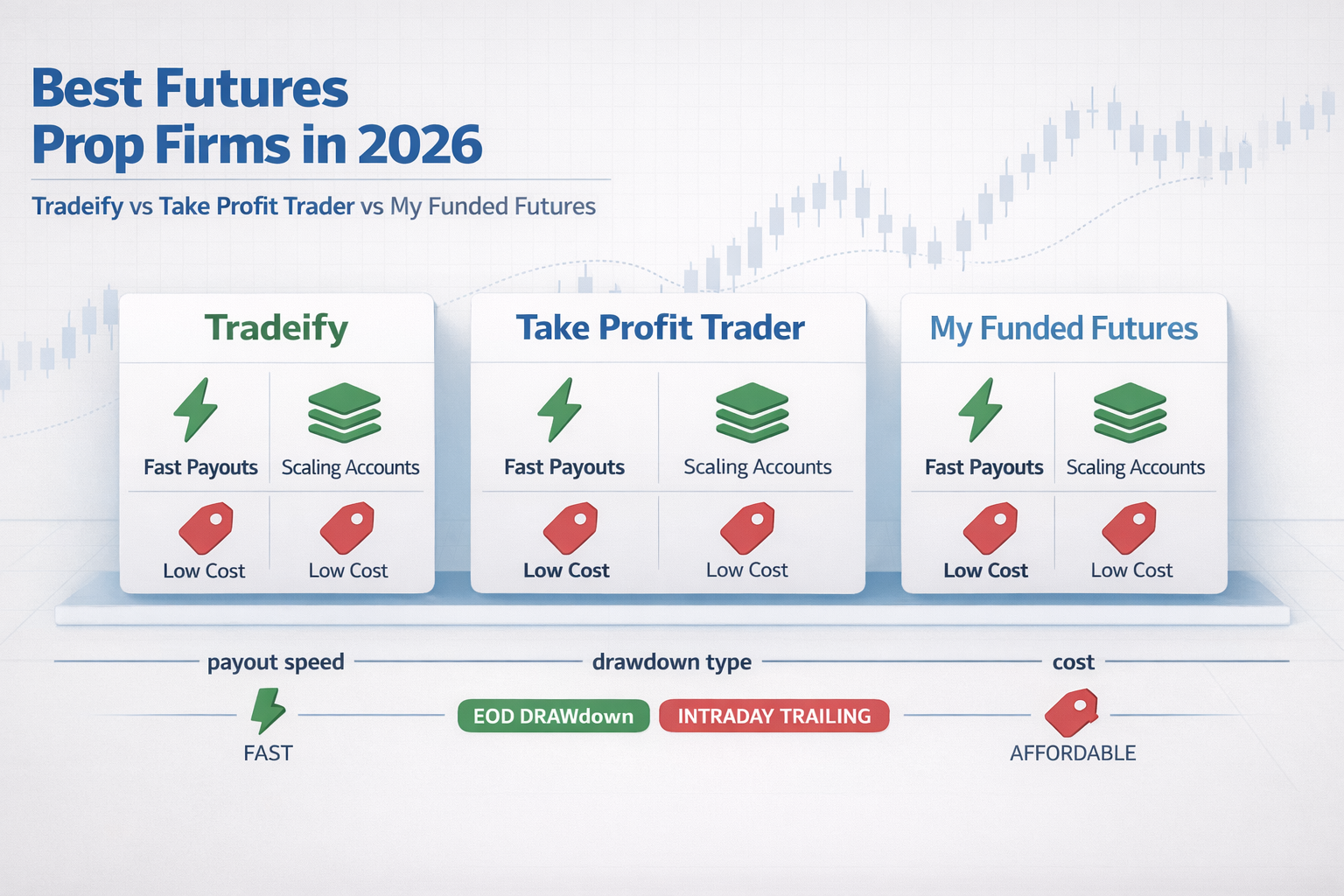
The futures prop firm market has matured fast. We review the three firms that consistently deliver on what matters most – payout speed, transparent rules, reliable support, and trading conditions that don’t work against you.
TL;DR Summary
-
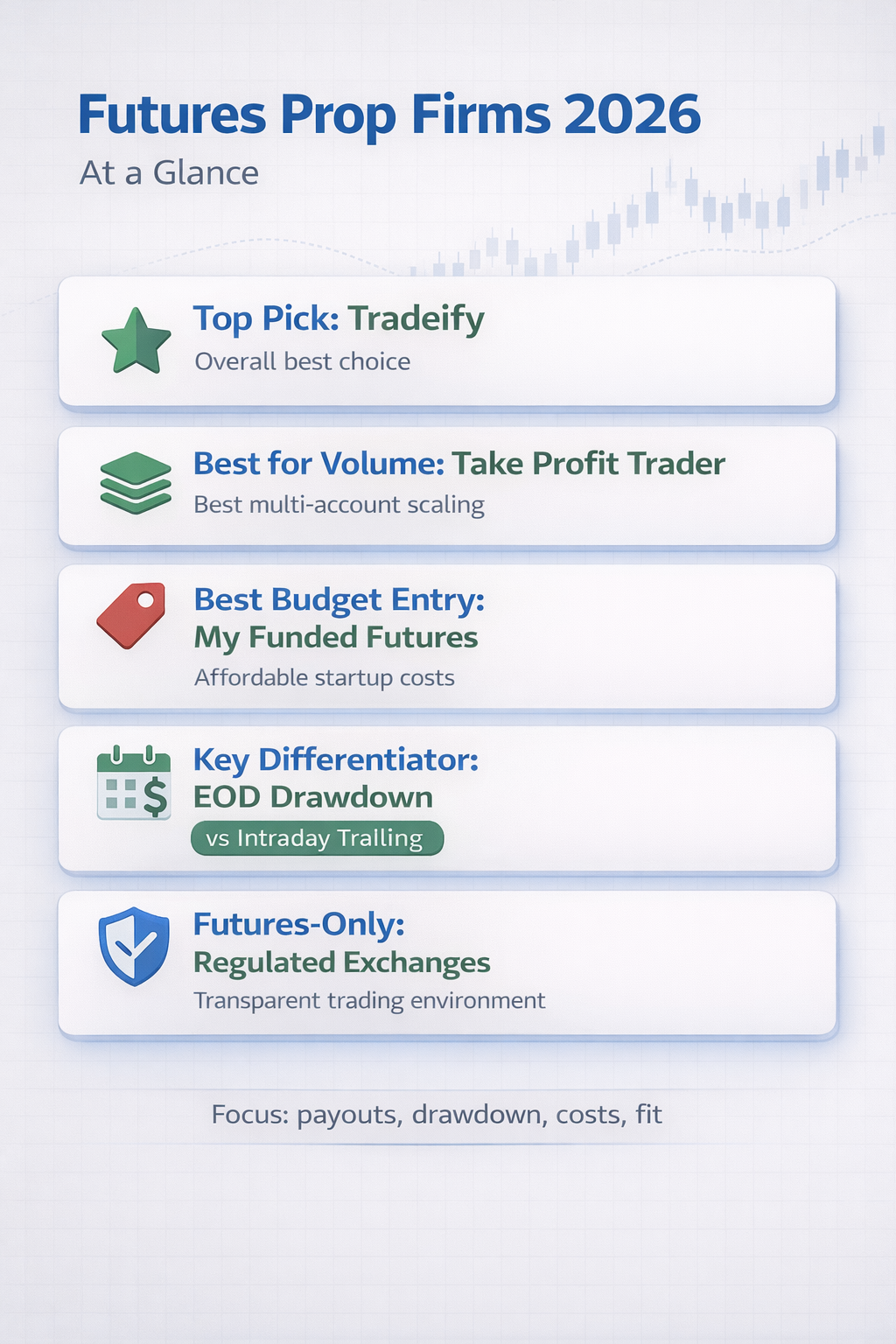
Top Pick
Tradeify – fastest payouts (under 60 minutes), new Select plan with daily or 5-day payout options, 90% profit split, EOD drawdown, $0 activation fee
-
For PRO/PRO+ Path
Take Profit Trader – Best for Traders Who Want the PRO / PRO+ Path
-
Best Budget Entry
Best Budget Entry: My Funded Futures – Core plan from $84/month(25k), EOD drawdown, instant payout approvals, 4.9 Trustpilot
-
Key Differentiator
Key Differentiator: End-of-Day (EOD) drawdown is available on major evaluation paths, but drawdown type varies by firm and by funded plan – compare the exact plan rules before buying.
-
All Firms
All Firms: Futures-only (CME Group), regulated exchanges, no CFDs or forex
Table of Contents
- Why Futures Prop Firms Are Different
- What to Look For in a Futures Prop Firm
- The Three Best Firms – Reviewed
- Full Comparison Table
- EOD vs. Intraday Drawdown – Why It Matters
- Pros and Cons
- Tips for Choosing the Right Firm
- FAQ
Why Futures Prop Firms Are Different
Futures prop firms operate in a fundamentally different world than many forex prop firms. You’re dealing with standardized contracts on regulated exchanges such as CME Group markets (including CME/CBOT/NYMEX/COMEX), with centralized price discovery and transparent contract specifications. That distinction matters.
In many futures prop programs, however, the evaluation and sim-funded stages are simulated environments. That means contract pricing references exchange-traded instruments, but fills, slippage behavior, and platform execution experience can still vary by platform/data feed/simulator setup (especially before any live-routing stage). This is an important nuance when comparing futures vs. forex prop experiences.
The other major difference is the asset range. Futures firms typically give access to equity index futures (ES, NQ, YM, RTY), commodities (crude oil, gold, natural gas), rates/treasuries, and more from a single futures setup. For traders who follow macro themes or prefer centralized market structure and volume-led trading, futures remain a strong fit.
What to Look For in a Futures Prop Firm
Not all futures prop firms are built the same. The evaluation rules, drawdown mechanics, and payout processes vary significantly. Here’s what separates trader-friendly firms from the rest:
- Drawdown type. End-of-Day (EOD) drawdown updates at session close; intraday trailing drawdown can move in real time. This has a major impact on survivability.
- Payout process. Approval time, payment rail, and final receipt time are not always the same thing.
- Activation fees. Some firms charge a post-pass activation fee; others don’t.
- Profit split structure. Check whether the split changes by plan/account phase.
- Support quality and rule clarity. Hidden rule friction is often more expensive than headline pricing.
The Three Best Futures Prop Firms – Reviewed
Tradeify – Best Overall
Tradeify remains one of the more notable names in futures prop trading, especially for traders who care about payout policy choice and EOD-style structures on certain plans.
The Select Plan – Tradeify’s Unified Evaluation Model
Tradeify’s Select Evaluation uses one evaluation path first, then lets the trader choose the funded payout policy after passing (Select Flex or Select Daily). Tradeify’s help center confirms the following for Select Evaluation:
- Minimum 3 trading days
- 40% consistency rule (eval only)
- No daily loss limit during evaluation
- End-of-day drawdown during evaluation
- No activation fee
- Choice of payout policy after passing (Flex or Daily)
- Select evaluation platform: Tradovate only
Tradeify also confirms that the 40% consistency rule is removed once funded on Select accounts.
Select Daily vs. Select Flex
Tradeify’s payout-policy documentation confirms:
- Select Flex (5-day payout policy)
EOD drawdown
No daily loss limit
90/10 split
Payout eligibility every 5 winning days
Payout caps (50K/100K/150K): $3,000 / $4,000 / $5,000 (subject to % rules and current policy terms) - Select Daily (daily payout policy)
EOD drawdown
Daily loss limit applies
Buffer system applies
90/10 split
Daily payout eligibility (subject to buffer + continuity rules)
50K/100K/150K daily caps listed as $1,000 / $1,500 / $2,500 in the current help article
Tradeify also documents a path to Elite Live eligibility after 5 total payouts (tracked at user level across account types), with transition ultimately subject to Tradeify’s review/selection process unless other thresholds trigger automatic transition.
Other Tradeify Paths
Tradeify documents multiple paths, including:
- Growth (evaluation path)
- Lightning (instant funded / no evaluation path)
- Elite Live transition framework after payout milestones (subject to program rules)
Important Accuracy Note on Tradeify Payout Speed
Tradeify’s homepage markets very fast/automated payouts and references a “Guaranteed 60 minutes payouts” message in its Lightning marketing. At the same time, Tradeify help-center payout articles also describe processing windows like 24-48 hours depending on method/policy and payout flow (e.g., Rise/Plane and downstream transfer timing). In practice, this means you should distinguish between:
- approval time,
- funds reaching a payout wallet/provider, and
- bank/crypto settlement time.
Take Profit Trader – Best for Traders Who Want the PRO / PRO+ Path
Take Profit Trader (TPT) uses a futures-focused progression centered around:
- Test (evaluation)
- PRO (funded simulated account)
- PRO+ (separate upgraded/live-market-oriented path with distinct rules)
Verified Rule Structure (Test / PRO / PRO+)
Test (Evaluation)
- Uses End-of-Day (EOD) maximum trailing drawdown
- Requires at least 5 trading days
- Has a consistency requirement where no single day may exceed 50% of total net profit
- TPT also explains the “updated profit goal” logic tied to the consistency rule in its help docs
PRO
- Uses intraday trailing drawdown (including unrealized gains in peak balance)
- No bots/algos allowed (manual execution required)
- Weekly trading activity requirement
- Prohibited-news flat rules apply around specific events (e.g., FOMC/NFP/CPI)
PRO+
- TPT’s PRO+ rules page confirms EOD drawdown
- Weekly trading requirement
- No counter positions
- Prohibited-news flat rules also apply to PRO/PRO+ around listed events
Profit Split / Withdrawals (Verified for PRO)
TPT’s official withdrawal documentation confirms for PRO:
- 80/20 split (trader keeps 80%)
- Withdrawal eligibility can start on day one after buffer requirements are met
- For a 50K PRO, the buffer example is $52,000 (i.e., $2,000 buffer)
TPT’s withdrawal docs also state:
- PRO-to-wallet withdrawal request review takes roughly 24 business hours
- Wallet payout approvals may take up to 12 business hours (often faster), with downstream payout timing depending on payout method/region
Fees (Verified / Time-Sensitive)
TPT’s homepage currently references a one-time $130 PRO account fee (activation fee context).
I’m not locking in exact Test subscription pricing in this update, because those prices are time-sensitive and may vary by account size and promotions.
Bottom line: TPT is a solid fit if you want a structured path with a clear Test → PRO framework and understand the rule shift from EOD (Test) to intraday trailing (PRO). PRO+ exists as a separate rule set and should be reviewed directly before purchase.
My Funded Futures – Best Budget-Friendly Entry
My Funded Futures help-center change log confirms:
- The newer plan lineup includes Core, Pro, and Rapid
- Legacy Starter / Starter Plus / Expert and Scale plans are no longer offered (important correction vs. older comparisons)
- Standardized evaluation changes were introduced across the new plan structure
- No daily loss limit (universal change)
- No activation fees on the new plans
- 5 sim-funded accounts (noted as applicable to $50K accounts, per their help article wording)
- Consistency removed in the sim-funded stage; 50% consistency in eval stage across plans
- Profit split changes include Rapid upgraded to 90/10 effective Jan 12, 2026 (retroactive) while the change log also notes prior universal 80/20 language for new plans (this is why plan-specific verification matters)
Core / Rapid Plan Details
MFFU’s lists for Flex Core (50K):
- $107 price
- $2,000 max loss limit
- $3,000 profit target
- No daily loss limit
- 50% eval consistency
- Can pass in 2 days
- No consistency in sim-funded
- Max payout line listed as $1,000 in that change notice
MFFU’s Rapid help article confirms for Rapid 50K:
- Eval: $3,000 target, $2,000 EOD max loss, no DLL, 50% eval consistency, 2 minimum trading days
- Sim-funded stage uses intraday trailing drawdown
- No consistency in sim-funded
- Rapid sim-funded payout split shown as 90/10
- First payout availability wording references 24 hours after first trade on sim-funded (subject to their conditions/buffer/minimums)
- MFFU also explicitly describes Rapid as the intraday drawdown plan in its help content.
Important Note
Futures prop firm rules, pricing, and payout policies change frequently. The details in this article reflect verified items from official/help-center sources reviewed now, but you should still verify the current terms on each firm’s checkout page and rule pages before publishing or purchasing.
Full Comparison Table
All figures based on $50K tier where applicable. Primary plan shown where clearly identifiable.
EOD vs. Intraday Drawdown – Why It Matters
This is still the single most impactful rule difference across futures prop firms.
Intraday trailing drawdown recalculates your risk threshold while you trade (often using peak equity including unrealized gains). That can make normal pullbacks more dangerous.
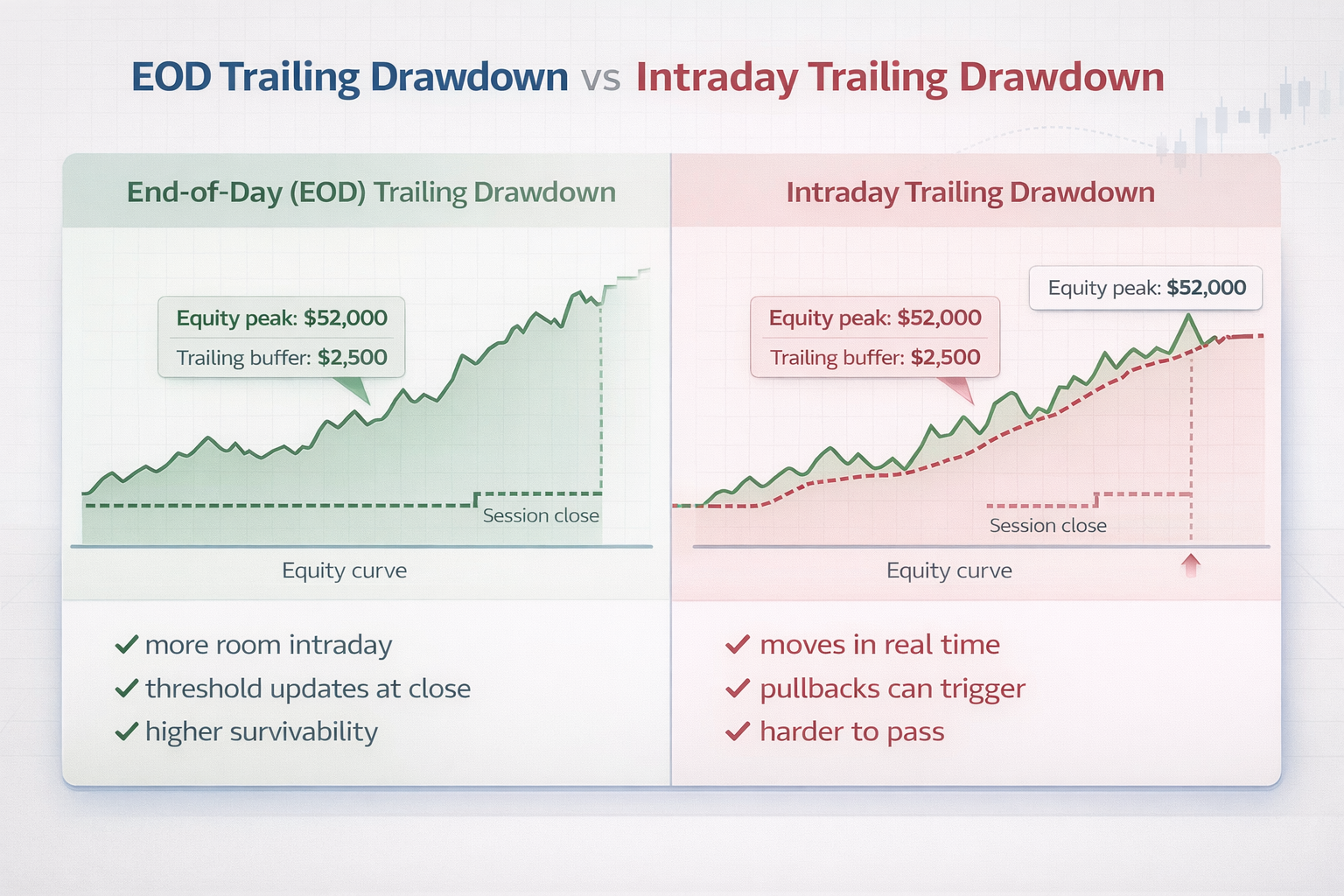
EOD drawdown updates at session close, which typically gives more room for intraday fluctuation.
That’s why many traders prefer starting with firms/plans that use EOD drawdown for their first evaluations.
Pros and Cons of Futures Prop Firms vs. Forex
Pros (Futures)
- Standardized contracts and centralized markets (CME-group futures products)
- EOD drawdown is available at some firms/plans
- Broad instrument coverage (indices, commodities, rates, etc.)
- Less firm-controlled pricing than OTC-style models
- Some firms offer a path from sim-funded to live-funded participation
Cons (Futures)
- Higher notional exposure / margin sensitivity
- Session structure and maintenance windows (not 24/5 in the same way spot forex is marketed)
- Fewer firms than forex prop
- Complex rule sets (news restrictions, activity requirements, etc.)
- Monthly evaluation subscriptions are common
Tips for Choosing the Right Futures Prop Firm
1. Start with EOD drawdown firms/plans.
If possible, start with EOD drawdown. It is usually more forgiving operationally than intraday trailing when you’re still adapting to prop rules.
2. Calculate total cost of funding, not just the evaluation fee.
Include eval + activation fee + likely reset cost.
3. Test the payout process early.
A small first withdrawal is still the best way to validate speed and process.
4. Don’t over-account.
Operational complexity kills more traders than they expect.
5. Match the payout structure to your trading style.
Daily payout eligibility sounds great until it’s paired with rule structures you don’t actually trade well under.
Final Thought
The futures prop firm space is competitive, but the details matter more than the marketing. Tradeify, Take Profit Trader, and My Funded Futures all have viable offerings – if the specific plan rules match your strategy and you understand the trade-offs around drawdown type, payout rules, and fee structure. The safest approach is to compare current official rule pages side by side before buying anything.
Frequently Asked Questions
Are futures prop firms trading real money?
Most start you on simulated accounts that mirror live market conditions. Your profits and withdrawals are real money, but the underlying positions may not hit the exchange directly. The best firms – including Tradeify and MFFU – offer a progression to live funded accounts where you’re trading actual CME contracts once you’ve demonstrated consistency through multiple payouts.
Which futures prop firm has the fastest payouts?
Tradeify, by a significant margin. Payout requests are typically processed in under 60 minutes, including weekends. My Funded Futures processes approvals instantly (automated) with funds arriving next business day.
What’s the cheapest way to get started?
My Funded Futures’ Flex plan is listed at $107 for the 50K evaluation in MFFU’s current evaluation pricing table. Tradeify’s Select at $111/month is mid-range on sticker price but has the lowest total cost of funding when you account for the $0 activation fee.
Can I trade during major news events?
It depends on the firm and plan. Tradeify allows unrestricted Tier 1 news trading on Select plans during both evaluation and funded phases – FOMC, NFP, CPI, all of it. My Funded Futures allows news trading on Core plans but restricts it on some legacy accounts (Starter/Expert). Always check the specific plan’s rules before trading high-impact releases.
How many accounts can I run at once?
Tradeify and My Funded Futures both cap at 5 simultaneous accounts (50K tier). More accounts means more potential income, but also more rules to track. Most traders find 2-5 accounts is the practical sweet spot before operational complexity starts hurting performance.
Disclaimer
The information provided on this page is for educational and informational purposes only. It does not constitute financial advice, trading recommendations, or endorsement of any specific prop firm. Futures trading involves significant risk of loss and is not appropriate for all investors. Prop firm terms, pricing, rules, and payout structures are subject to change without notice. Always verify current terms directly with each firm before committing capital. Past performance and firm policies described here may not reflect current or future conditions. Simulated trading results do not guarantee future performance. Only risk capital you can afford to lose.